
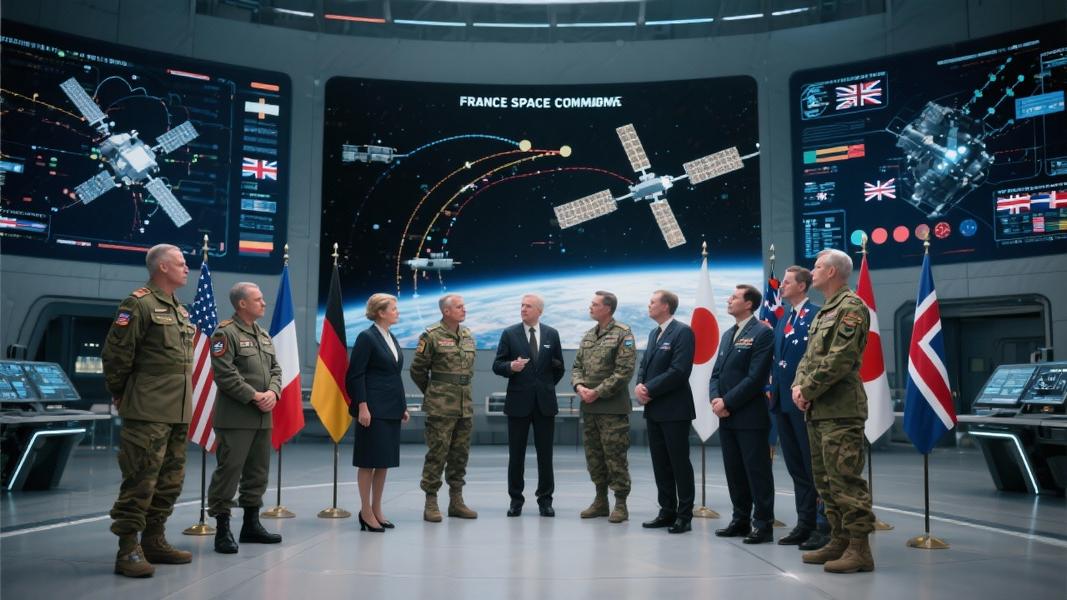
In an era of rapid space militarization, ten nations have banded together to coordinate their cosmic defense strategies, setting new standards for international cooperation beyond Earth’s atmosphere.
The Combined Space Operations (CSpO) Initiative unites Australia, Canada, France, Germany, Italy, Japan, New Zealand, Norway, the United Kingdom, and the United States in an unprecedented alliance aimed at maintaining freedom of action in space while preventing conflicts that could destabilize the increasingly crowded orbital environment. Unlike traditional military alliances, this coalition focuses on networking existing national operations centers rather than building centralized command structures, as outlined in recent defense publications.
Racing Against “Jaw-Dropping” Adversary Advancements
U.S. Space Force General Stephen Whiting didn’t mince words about the urgency driving this partnership. “Our opponents are moving at jaw-dropping speed, and we must match that pace with integrated coalition capabilities that deter aggression and defend our interests,” he warned during recent multilateral talks. His colleague, General Chance Saltzman, echoed this sentiment, emphasizing that effective deterrence requires collaboration “on our architectures, integrate our training, exercises, and operations, and build a common understanding of the threats we face.”
What makes this initiative particularly powerful? The real-time sharing of strategic and tactical intelligence across multiple classification levels, enabling coordinated responses to emerging threats. Information flows continuously between command centers like Australia’s HQ Joint Operations Command and the Combined Space Operations Center at Vandenberg Space Force Base in California, as documented by security analysts.
The partnership represents a significant evolution in how spacefaring nations approach orbital security. Blake Brose, representing U.S. space policy interests, put it bluntly: “Just as our military defends our freedom, rights, and interests on earth, the military of the United States of America will protect and defend our freedom, rights, and interests in space,” according to defense statements.
From Treaties to Tactical Reality
The CSpO partners aren’t starting from scratch. Their cooperation builds upon established international frameworks, particularly the Outer Space Treaty, which prohibits placing “nuclear weapons or other weapons of mass destruction” in orbit, on celestial bodies, or stationed in space, as affirmed in joint statements from the initiative’s principals board.
But today’s space environment faces challenges that the authors of those treaties could hardly have imagined. The CSpO initiative addresses modern concerns through its Vision 2031, which recognizes “challenges to space sustainability, threats presented by technological advances, and the increasingly comprehensive and aggressive counterspace programs of other nation states.”
Notably, all partner nations have committed not to conduct destructive direct-ascent anti-satellite missile tests, which create dangerous debris fields that can threaten all space operations. This stance reflects growing international consensus about responsible behavior in space, with the coalition actively supporting “multilateral efforts, including at the United Nations, to foster international cooperation, transparency, confidence-building and verification measures,” according to their joint statement.
Rethinking Space Architecture
Could smaller satellites be the key to more resilient space operations? Australia and other CSpO partners are increasingly shifting away from large, expensive geostationary satellites toward distributed constellations of smaller, cheaper satellites across multiple orbits.
This “small, cheap and many” approach embraces proliferated Low Earth Orbit (pLEO) mega-constellations to enhance resilience against potential attacks or failures. Defense analysts suggest these architectures could deliver critical services including “satellite communications, satellite relay, intelligence, surveillance and reconnaissance, and other specialised tasks.”
Behind the scenes, the initiative’s Policy and Legal Working Group (PLWG) tackles the complex legal frameworks necessary for multinational space operations. This mechanism has been “critical for trust-building and operational alignment among trusted partners,” as reported by defense ministries, working to align strategic communications and operational frameworks.
The CSpO initiative reflects a fundamental truth about modern space operations: no single nation can secure its interests alone. In an increasingly contested domain where satellites provide essential services for everything from navigation to communications, these ten nations are betting that their combined capabilities will prove more resilient than individual efforts.
As space becomes more congested and contested, this coalition’s success may determine whether humanity’s future in orbit remains peaceful or becomes the next battlefield in an expanding sphere of great power competition.
