
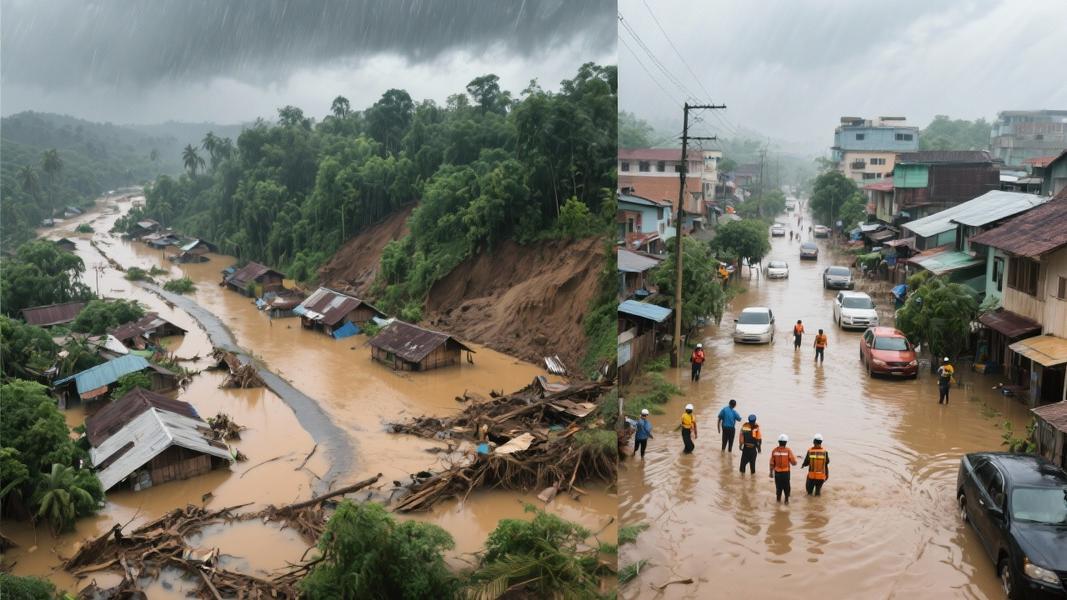
The monsoon season in Southeast Asia has always been a time of both life-giving rain and potential danger. But 2025 has shattered all modern records, turning familiar seasonal patterns into catastrophic deluges that have claimed more than 1,400 lives across Indonesia, Sri Lanka, and Thailand alone.
Entire villages in Indonesia remain underwater or cut off from aid. More than 1,000 people are still missing, presumed swept away by raging floodwaters or buried in landslides that came with virtually no warning. In Sri Lanka, survivors face a desperate shortage of clean water despite being surrounded by contaminated floodwater, while Thai officials have publicly acknowledged their government’s response fell catastrophically short.
A Climate Warning Turned Reality
The devastation across Southeast Asia isn’t just bad luck or an anomalous weather pattern. It’s the manifestation of climate change warnings that scientists have been sounding for decades. Asia is warming nearly twice as fast as the global average, creating conditions where storms arrive later, form more quickly, and hit with unprecedented force.
“While the total number of storms may not dramatically increase, their severity and unpredictability will,” climate scientist Dr. Radley Horton explained in an assessment of the disaster.
The economic toll is staggering. Vietnam estimates losses exceeding $3 billion from floods, landslides and storms in the first 11 months of 2025. Thailand’s agricultural sector has been crushed with losses of roughly $47 million since August, with November floods alone causing approximately $781 million in damage. Indonesia typically loses about $1.37 billion annually to natural disasters, but 2025’s figures are expected to dwarf that average.
Too Little Preparation, Too Late
Why were governments so unprepared? The answer lies partly in a regional tendency to focus on disaster response rather than prevention, with emergency preparedness chronically underfunded despite Asia being the world’s most disaster-prone region.
In 2022 alone, Asia experienced 81 weather, climate and water-related disasters, with over 83% being flood and storm events. These disasters claimed more than 5,000 lives and caused over $36 billion in economic damages, according to the World Meteorological Organization.
“Future disasters will give us even less lead time to prepare,” warned Aslam Perwaiz, deputy executive director of the Asian Disaster Preparedness Center. His prediction proved tragically accurate in 2025, as La Niña conditions brought above-normal rainfall across much of southern and southeastern Asia, overwhelming systems designed for a climate that no longer exists.
Human Factors Amplifying Natural Disasters
The catastrophe isn’t solely climate-driven. Human activities have dramatically worsened flood impacts. Since 2000, the Indonesian provinces of Aceh, North Sumatra and West Sumatra — all heavily affected by this year’s floods — have lost 19,600 square kilometers of forest, an area larger than New Jersey, reports Global Forest Watch.
Deforestation removes natural flood defenses. When combined with unregulated development in flood-prone areas, the result is predictable: water with nowhere to go except through homes, businesses, and critical infrastructure. The most vulnerable communities — often the poorest and most marginalized — suffer disproportionately, especially in areas prone to landslides.
Malaysia’s experience underscores this reality. The country faced one of its worst floods in recent memory, killing three and displacing thousands. In rapidly developing cities throughout the region, inadequate drainage infrastructure simply couldn’t handle the volume of water that fell in such short periods, creating urban lakes where streets once stood.
A Region-Wide Water Crisis
What makes 2025 particularly alarming is the simultaneous water challenges throughout South Asia. While Indonesia, Thailand and Sri Lanka drowned, parts of Bangladesh faced drought. Pakistan and India experienced devastating flash floods, with hundreds dead and enormous infrastructure damage.
Is this the new normal? Climate scientists point to accelerating Himalayan glacier melt and increasingly unpredictable monsoons as driving these extreme hydrological conditions. The pattern fits climate models that have long predicted more intense precipitation events interspersed with longer dry periods — precisely what the region is now experiencing.
For millions across Southeast Asia who have lost homes, livelihoods, and loved ones, the abstract threat of climate change has become devastatingly concrete. As waters slowly recede, they leave behind not just mud and debris, but profound questions about how these nations will adapt to a wetter, more unpredictable future that seems to have arrived decades ahead of schedule.
