
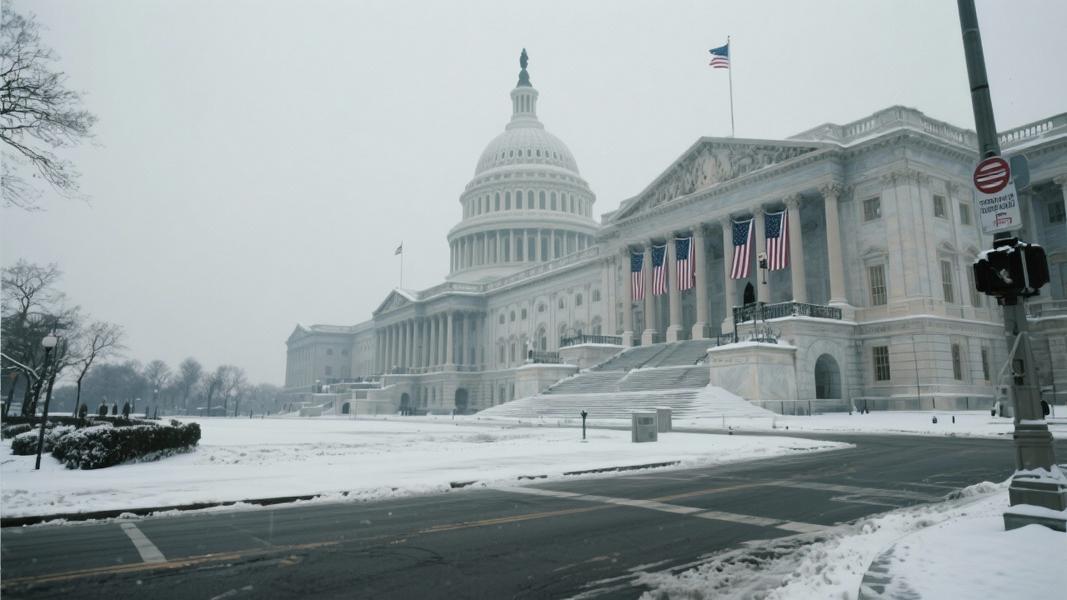
Senate negotiators reached a deal Friday evening to fund most of the federal government through 2026, but the agreement came too late to prevent yet another partial government shutdown — the second in just four months.
The shutdown officially began at midnight as the House of Representatives, already in recess, cannot vote on the Senate-approved package until Monday at the earliest. This marks another chapter in what has become a frustrating cycle of fiscal brinkmanship in Washington.
What’s closed, what’s open
This partial shutdown affects eight major federal departments, including Defense, Treasury, State, Health and Human Services, Labor, Housing and Urban Development, Transportation, and Education, according to housing officials who confirmed the scope of the closure.
Essential government functions will continue, but thousands of federal employees face furloughs or working without pay. Air traffic controllers and TSA agents fall into the latter category — they’ll keep working even as their paychecks stop if the shutdown drags on, as news outlets have noted.
Worried about your Social Security check or Medicare coverage? Don’t be. These benefits continue uninterrupted during shutdowns, along with food assistance programs like SNAP and WIC. FEMA also has approximately $7-8 billion available in disaster response funds, which should cover current winter storm emergencies — though an extended shutdown could complicate responses to any new disasters.
A deal derailed by tragedy
How did we get here? What seemed like a smooth funding process suddenly unraveled following the shooting deaths of two U.S. citizens, Alex Pretti and Renée Good, by federal agents in Minneapolis earlier this month. The tragedy fundamentally changed the negotiation dynamic, as local media reported.
Democrats responded by demanding new restrictions on the Department of Homeland Security’s immigration enforcement efforts. The resulting impasse led to Friday’s compromise: full funding for five major appropriations bills through fiscal year 2026, but a two-week continuing resolution for DHS to allow time for further negotiations on immigration enforcement.
“Senate Democrats and the White House came to an agreement late Thursday to fund the vast majority of federal agencies, while providing a two-week stopgap continuing resolution to the Homeland Security Department,” budget analysts explained.
Shutdown fatigue setting in
This marks the second major shutdown in less than a year. The previous closure — which lasted a staggering 43 days from October 1 through November 12, 2025 — was the longest in modern American history, according to budget watchdogs who tracked its impact.
The Senate ultimately approved the spending package Friday evening, but as government officials acknowledged, the vote came “too late to stave off an appropriations lapse.”
With the House unable to vote until Monday at the earliest, federal agencies have already begun implementing shutdown procedures. The question now is whether this will be a brief weekend blip or the beginning of another extended funding crisis.
For federal workers who just endured last fall’s record-breaking shutdown, the prospect of another payless period feels particularly cruel. They’ll be watching closely as House members return to Washington next week with the power to end — or extend — their financial uncertainty.
