
Fast-Growing Atlanta Church Attracts Thousands With Bold Vision, Conservative Theology
In a city known for its storied civil rights history and religious diversity, a relatively new church is making waves. 2819 Church, a nondenominational congregation with a distinctly conservative theological bent, has rapidly grown from humble beginnings to become one of Atlanta’s most dynamic faith communities.
Founded and led by Pastor Philip Anthony Mitchell, a Queens, New York native, the church derives its unusual numerical name from Matthew 28:19 — the biblical verse containing Jesus’s Great Commission to “make disciples of all nations.” This mission isn’t just symbolic; it’s the driving force behind everything the congregation does.
From School to Stadium
What began as a small gathering has blossomed into a thriving ministry that now hosts three packed Sunday services at 8:00 AM, 10:30 AM, and 1:00 PM at its dedicated facility on Greenbriar Parkway in southwest Atlanta. The church previously met in a charter school before outgrowing the space.
“We exist to spread the Gospel and multiply disciples,” Mitchell states plainly on the church’s website, echoing the Great Commission that inspired the church’s name. It’s a simple mission statement that has resonated with thousands across the metro Atlanta area.
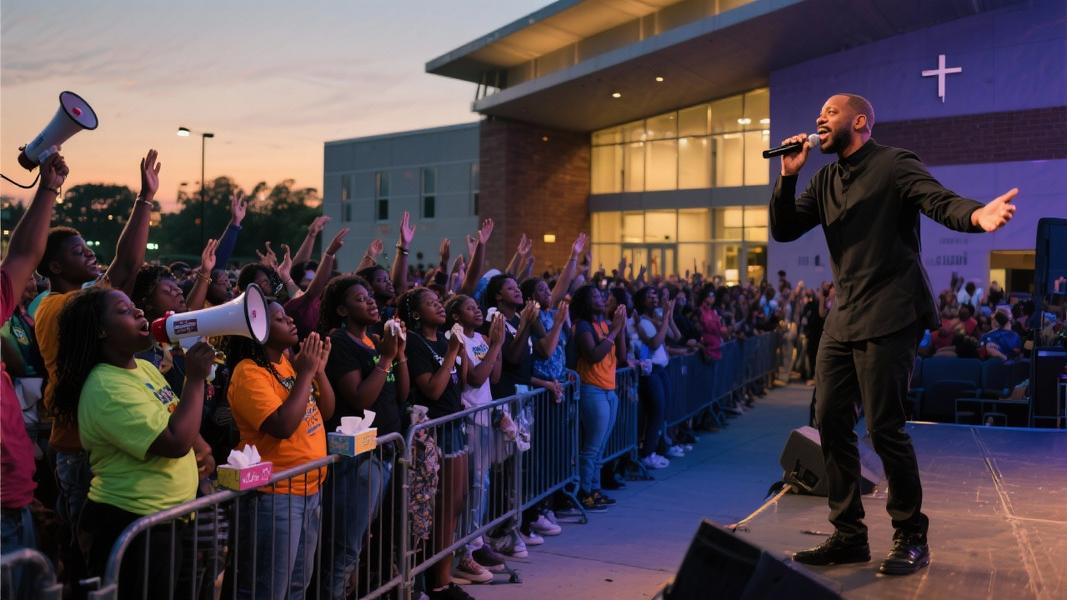
The congregation’s growth trajectory became especially evident during a recent prayer gathering at State Farm Arena that Mitchell described as historic. “Maybe 50,000 of us. Maybe it was a historic day in the city of Atlanta,” Mitchell told his congregation in a recent sermon. “The largest crowd to ever descend on State Farm Arena in its history,” he added, noting that both the arena and nearby overflow spaces were filled to capacity.
A Different Kind of Church Experience
What makes 2819 Church stand out in Atlanta’s crowded religious landscape? For starters, its worship style defies easy categorization.
Attendees describe high-energy Sunday gatherings featuring a deliberate blend of contemporary Christian and gospel music, creating an atmosphere where, as the church puts it, people can “easily encounter God.” These musical selections set the stage for Mitchell’s passionate expository preaching, which followers praise for its biblical depth and practical applications.
Unlike many large churches, 2819 doesn’t offer midweek services. Instead, it emphasizes small group gatherings — called “squads” — that meet throughout the metropolitan area, fostering intimate community connections that might otherwise be difficult in a rapidly growing congregation.
A Pastor with a Burden
Who exactly is Philip Anthony Mitchell? Beyond his role as founder and lead pastor of 2819 Church, Mitchell describes himself as “an unwavering voice for change, the veneration of the Holy God, and the preservation of Biblical Christianity in America” — a mission that took shape following what he describes as a transformative spiritual experience in Israel.
Mitchell speaks openly about that pivotal moment. “Since my return from Israel, and the encounter I had with God there in December of 2018, constant brokenness over the state of the Church in America has been my portion,” he explains on his personal website. This experience left him grieving what he perceives as “the perversion of The Faith in the west, our growing lack of reverence, and our overt mockery of Christ.”
Is this concern for American Christianity’s future what’s driving 2819’s rapid growth? Many attendees seem to think so, finding resonance with Mitchell’s call for a return to what he considers biblical orthodoxy.
Beyond the local church, Mitchell has expanded his influence through the 2819 Institute and maintains an active digital presence. The church’s official podcast and YouTube channel feature his messages alongside guest communicators, extending the congregation’s reach well beyond physical gatherings.
As Atlanta’s religious landscape continues to evolve, 2819 Church appears poised for continued growth — a testament to the enduring appeal of bold leadership and clear vision in an age often characterized by spiritual uncertainty.
