
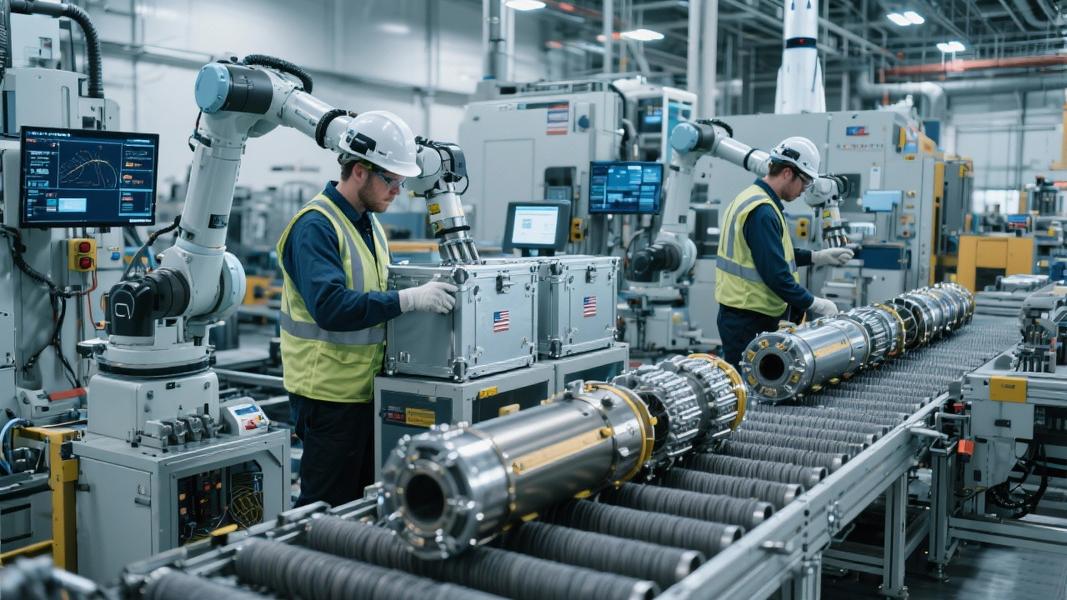
The Department of War has awarded three contracts worth $39.6 million to bolster the nation’s solid rocket motor (SRM) industrial base — a critical investment aimed at securing America’s access to essential munition propulsion systems.
The contracts, announced by the department yesterday, will fund Materials Resources LLC, ICF Mercantile LLC, and SPARC Research LLC to expand domestic manufacturing capabilities for these crucial defense components. “These strategic investments in our solid rocket motor industrial base are crucial to ensuring the Department of War continues to have access to the munition propulsion systems required for our national security,” said Under Secretary of War for Acquisition and Sustainment Michael Duffey.
Breaking Down the Investments
Materials Resources LLC (MRL) received the largest share at $25.2 million to demonstrate SRM prototype production using advanced additive manufacturing techniques for metallic cases. The company’s approach emphasizes agility and horizontal scalability — allowing for quick adaptation to different materials and component designs in response to evolving defense needs.
ICF Mercantile secured $9.3 million to establish the first domestic production source of rayon filament cellulose precursor, a critical material supporting Carbon Phenolic Ablatives production used in SRMs and Re-Entry Body heatshields. The company’s solution leverages environmentally safe Ionic Liquid technology, addressing both security and sustainability concerns.
SPARC Research rounds out the awards with $5.1 million to establish dedicated supply channels for rocket motor components that will support high-performance propulsion systems. While the smallest of the three contracts, this investment plays a crucial role in the broader strategy to shore up supply chain vulnerabilities in the SRM industrial base.
Part of a Larger Effort
Why the sudden focus on solid rocket motors? The answer lies in both defense readiness and industrial capacity concerns that have been building for years.
These three contracts are part of a broader initiative under the Defense Production Act Title III, bringing the total awards under the Defense Industrial Base Consortium Other Transaction Agreement to four, totaling $53.9 million. But that’s just the tip of the iceberg. Since the beginning of fiscal year 2025, the department’s DPA Purchases Office has made 14 investments totaling a staggering $777.1 million, complemented by $88 million in recipient cost shares.
Major defense contractors are also ramping up their SRM capabilities. Northrop Grumman is investing $100 million in a new Propulsion Innovation Center in Elkton, Maryland, with ambitious plans to nearly double its production capacity from 13,000 units annually to 25,000 by 2029.
“The components produced will support improvements to high performance propulsion systems,” the Department of War noted in its statement, underscoring the critical nature of these investments for national security.
Industry-Wide Movement
The push to expand SRM production extends beyond these recent awards. X-Bow Systems Inc. recently received $64 million from the department’s Manufacturing Capability Expansion and Investment Prioritization office to expand manufacturing capacity for SRMs used in hypersonic weapons, including the Navy’s Conventional Prompt Strike and Army’s Long-Range Hypersonic Weapon programs.
Meanwhile, Raytheon has taken steps to diversify its supply chain, awarding initial phase contracts for MK72 SRM development to both Nammo and Northrop Grumman. Barbara Borgonovi, president of Naval Power at Raytheon, explained the strategy: “These contracts are an important step toward increasing capacity and source options to meet global demand for critical defense systems, such as Standard Missile.”
The investments come at a time of increasing global tensions and growing recognition that America’s defense industrial base needs significant reinforcement. Solid rocket motors, which power everything from tactical missiles to strategic weapons, represent a foundational technology where domestic production capabilities had been allowed to atrophy for decades.
As defense officials privately acknowledge, rebuilding this capacity isn’t just about meeting current demands — it’s about preparing for a future where America’s military advantage increasingly depends on its industrial resilience as much as its technological edge.
