
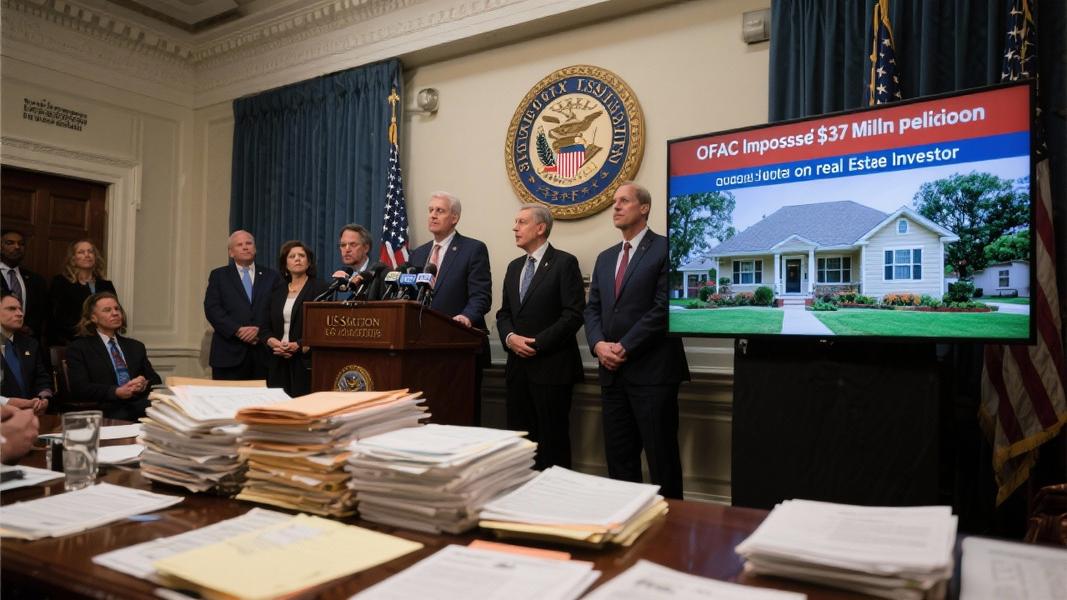
The Treasury Department has slapped a $4.67 million penalty on a U.S. real estate investor who knowingly sold property belonging to a Russian oligarch’s family member in direct violation of sanctions, officials announced Thursday.
The fine — the maximum allowed by law — represents a rare case of an individual being held accountable for deliberately circumventing Russia sanctions through real estate transactions, despite explicit warnings from federal authorities.
Willful violation amid escalating sanctions
“Under President Trump’s leadership, the United States has put in place strong sanctions against Russia,” Treasury Under Secretary John K. Hurley said in a statement. “Today’s action makes clear that Treasury will continue to actively investigate and hold accountable those who violate U.S. sanctions.”
According to the Office of Foreign Assets Control (OFAC), the unidentified U.S. person operated through Atlanta-based King Holdings LLC to mortgage, renovate, and ultimately sell real estate that had been explicitly blocked under sanctions. The property was owned by a family member of a Russian oligarch who had been designated under Executive Order 14024 in March 2022.
What makes this case particularly egregious? The individual proceeded with the property transactions between April 2023 and March 2024 even after being directly informed by OFAC that the property remained blocked.
Ignoring repeated warnings
The saga began when King Holdings purchased the property at a public foreclosure auction in January 2023. When OFAC discovered the foreclosure months later, officials immediately contacted the investor and explained that the property remained blocked under sanctions and could not be dealt with without authorization.
“OFAC also informed U.S. Person-1 that they could apply for a license from OFAC,” the Treasury Department explained. “Instead of applying for a license, U.S. Person-1 willfully continued with their plan to renovate and sell the property through King Holdings without notifying or seeking approval from OFAC.”
The property was ultimately sold to “an unwitting third party” — effectively laundering a sanctioned asset back into the legitimate real estate market.
A warning to the real estate sector
Treasury officials made clear that this enforcement action serves as a warning shot to others in the real estate industry who might consider similar violations.
“This action — which imposes the statutory maximum penalty — highlights the obligation of all U.S. persons, including individual investors and others in the real estate sector, to comply with OFAC’s sanctions regulations and orders,” the department noted.
The case underscores the growing challenge of enforcing sanctions on Russian elites, many of whom have extensive property holdings in the United States through complex ownership structures. Real estate has long been considered a vulnerability in sanctions enforcement due to limited transparency in transactions.
Yet the maximum penalty in this case signals the Biden administration’s determination to close those loopholes. “Today’s action makes clear that Treasury will continue to actively investigate and hold accountable those who violate U.S. sanctions,” Hurley emphasized.
For real estate professionals and investors, the message couldn’t be clearer: when it comes to Russian sanctions, pleading ignorance won’t protect you from a multimillion-dollar penalty.
