
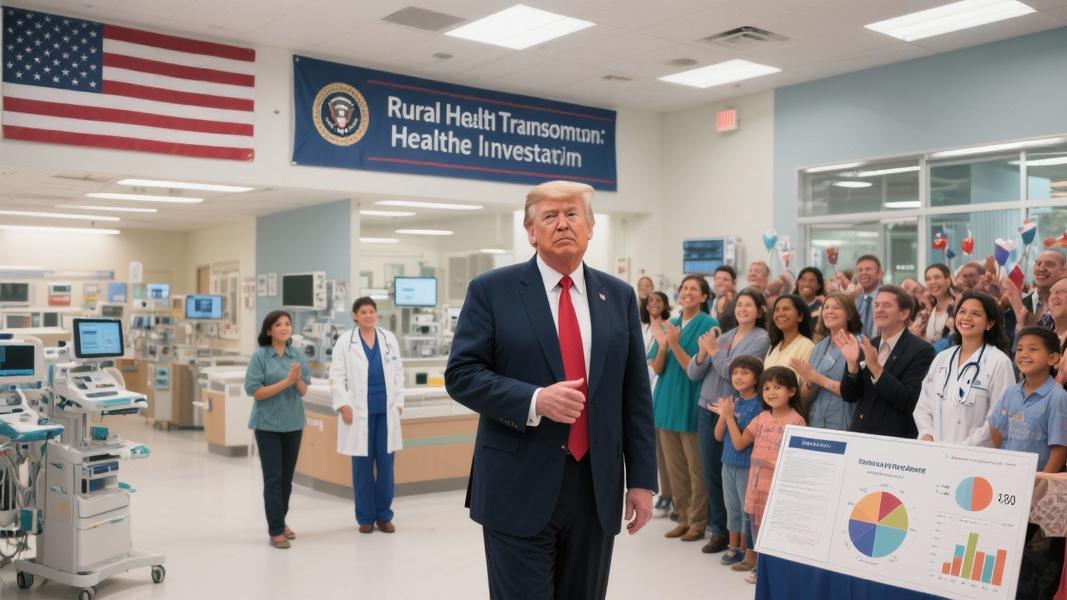
In a landmark move for America’s struggling rural healthcare system, all 50 states have received their first round of funding from the newly created $50 billion Rural Health Transformation Program. The program, signed into law by President Trump last July as part of the Working Families Tax Cuts Act, aims to revitalize healthcare access in the nation’s most underserved rural communities.
The Centers for Medicare & Medicaid Services (CMS) announced the first-year funding allocations just before the new year, distributing $10 billion across states with widely varying award amounts. Texas received the largest allocation at $281 million, while New Jersey secured $147 million — still well above the $100 million minimum guaranteed to each state.
How the money flows
The distribution formula reflects a balanced approach to addressing rural healthcare disparities. Half of the annual $10 billion is divided equally among all approved state applications, while the remaining 50% is allocated based on complex factors including rurality metrics, state policy initiatives, and potential impact of proposed programs, according to White House documents.
“This isn’t just about throwing money at a problem,” said Health Secretary James Reynolds during the funding announcement. “It’s about strategic investments that can transform healthcare delivery in communities that have been left behind for decades.”
States like Alaska ($272 million) and Alabama ($203 million) scored particularly well in the rurality metrics, while Arizona received $167 million based on its comprehensive proposal targeting telehealth expansion in tribal areas, as highlighted by administration officials.
Time-limited opportunity
The clock is already ticking on this massive investment. The program is structured as a temporary five-year initiative running from fiscal years 2026 through 2030, with $10 billion distributed annually. Health policy experts at KFF note that this temporary nature creates both opportunity and pressure for states to demonstrate sustainable improvements.
What happens after 2030? That’s the question already concerning many rural health advocates, who worry about building infrastructure that can’t be maintained once federal funding expires.
The variation in funding between states has raised some eyebrows. An analysis by KFF Health News revealed significant disparities in the allocations beyond the base $100 million each state receives. These differences largely stem from the technical scoring of state applications and the extent of rural populations served.
State health departments now face the challenge of turning these funds into tangible improvements before the next annual allocation. Most states have prioritized expanding telehealth services, addressing healthcare workforce shortages, and keeping struggling rural hospitals afloat.
The program represents one of the largest federal investments in rural healthcare in decades — a fact not lost on local officials in affected communities. As the implementation phase begins, the true test will be whether this unprecedented funding can reverse the troubling trend of rural hospital closures that has accelerated over the past decade.
