
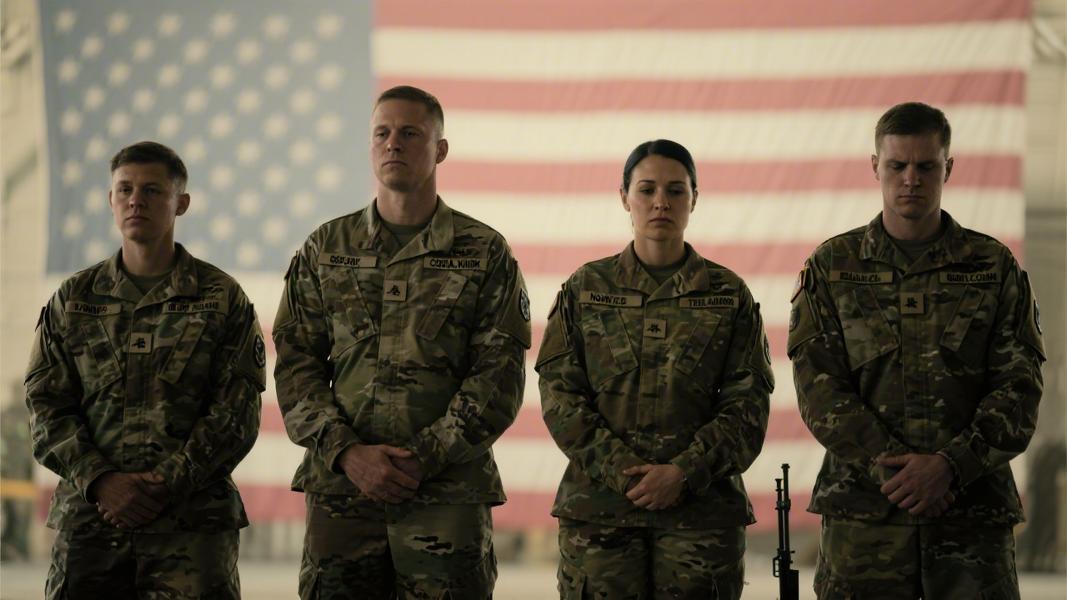
Six American service members are dead. Eighteen more are wounded. And U.S. military commanders are already warning the country to brace for more.
The casualties from Operation Epic Fury — the U.S. military’s ongoing offensive against Iran — climbed sharply over the first two days of March 2026, with the Department of War officially identifying four of the fallen while U.S. Central Command confirmed the broader toll. It’s the kind of news that lands hard on a Tuesday morning, and it raises a question that’s growing louder by the hour: how far does this go?
The Fallen
The Department of War identified four of the six service members killed in action. They were Capt. Cody A. Khork, 35, of Winter Haven, Fla.; Sgt. 1st Class Noah L. Tietjens, 42, of Bellevue, Neb.; Sgt. 1st Class Nicole M. Amor, 39, of White Bear Lake, Minn.; and Sgt. Declan J. Coady, 20, of West Des Moines, Iowa. All four were assigned to the 103rd Sustainment Command out of Des Moines, Iowa — an Army Reserve unit, not a front-line combat brigade. That detail matters.
They died on March 1, 2026, in Port Shuaiba, Kuwait, during an unmanned aircraft system attack. The Pentagon described the strike as the result of a projectile that evaded air defenses — a sobering reminder that no position in this theater is truly out of reach. The identities of the remaining two service members were withheld pending notification of their families.
How the Numbers Grew
It didn’t start at six. Early reports on March 1 put the death toll at three, with five service members seriously wounded. By the following afternoon, CENTCOM had updated the count to six killed — two of them recovered from a struck facility — and 18 wounded in total, a figure that had grown considerably from the initial five. The escalation in casualty numbers over roughly 24 hours tells its own story about the pace and intensity of what’s unfolding.
CENTCOM’s confirmation came around 21:00 UTC on March 2, cementing the grim arithmetic of the operation’s opening days.
The Pentagon’s Message: More Is Coming
Nobody in uniform is sugarcoating it. Air Force Gen. Dan Caine, chairman of the Joint Chiefs of Staff, stood before reporters and said plainly that additional air assets are being sent to the region — and that American forces should expect to take more losses. “I think we are just about where we want to be in terms of total combat capacity and combat power,” he said. “We expect to take additional losses, and as always, we will work to minimize U.S. losses. But, as the secretary said, this is major combat operations.”
That phrase — major combat operations — is doing a lot of work right now. It’s the kind of language that tends to reframe public understanding of what the military is actually doing, and it signals that the administration isn’t treating this as a limited strike or a surgical raid. The Pentagon has ordered additional troops to the region, underscoring the point.
Defense Secretary Pete Hegseth offered his own framing, insisting the offensive won’t become an endless war while acknowledging the human cost directly. “As the president warned, an effort of this scope will include casualties,” Hegseth said. “War is hell and always will be.” It’s a blunt line — almost deliberately so. Whether it reassures or unsettles probably depends on who’s reading it.
Trump Addresses the Nation
President Trump took to Truth Social to address the deaths, framing the fallen as patriots and signaling that he doesn’t expect the losses to stop soon. “As one nation, we grieve for the true American patriots who have made the ultimate sacrifice for our nation, even as we continue the righteous mission for which they gave their lives,” he wrote. The post acknowledged, with unusual directness for a presidential statement, that more American casualties are likely before the war against Iran concludes.
Still, the gap between solemn tribute and operational reality is a wide one. Four of the six Americans killed weren’t infantrymen or special operators — they were logistics and sustainment soldiers, Army Reservists doing the unglamorous but essential work of keeping a military campaign supplied and running. The war, it turns out, doesn’t much care about job descriptions.
What Comes Next
The reinforcements are already moving. More air assets, more troops, and — by the Joint Chiefs’ own admission — more expected casualties. The wounded count of 18 will likely shift again before the week is out. CENTCOM has been updating its figures steadily, and there’s little reason to think the operational tempo is about to ease.
Six dead in the first two days of March. Eighteen wounded. Families in Florida, Nebraska, Minnesota, and Iowa now living in the specific, terrible silence that follows a knock at the door. Gen. Caine’s words keep echoing: this is major combat operations. For the soldiers on the ground, that’s not a press conference talking point. It’s the world they woke up in this morning — assuming they woke up at all.
