
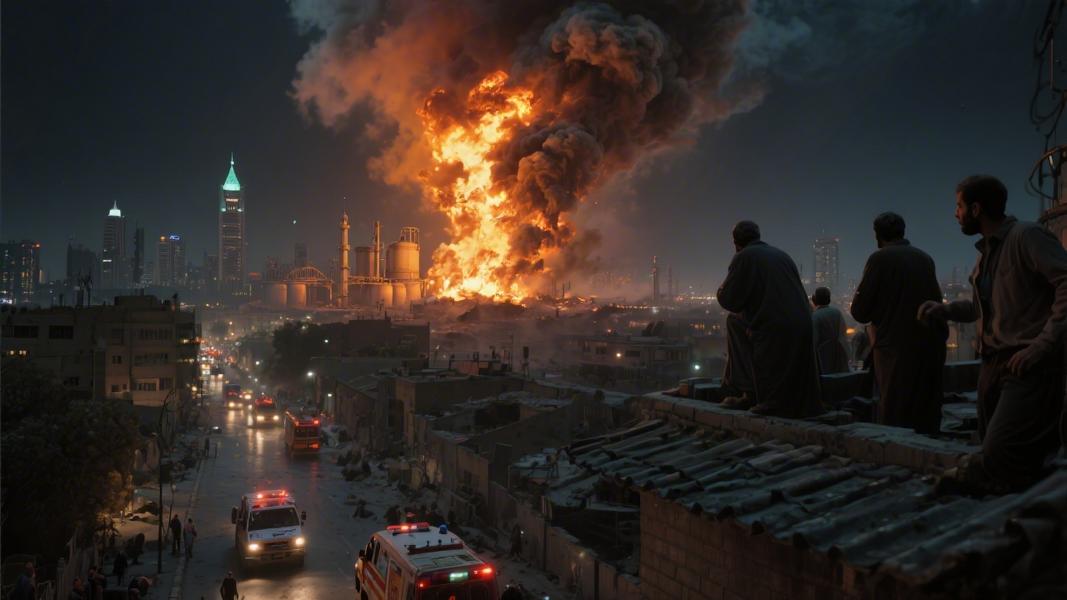
The Middle East crossed a threshold this week that many feared but few believed would actually come. The United States and Israel have launched a sweeping, coordinated military campaign against Iran — and the man who led that country for decades is dead.
Beginning on February 28, 2026, joint U.S.-Israeli forces executed what officials are calling Operations Roaring Lion and Epic Fury — twin offensives that struck Iranian military installations, command centers, and top officials in a campaign of stunning speed and scale. Among those killed: Supreme Leader Ali Khamenei, the 85-year-old cleric who had shaped Iranian foreign policy — and its nuclear ambitions — for more than three decades. The strikes have reshaped the regional order overnight, triggering a cascade of diplomatic, military, and humanitarian consequences that are still unfolding.
A Strike Unlike Any Other
President Donald Trump addressed the nation in characteristically sweeping terms, framing the operation as a historic moment of American resolve. Declared Trump: “Over the past 36 hours, the United States and its partners have launched Operation Epic Fury, one of the largest, most complex, most overwhelming military offensives the world has ever seen.” He confirmed the death of Ayatollah Khamenei and described hundreds of Revolutionary Guard facilities as among the targets hit.
It’s a lot to absorb. Hundreds of targets. A supreme leader assassinated. And a region that was already volatile now staring into something far darker. Whether this was a surgical decapitation or the opening act of a longer war — that question is very much open.
Washington’s Justification
The administration has been quick to frame the strikes as defensive rather than aggressive. Secretary of State Marco Rubio told reporters that intelligence pointed clearly to an imminent Iranian threat. “There absolutely was an imminent threat,” Rubio argued, “and the imminent threat was that we knew that if Iran was attacked — and we believe…” The statement, notably, trailed off in its public release — leaving analysts to fill in the blanks about exactly what was believed, and by whom.
That’s the catch. The legal and moral architecture of preemptive war has always been contested, and citing an “imminent threat” without full transparency has a long, uncomfortable history in American foreign policy. Critics on both sides of the aisle are already asking for the intelligence behind the decision.
Israel at the UN: “A Regime Going Down”
By March 5, the diplomatic fallout was in full swing. Israeli Ambassador Danny Danon appeared before the UN Security Council and offered little in the way of restraint. The Iranian regime, he told the chamber, is “going down and trying to set the entire region on fire as it falls.” It was a vivid line — and not an entirely inaccurate one, given reports of Iranian proxy activity spiking in Lebanon, Iraq, and Yemen in the hours following the initial strikes.
Still, the optics of an ambassador celebrating the collapse of a foreign government — however hostile — before an international body designed to prevent exactly this kind of conflict weren’t lost on observers in the room.
The Human Cost
How bad is it on the ground? Bad. The Iranian Red Crescent Society has confirmed at least 555 deaths inside Iran since the campaign began — a figure that is almost certainly incomplete and likely to rise. Civilian infrastructure, proximity to military targets, and the sheer volume of ordnance deployed all but guarantee that number will climb before any ceasefire is in sight.
The toll has prompted renewed calls from humanitarian organizations for an immediate pause in hostilities. It’s also stirred uncomfortable echoes of past conflicts where initial casualty figures proved to be dramatic underestimates.
What Comes Next
That’s the question nobody has a clean answer to. Iran’s political succession is unclear. Its military command, reportedly fractured by the strikes, hasn’t issued a unified response. Regional allies — Hezbollah, Hamas, the Houthis — are watching and, in some cases, already moving. The broader concern among foreign policy veterans is that removing a regime, however brutal, without a credible plan for what follows is a recipe for prolonged chaos.
But it’s not that simple, either. Those same veterans spent decades warning about Iran’s nuclear trajectory, its proxy networks, its explicit hostility toward both Israel and American interests. The argument that something had to give — eventually — isn’t a fringe position.
Amid the noise and the smoke, an old quote is circulating widely again — one attributed to John F. Kennedy and invoked now with renewed, aching relevance: “Mankind must put an end to war before war puts an end to mankind.” Whether that sentiment registers in any of the war rooms currently lit up across Washington and Tel Aviv remains, for now, an open and urgent question.
