
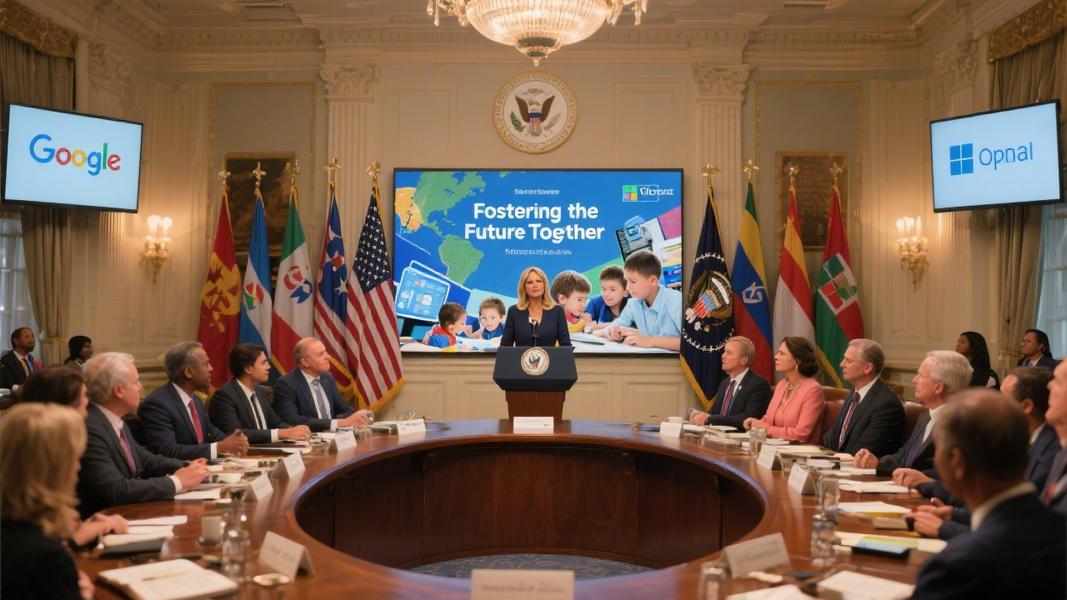
When Melania Trump stepped to the podium at the United Nations last September, she wasn’t just making a speech — she was laying the groundwork for something considerably more ambitious. Six months later, that ambition has a name, a summit, and a growing roster of the world’s most powerful technology companies behind it.
The Fostering the Future Together global coalition, launched by First Lady Melania Trump on September 23, 2025, during the 80th United Nations General Assembly, is holding its inaugural Global Coalition Summit this week — a two-day gathering that’s drawing diplomats, tech executives, and child welfare advocates from across the globe. The stakes, at least according to the White House, couldn’t be higher: the future of how children learn, grow, and stay safe in an increasingly digital world is very much on the table.
A Summit Split Between State and the White House
The summit opened March 24, 2026, at the U.S. Department of State and wraps up March 25 at the White House — a deliberate staging that signals both the diplomatic weight and the domestic political investment the administration is placing in this effort. Leaders from 45 nations and representatives from 28 technology entities are attending, making it one of the more expansive child-focused convenings in recent memory.
That’s a significant pull for an initiative that’s less than a year old. Still, the coalition’s core mission is straightforward enough to state, even if it’s fiendishly complicated to execute: empower children through education and technology, deliver advanced tools — including artificial intelligence — at little or no cost, and simultaneously shield them from the very real dangers those same digital environments can pose. Easy to say. Considerably harder to do at scale across 45 sovereign nations with wildly different infrastructure, legal frameworks, and cultural contexts.
Tech Giants Sign On
The corporate lineup is, to put it plainly, a who’s-who of the modern internet economy. OpenAI, Microsoft, xAI, Meta, Palantir, Adobe, Google, and Zoom Communications are all listed as participating entities, according to documents released by the White House. That’s a remarkable breadth — covering everything from generative AI and cloud computing to social platforms and enterprise video tools.
But it’s not that simple. Several of those same companies have spent years navigating congressional scrutiny, regulatory pressure, and very public controversies over child safety on their own platforms. Meta, for instance, has faced sustained criticism over Instagram’s effects on adolescent mental health. OpenAI’s rapid rollout of consumer AI tools has prompted ongoing debate about age-appropriate access. The presence of these companies at a child-welfare summit is either a sign of genuine course correction — or a very well-timed reputational opportunity. Probably, as is usually the case, some complicated mix of both.
A Global Footprint
The coalition’s member nations span a striking range of geographies, economies, and political systems. The White House has outlined a list that includes France, Poland, Ukraine, Nigeria, Kenya, Saudi Arabia, Morocco, Israel, Panama, Paraguay, the United Arab Emirates, Lithuania, Aruba, and the United States itself, among others. It’s a genuinely diverse collection — not the usual cluster of wealthy Western nations that tends to dominate these kinds of multilateral efforts.
What does that mean in practice? A country like Nigeria, with one of the world’s largest youth populations and significant connectivity gaps, has very different needs than, say, Lithuania or the UAE. Whether the coalition can deliver meaningful, tailored outcomes across that spectrum — rather than a one-size-fits-all framework that looks good on a summit agenda — will likely determine whether this effort has real staying power beyond the press cycle.
The First Lady’s Signature Issue
For Melania Trump, this initiative represents something of a second act for what was, during her husband’s first term, a somewhat underdeveloped platform. Her Be Best campaign, launched in 2018, touched on similar themes — child wellbeing, online safety, opioid awareness — but was often overshadowed by the turbulence of the broader political moment. This time, the coalition’s structure feels more institutionally grounded: formal government partnerships, named corporate commitments, and a multilateral diplomatic framework built into its DNA from the start.
Whether that translates into durable policy change, or fades as first-lady initiatives sometimes do once the news cameras move on, remains to be seen. The summit’s two-day format, split between the State Department and the White House, suggests the administration is at least trying to embed this in both foreign policy and domestic executive structures simultaneously — which, if it holds, is a smarter architecture than a single high-profile event followed by silence.
Forty-five nations, twenty-eight tech companies, and a First Lady with something to prove. The room is full. Now comes the harder part: making it mean something once everyone goes home.
