
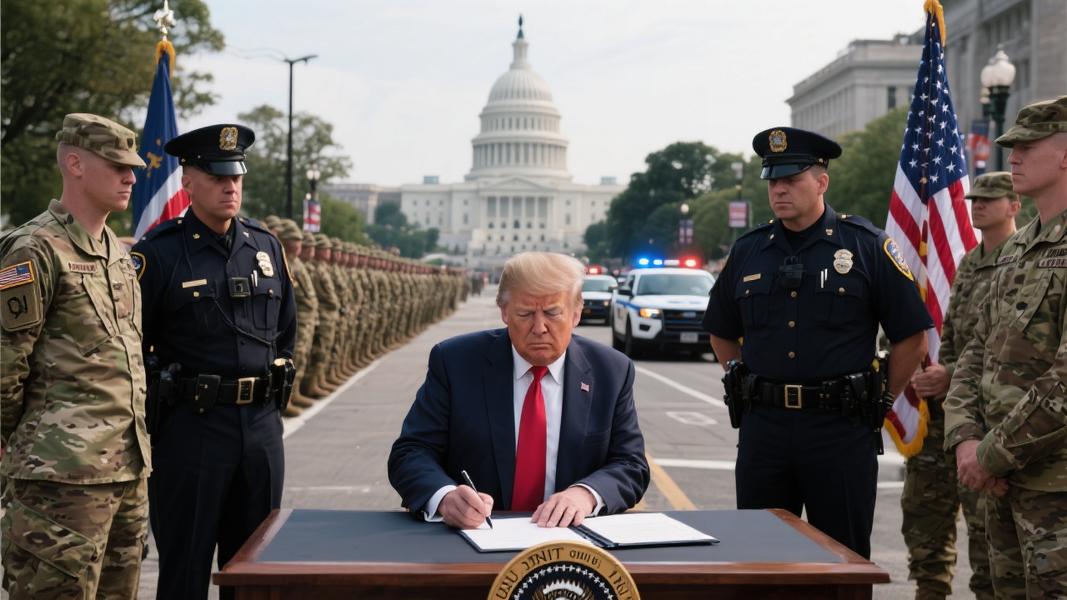
President Trump Activates National Guard to “Restore Law and Order” in DC
In a dramatic escalation of federal involvement in the nation’s capital, President Donald Trump has ordered the mobilization of the District of Columbia National Guard to combat what his administration describes as an “epidemic of crime” threatening Washington, DC. The directive, issued through a Presidential Memorandum, places the District’s National Guard under the Secretary of Defense until “the situation is controlled,” with provisions for additional units from neighboring states if deemed necessary.
“I’m deploying the National Guard to help reestablish law, order and public safety in Washington, DC,” Trump declared at an August 11 press conference, where he also announced the unprecedented step of federalizing the Metropolitan Police Department under Attorney General Pam Bondi’s authority. “It’s becoming a situation of complete and total lawlessness, and we’re getting rid of the slums, too.”
Capital Under Siege?
The White House has painted a stark picture of a federal city in crisis. According to a fact sheet, Washington’s 2024 murder rate of 27.54 per 100,000 residents exceeds those of international cities like Bogota (15.1), Mexico City (10.6), and far outpaces European capitals such as Paris (1.64), London (1.1), and Madrid (0.96). The administration cited several high-profile violent incidents, including the murders of two embassy staffers in May, a Congressional intern near the White House in June, and an alleged mob attack on a Trump administration official.
Is the capital truly as dangerous as portrayed? While the White House characterizes DC as “one of the most dangerous cities anywhere in the World,” official statistics show recent crime decreases in some categories. Nevertheless, Trump has initiated a 7-day law enforcement surge involving multiple federal and local agencies under his directive.
The President’s rhetoric has been unsparing. “The Memorandum directs the Secretary of Defense to mobilize the District of Columbia National Guard to address the epidemic of crime in our Nation’s capital,” the White House stated in its official announcement.
Local Control Questioned
Trump’s intervention sets up a potential clash over local governance in the District, which has limited home rule under federal oversight. The President directly criticized DC Mayor Muriel Bowser, though with a personal caveat.
“The Mayor of D.C., Muriel Bowser, is a good person who has tried, but she has been given many chances, and the Crime Numbers get worse, and the City only gets dirtier and less attractive,” Trump told reporters. “The American Public is not going to put up with it any longer.”
House Oversight Committee Chairman James Comer enthusiastically backed the President’s actions, placing blame on local leadership. “President Trump is rightly using executive power to take bold and necessary action to crack down on crime and restore law and order in Washington, D.C. For years, the D.C. Council’s radical, soft-on-crime agenda has emboldened criminals and put public safety at risk in our nation’s capital,” Comer said in a statement.
A Vision Beyond Security
The President’s ambitions for the District extend beyond law enforcement. In March 2025, Trump established a task force focused on both safety and infrastructure improvements, suggesting a comprehensive overhaul of the capital.
Trump has framed the DC intervention as part of a broader restoration project, drawing parallels to his border policies. “Just like I took care of the Border, where you had ZERO Illegals coming across last month, from millions the year before, I will take care of our cherished Capital, and we will make it, truly, GREAT AGAIN!” he promised. “Before the tents, squalor, filth, and Crime, it was the most beautiful Capital in the World. It will soon be that again.”
The deployment comes at a moment of heightened political tension, as the administration has characterized the security situation as threatening the basic functioning of government itself. Whether this extraordinary federal intervention will produce the transformation Trump envisions—and at what cost to local autonomy—remains to be seen.
