
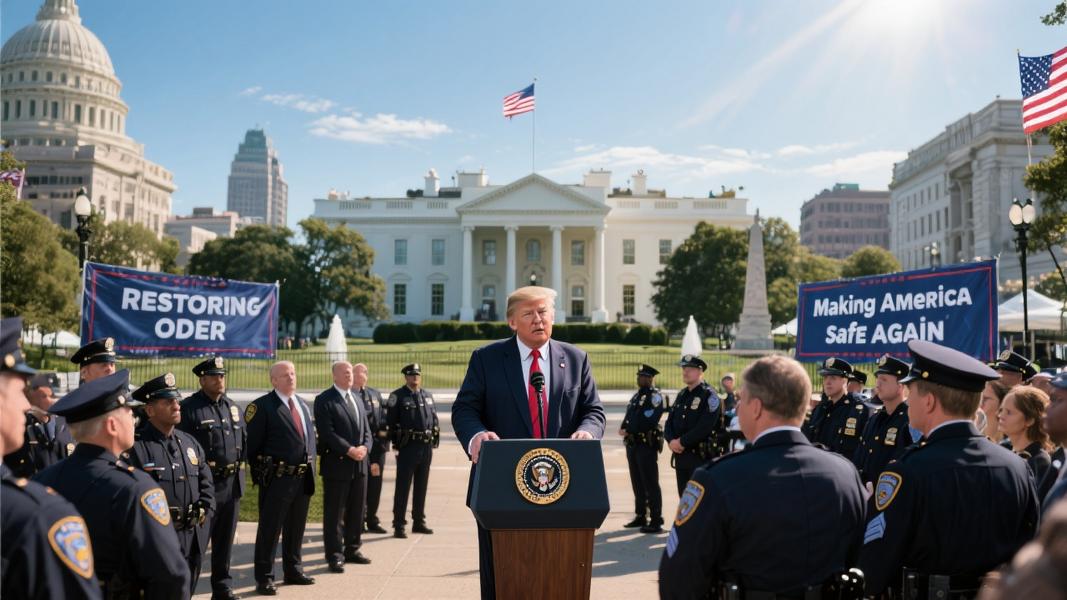
President Trump has declared a “crime emergency” in Washington, D.C., taking unprecedented control of the city’s police department and deploying the National Guard in what he calls a necessary step to restore safety to the nation’s capital.
On August 11, 2025, Trump signed an Executive Order invoking his authority under the District of Columbia Self-Government and Governmental Reorganization Act, effectively commandeering the Metropolitan Police Department and launching a massive federal law enforcement surge across the city. The order delegates Attorney General Pam Bondi to monitor the emergency and command police operations, with Trump citing “special conditions of an emergency nature” requiring federal intervention to maintain law and order in the district.
Crime Crisis or Political Power Play?
“Just like I took care of the Border, where you had ZERO Illegals coming across last month, from millions the year before, I will take care of our cherished Capital, and we will make it, truly, GREAT AGAIN!” Trump declared in announcing the move. “Before the tents, squalor, filth, and Crime, it was the most beautiful Capital in the World. It will soon be that again.”
The White House points to alarming statistics to justify the takeover, noting that Washington has “one of the highest robbery and murder rates among large U.S. cities nationwide, with a homicide rate exceeding 27 per 100,000 residents in 2024.” Vehicle theft rates reportedly stand at more than three times the national average at 842.4 per 100,000 residents.
Attorney General Bondi struck a decisive tone at a press conference following the announcement. “Let me be crystal clear: Crime in D.C. is ending and ending today,” she stated. “We are going to use every power we have to fight criminals here.”
Massive Federal Response Underway
The administration has wasted no time mobilizing resources. In recent days, a multi-agency federal response has materialized on D.C. streets, with officers from the U.S. Park Police, FBI, Bureau of Alcohol, Tobacco, Firearms and Explosives, and U.S. Marshals conducting night patrols throughout the city.
What began as isolated federal operations has now expanded into a comprehensive seven-day law enforcement effort involving no fewer than a dozen agencies. The operation includes personnel from Metro Transit Police, Amtrak Police, Capitol Police, Homeland Security Investigations, Federal Protective Service, DEA, and several other federal and local law enforcement entities.
Trump’s concerns extend beyond violent crime. “So whether you call it federalize or what. And that also includes the graffiti that you see, the papers all over the place, the roads that are in bad shape, the medians that are falling down,” he explained to reporters. “We’re going to beautify the city. We’re going to make it beautiful.”
Questions of Authority and Necessity
The dramatic federal intervention raises questions about the limits of presidential authority over the District of Columbia, which has long struggled for greater autonomy from federal control. While the president does have certain powers over D.C. under the Home Rule Act, the scale of this takeover is virtually unprecedented in modern times.
Local leadership has challenged Trump’s characterization of the city’s crime situation, though the White House maintains that the emergency measures are essential to protect both residents and the “orderly functioning of the Federal Government.”
This isn’t Trump’s first attempt to assert federal authority over domestic policing. In March, he established a task force to tackle crime and rebuild the city’s infrastructure, part of his broader “law and order” agenda that was a centerpiece of his campaign.
For now, Attorney General Bondi will report directly to the president on the emergency situation, with the authority to recommend either further actions or termination of the order. But with the National Guard deployed and federal agents patrolling the streets, Washington, D.C. finds itself under a level of federal control not seen in generations — a situation that seems unlikely to change anytime soon.
