
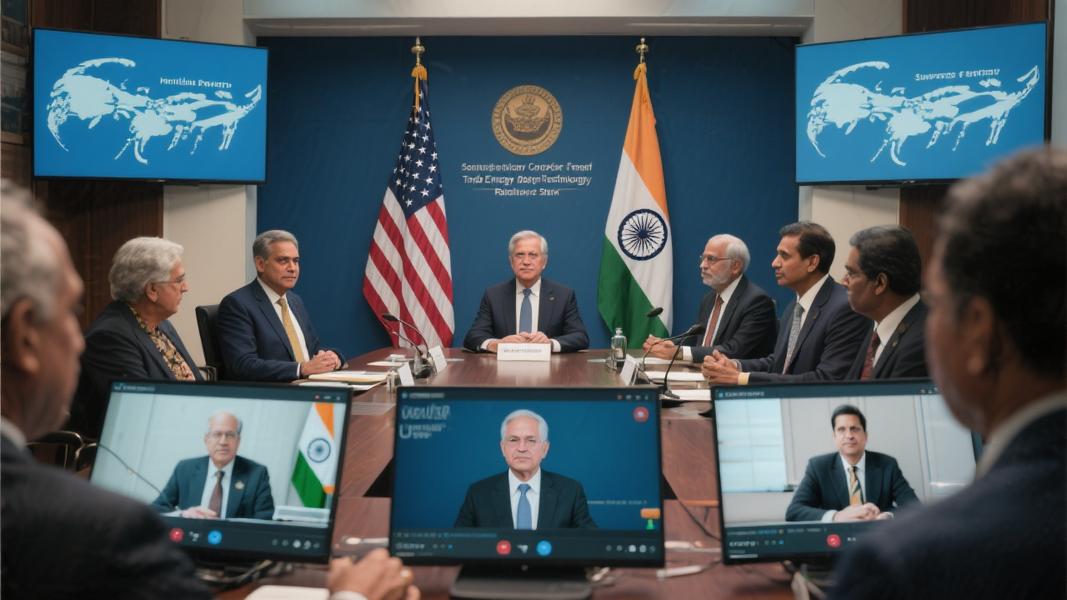
India and the US have agreed to sign a new ten-year defense partnership framework as part of ongoing bilateral discussions, even as the two nations navigate recent trade tensions over Russian oil purchases.
The virtual 2+2 Intersessional Dialogue, held on August 25, 2025, covered significant ground across multiple sectors despite looming tariffs set to take effect this week. Officials from both sides emphasized their commitment to strengthening cooperation on defense, energy security, counterterrorism, and regional stability in the Indo-Pacific region.
Defense Cooperation Takes Center Stage
Perhaps the most notable outcome was the announcement of a forthcoming ten-year Framework for the India-US Major Defense Partnership. This agreement aims to advance “defense industrial, science, and technology cooperation; operational coordination; regional cooperation; and information-sharing,” according to a joint statement released after the talks.
The dialogue also reaffirmed progress under the India-US COMPACT (Catalyzing Opportunities for Military Partnership, Accelerated Commerce & Technology) initiative. “Participants agreed to build upon the progress made in these areas… for the 21st Century and beyond,” the statement noted.
Proceeding Despite Trade Tensions
What makes this dialogue particularly significant? It represents the first official bilateral communication acknowledged by both governments after a period of strained relations over trade issues. The Biden administration recently announced a 25% tariff on certain Indian goods in response to India’s continued purchases of Russian oil, a measure set to begin Wednesday.
Despite these tensions, both sides appeared determined to maintain momentum across their strategic partnership. The dialogue covered trade, investment, energy security, civil-nuclear cooperation, critical minerals exploration, and counterterrorism efforts, among other areas, according to officials who participated in the talks.
Indo-Pacific Strategy and the Quad
The regional dimension remained prominent throughout discussions. “The chairs reaffirmed their commitment to promoting a safer, stronger, and more prosperous Indo-Pacific region through the Quad,” the statement confirmed, referencing the strategic partnership between the US, India, Japan, and Australia that has gained prominence as a counterweight to China’s growing influence.
This focus on the Quad underscores how both nations view their bilateral relationship within the broader context of regional security architecture and shared democratic values.
Key Officials Lead Virtual Discussions
The dialogue was co-chaired by senior officials from both countries. India was represented by Additional Secretary (Americas) Nagaraj Naidu Kakanur and Joint Secretary (International Cooperation) Vishwesh Negi from the Ministry of External Affairs. The US delegation was led by Senior Bureau Official Bethany P. Morrison from the State Department’s Bureau of South and Central Asian Affairs and Acting Assistant Secretary of Defense Jedidiah P. Royal for Indo-Pacific Security Affairs, as detailed in official statements.
Can the relationship weather current economic disagreements? That’s the question diplomats on both sides appear determined to answer affirmatively. Despite the looming tariff implementation, the dialogue “concluded with the chairs expressing their appreciation for the productive meeting and eagerness to continue enhancing the breadth and depth of the bilateral relationship,” according to people familiar with the discussions.
The 2+2 Intersessional format itself represents a mechanism designed to maintain regular communication between the full-fledged ministerial dialogues that typically involve cabinet-level officials from both nations.
As India continues to pursue strategic autonomy in its foreign policy while the US seeks to strengthen alliances in Asia, these ongoing dialogues — even amid disagreements — suggest both capitals recognize that their relationship is too important to be derailed by individual policy differences, however significant they might appear in the short term.
