
Trump Unveils Sweeping Strategy to Combat Domestic Terrorism and Political Violence
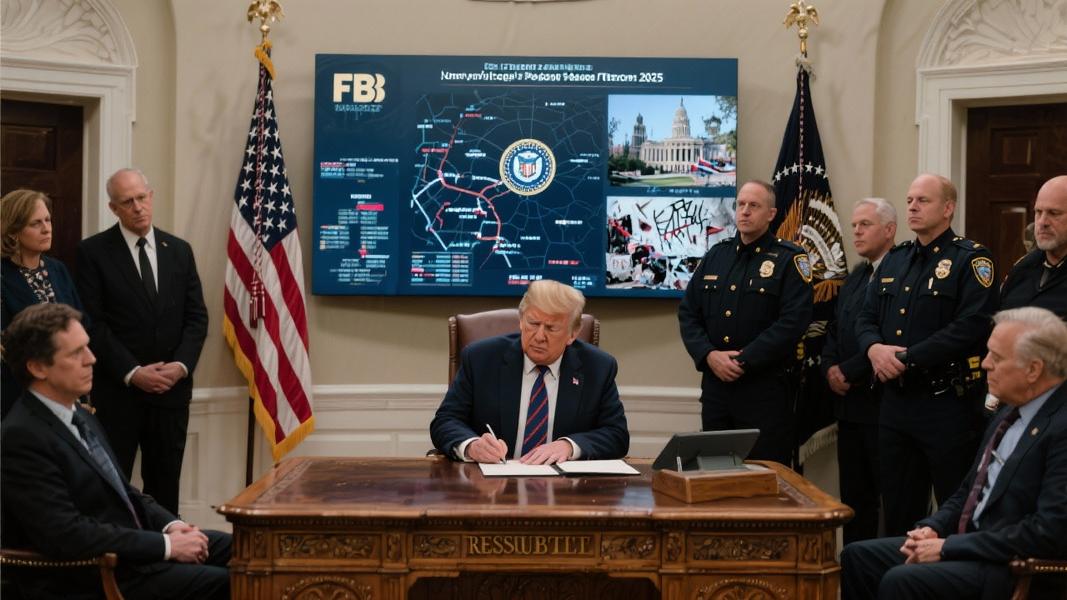
President Donald Trump signed a far-reaching National Security Presidential Memorandum (NSPM) Wednesday that establishes what the administration calls a “comprehensive strategy” to counter domestic terrorism and organized political violence across the United States.
The directive positions the FBI’s Joint Terrorism Task Forces at the center of a national effort to “investigate, disrupt, and dismantle all stages of organized political violence” that the administration says aims to suppress lawful activity or obstruct the rule of law, according to a White House statement.
Targeting “Left-Wing Terrorism”
The memorandum directs federal authorities to prosecute all crimes related to organized political violence and specifically addresses politically motivated acts like “organized doxing campaigns, swatting, rioting, and property crimes.” It also targets the financial networks supporting domestic terrorism, with provisions requiring the Treasury Department to identify and disrupt funding sources.
“This marks a historic moment in the United States, being the first comprehensive government initiative aimed at dismantling left-wing terrorism,” Deputy Chief of Staff Stephen Miller declared in what appears to be a clear indication of which groups the administration intends to focus on.
FBI Director Kash Patel reinforced that message, telling reporters, “We are properly going to chase them down like the domestic terrorists that they are. We are going to pursue them rigorously like the domestic terrorists they truly are.” Patel emphasized the bureau would be tracing financial support for these groups, with George Soros specifically mentioned as a likely target for investigation.
Response to Recent Violence
The White House cited several recent acts of political violence as justification for the new strategy, including what it described as the assassination of conservative leader Charlie Kirk on September 10 at Utah Valley University. “On September 10, beloved conservative leader Charlie Kirk was assassinated while speaking to college students at Utah Valley University in a horrific act of political violence,” the memorandum states.
What’s driving this aggressive approach? The administration points to a dramatic surge in violence against law enforcement. “Attacks on ICE officers have increased by more than 1,000% since January 21, 2025,” according to the White House, which also referenced a shooting at an ICE facility in Dallas that reportedly resulted in multiple casualties.
The memorandum also highlights anti-police and “criminal justice” riots that have allegedly “left many dead and injured, and have inflicted over $2 billion in property damage nationwide.”
Special Focus on Financial Networks
A significant portion of the strategy focuses on cutting off funding for groups deemed to be engaged in domestic terrorism. The memorandum “instructs the Secretary of the Treasury to identify and disrupt financial networks that fund domestic terrorism and political violence,” and directs the IRS Commissioner to ensure tax-exempt entities aren’t financing these activities, either directly or indirectly.
Organizations found in violation would be referred to the Department of Justice for potential prosecution.
The NSPM also designates domestic terrorism as a “national priority area” to ensure appropriate funding for law enforcement agencies to “detect, prevent, and protect against threats arising from this area,” according to the White House document.
President’s Rhetoric
Trump didn’t mince words about who he believes is responsible for recent violence. “For years, those on the radical left have compared wonderful Americans like Charlie [Kirk] to Nazis and the world’s worst mass murderers and criminals,” the president said. “This kind of rhetoric is directly responsible for the terrorism that we’re seeing in our country today, and it must stop right now.”
He added a direct warning: “My administration will find each and every one of those who contributed to this atrocity, and to other political violence, including the organizations that fund it and support it, as well as those who go after our judges, law enforcement officials, and everyone else who brings order to our country.”
The directive follows earlier actions by the administration, including designating Antifa as a domestic terrorist organization and declaring a crime emergency in Washington, D.C., to what it calls “protect residents, federal workers, and institutions of democracy.”
Critics are likely to question whether the initiative will be applied evenly across the political spectrum or primarily target left-leaning organizations. But for now, the administration appears intent on moving forward with what represents one of the most aggressive domestic security initiatives in recent memory.
