
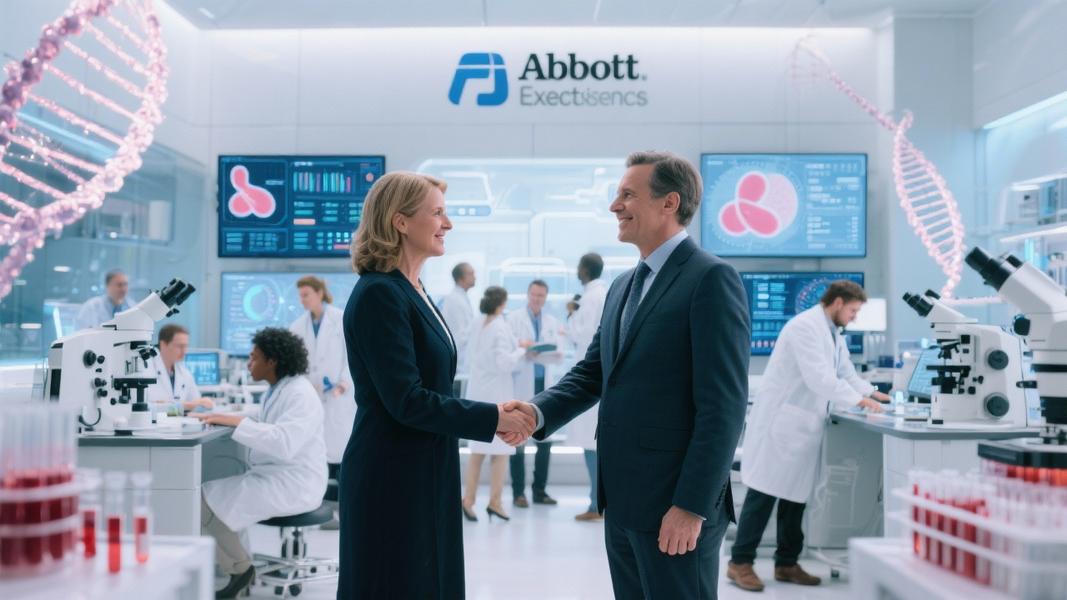
Abbott announced Thursday it will acquire cancer diagnostics leader Exact Sciences in a massive $21 billion all-cash deal, positioning the healthcare giant to dominate the rapidly growing cancer screening market in what stands as one of the largest medical diagnostics acquisitions in recent years.
Under the agreement, Abbott will pay $105 per share for Exact Sciences, representing approximately $21 billion in equity value and an enterprise value of $23 billion. The transaction, announced by both companies, has been unanimously approved by their respective boards of directors but isn’t expected to close until the second quarter of 2026, pending shareholder and regulatory approvals.
Strategic Expansion into Cancer Diagnostics
Why such a massive investment? The acquisition gives Abbott immediate leadership in the booming $60 billion U.S. cancer screening and precision oncology diagnostics market. With approximately 20 million people globally diagnosed with cancer annually — including 2 million Americans — the deal represents a strategic pivot toward addressing one of healthcare’s most persistent challenges.
“Exact Sciences’ innovation, its strong brand and customer-focused execution are unrivaled in the cancer diagnostics space, and its presence and strengths are complementary to our own,” said Robert B. Ford, chairman and chief executive officer of Abbott. “We’re excited to bring Exact Sciences’ people and know-how into Abbott so that together, we can take on the global challenge of cancer,” he stated in the announcement.
The Madison, Wisconsin-based Exact Sciences brings its market-leading Cologuard and Oncotype DX tests to the Abbott portfolio, along with cutting-edge liquid biopsy technologies for multi-cancer early detection and molecular residual disease testing. These products have positioned the company as a frontrunner in cancer diagnostics, with projected revenue exceeding $3 billion this year and high teens organic sales growth.
Once integrated, Abbott’s diagnostics division will see its annual sales surge past $12 billion — a significant boost to its already robust diagnostics business. The acquisition will be immediately accretive to Abbott’s revenue growth and gross margin, the company confirmed.
Financial Structure and Implications
The deal’s structure includes Abbott absorbing Exact Sciences’ estimated $1.8 billion of net debt. That’s a substantial commitment, but one that Abbott, with its strong balance sheet, appears well-positioned to handle.
Could another suitor emerge? It seems unlikely. The agreement includes a hefty termination fee of approximately $628.7 million payable to Abbott if Exact Sciences were to accept a superior proposal, according to filings with the Securities and Exchange Commission.
Kevin Conroy, chairman and CEO of Exact Sciences, expressed enthusiasm about the merger: “Together with Abbott, we can reach more patients, advance earlier detection, and deliver answers that change lives. Abbott’s culture of innovation and global commercial reach will help accelerate our mission of eradicating cancer and expanding access to our tests worldwide, while delivering immediate and substantial value to our shareholders.”
Looking Ahead
What happens to Exact Sciences’ approximately 7,000 employees? The company will maintain its presence in Madison, Wisconsin after the acquisition, with Conroy remaining in an advisory role to support the transition, according to the release.
“I want to thank the 7,000 Exact Sciences’ team members for their extraordinary work and dedication — our journey has just begun,” Conroy noted in his statement.
The acquisition comes at a time when cancer rates are expected to rise due to population growth, aging demographics, and other contributing factors. Exact Sciences has built a comprehensive portfolio spanning multiple testing categories including stool-based tests, liquid biopsies, molecular residual disease monitoring, and treatment guidance — all areas poised for significant growth as healthcare systems worldwide increasingly focus on early detection and precision treatment.
For Abbott, a company that has traditionally focused on cardiovascular, diabetes, and infectious disease diagnostics, this represents not just an acquisition but a transformation — positioning the healthcare giant to tackle one of medicine’s most formidable challenges with an expanded toolkit of cutting-edge technologies and expertise.
