
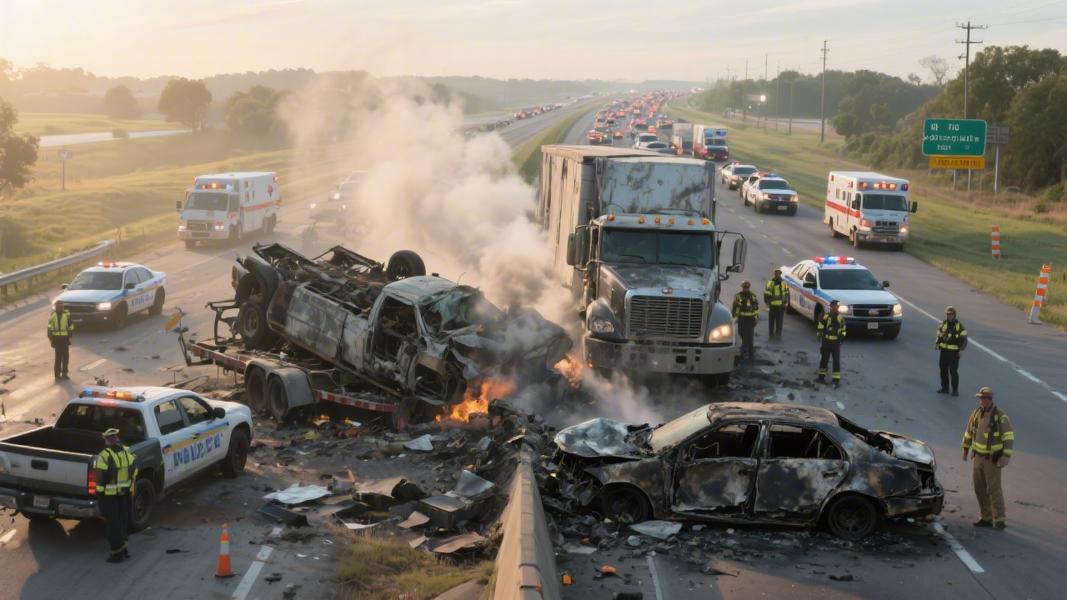
An Alvarado police lieutenant was shot in the neck on the Fourth of July. Now, nine people are sitting in federal court, and prosecutors say it was no spontaneous act of chaos — it was a plan.
The trial stemming from the July 4, 2025, attack on the Prairieland ICE Detention Center in Alvarado, Texas, is shaping up to be one of the most consequential domestic terrorism prosecutions in recent memory. Federal prosecutors have described the case as the first federal indictment tied to Antifa-related domestic terrorism — a label that has charged the proceedings with political and legal significance well beyond the borders of Johnson County.
What Happened That Night
Eleven individuals descended on the facility under the cover of Independence Day fireworks. What followed wasn’t just noise. According to the U.S. Department of Justice, somewhere between 20 and 30 rounds were fired at correctional officers. Vehicles were vandalized. A guard structure was damaged. And Alvarado Police Lt. Thomas Gross was struck in the neck by a bullet — a wound that, somehow, he survived. Investigators later recovered AR-style rifles and twelve sets of body armor connected to the group.
That’s not a protest. That’s an ambush.
The Ringleader and the Signal Chats
Benjamin Song is at the center of it all. Prosecutors say he directed the attack and fled for days afterward before being apprehended. FBI Special Agent Clark Wiethorn testified that the assault had been coordinated in the days leading up to July 4th through encrypted Signal app chats — messages that laid out weapons, tactical gear, and the distribution of anti-government materials. Eleven shell casings were recovered from a single shooter’s position, according to testimony from Wiethorn. This wasn’t improvised. Someone had done the math.
Alongside Song, eight other defendants — Daniel Estrada, Ines Soto, Elizabeth Soto, Maricela Rueda, Bradford Morris, Savanna Batten, Zachary Evetts, and Cameron Arnold — face charges including attempted murder of federal officers and multiple firearms offenses. A tenth individual was also charged in the broader indictment. Their fates now rest with a federal jury in what has quickly become a closely watched proceeding.
The Witness Who Cut a Deal
Then there’s Susan Kent. Kent, an inmate who signed a plea agreement for providing material support to terrorists, took the stand and offered a glimpse into the mindset swirling around the attack. Her words were striking in their casual defiance. “We’re gonna make some noise and we’re not going to do anything dangerous,” she recalled saying, before adding, “but let’s be clear, I’m not going to jail.” She confirmed knowledge of the defendants’ involvement and described post-incident coordination among those connected to the group.
Still, testimony from cooperating witnesses always carries its complications. Defense attorneys will almost certainly press on the incentives baked into Kent’s deal. That’s standard. But what she described — the breezy confidence, the sense that consequences were someone else’s problem — paints a portrait that prosecutors will be eager to keep in front of the jury.
A Broader Reckoning
Why does this case matter beyond Texas? Because the government is essentially arguing that what happened in Alvarado represents a new and dangerous threshold — organized, armed, ideologically motivated violence directed at federal law enforcement infrastructure. That framing has enormous implications, legally and politically, for how domestic extremism is prosecuted going forward.
The Wikipedia entry on the incident has already been catalogued as a discrete historical event — a small but telling sign of how quickly this case has embedded itself in the public record. Whether the jury ultimately agrees with the government’s sweeping characterization remains to be seen. Trials have a way of complicating tidy narratives.
Lt. Gross is alive. The defendants are in court. And somewhere in those Signal chats, prosecutors believe, is the blueprint for something the country hasn’t quite figured out how to name yet.
