
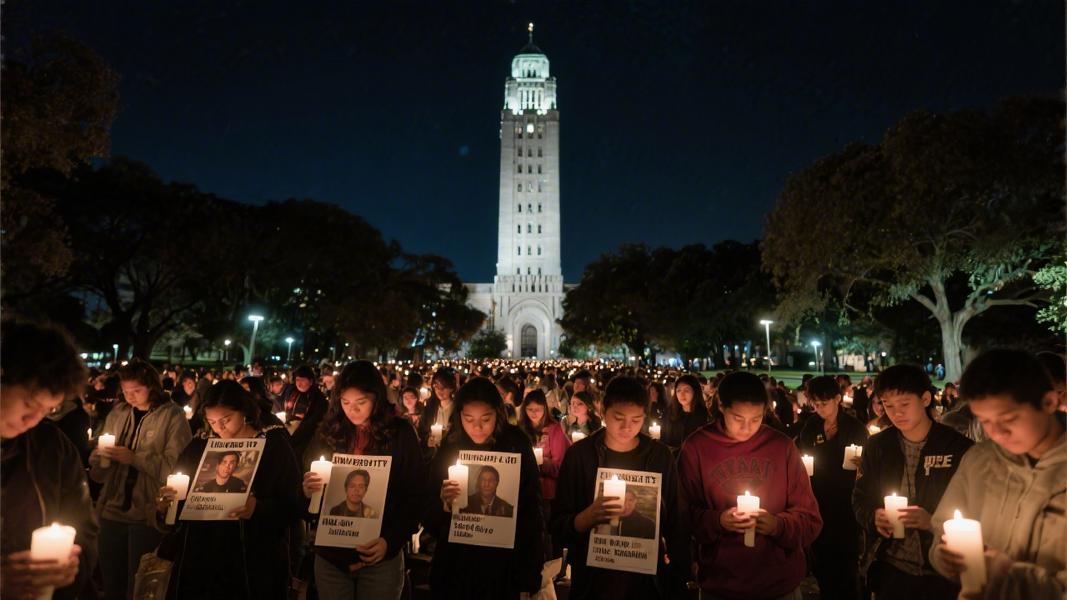
Three people are dead and more than a dozen others wounded after a gunman opened fire on one of Austin’s most crowded nightlife corridors in the early hours of Sunday morning — a massacre that has left a university community in mourning and investigators combing through thousands of hours of footage.
The shooting unfolded at approximately 1:59 a.m. on March 1, 2026, outside Buford’s Backyard Beer Garden on West Sixth Street, one of Austin’s most storied stretches of bars and live music venues. The gunman, identified by authorities as Ndiaga Diagne, first fired a pistol from inside a Cadillac Escalade before exiting the vehicle near Wood Street and continuing the attack with a rifle. Officers arrived within a minute of the first 911 call. Diagne was shot and killed by police at the scene.
The Victims
Austin Police have identified the three civilians killed as Savitha Shan, 21, a senior at the University of Texas at Austin; Ryder Harrington, 19; and Jorge Pederson, 30. Fourteen others were hospitalized, with 13 confirmed injured among that count. The range in ages — a college senior, a teenager barely old enough to be there, a man in his thirties — underscores just how indiscriminate the violence was.
Harrington’s friend, speaking to reporters afterward, couldn’t quite find the words at first. “He sent me a video on the way to the bar actually,” said Oothoudt. “Riding in a self-driving vehicle, and he thought it was pretty cool.” That video, sent just hours before the shooting, is now among the last records of his life. It’s the kind of detail that makes the tragedy feel unbearably ordinary — a young man excited about a novelty ride, headed out for a night that would never end the way anyone expected.
The University of Texas held a candlelight vigil in Shan’s honor, drawing students, faculty, and community members who gathered to grieve one of their own. UT’s community was shaken at an institutional level, with university leaders among those reacting publicly to the loss. “I cannot imagine the grief, pain, and loss these families are feeling today and my heart is with them,” said Lisa Davis.
Chaos on Sixth Street
By all accounts, the scene outside Buford’s was packed. “It was really crowded at one point, like literally shoulder to shoulder,” said a witness named Li, who recalled the scene in the moments before the shooting began. That density — the very thing that makes Sixth Street what it is on a Saturday night — is almost certainly what turned a single gunman into a mass casualty event.
New video footage capturing the chaos has since circulated widely, showing panicked crowds scattering as shots rang out. The images are difficult to watch. Austin police say the investigation now involves more than 150 witnesses and thousands of hours of surveillance and body camera video — a scope that reflects both the severity of the incident and the sheer number of people who were present.
The Gunman and a Possible Terror Link
Here’s where the story gets more complicated. Investigators say the weapons used by Diagne were purchased legally in 2017 in San Antonio — nearly a decade before the attack. But it’s what else they found that has federal authorities paying close attention.
“There were indicators on the subject and in his vehicle that indicate potential nexus to terrorism,” said Alex Doran, according to officials briefing reporters. When pressed on whether this was definitively a terrorist act, investigators were cautious. “Again, it’s still too early to make a determination on that.” Body camera footage and additional suspect details were set to be released Thursday.
Still, the word “terrorism” now hangs over the investigation — and over Austin itself — in a way that transforms the public conversation from tragedy to something potentially larger and more deliberate.
A City Responds
South Texas Blood & Tissue dispatched 20 units of blood to Austin in the immediate aftermath, a logistical response that speaks to how quickly the city’s emergency infrastructure mobilized. Local leaders were quick to address the public, though some struck a tone that balanced grief with defiance. “While this is a dark moment, our people are creating a lot of light in Austin, Texas,” Mayor Kirk Watson said.
It’s the kind of line politicians reach for in moments like this — and it doesn’t make it wrong. Austin has long prided itself on its culture, its nightlife, the very streets where this happened. The question now, as it always is after something like this, is what comes next: for the investigation, for the families, and for a city that will have to decide what it means to keep the lights on after a night like that one.
Ryder Harrington thought a self-driving car was pretty cool. He sent the video. He never made it home. That’s the part that doesn’t let go.
