
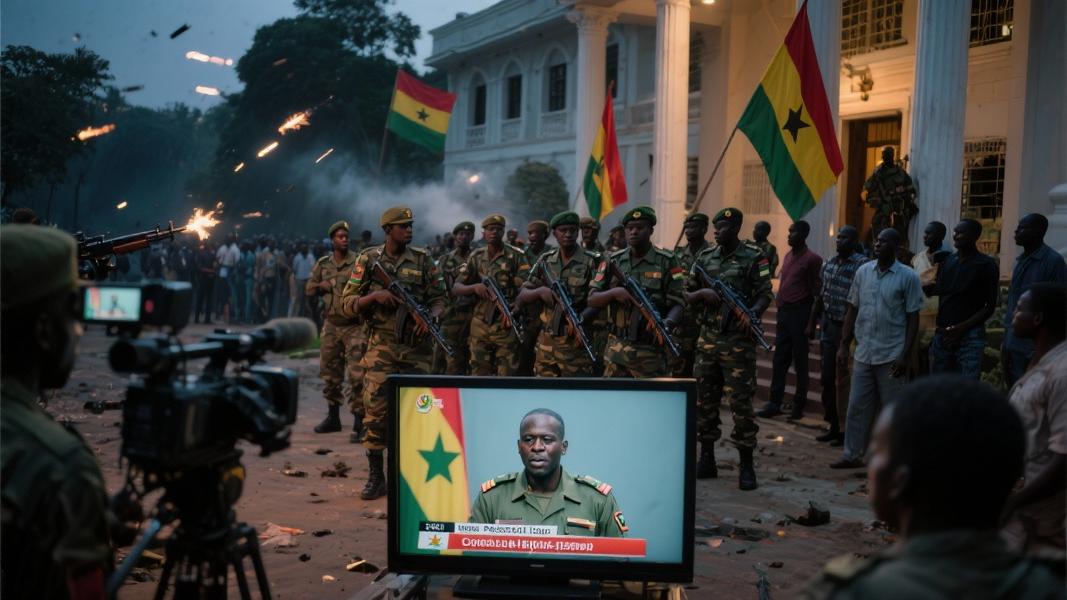
Gunfire erupted in Benin’s capital Sunday as a renegade military faction announced an attempted coup against President Patrice Talon, only to be swiftly countered by forces loyal to the government. The dramatic power struggle briefly threw the West African nation into chaos before authorities declared they had regained control.
In the pre-dawn hours of December 7, 2025, soldiers led by Lieutenant Colonel Pascal Tigri stormed state television to announce they had overthrown President Talon, suspended the constitution, and established what they called the “Military Committee for Refoundation” (CMR). The declaration followed an attack on Talon’s residence in Porto-Novo, with reports of military confrontations spreading to the economic hub of Cotonou.
But by midday, Benin’s government had a different story to tell.
“In the early morning of Sunday, Dec. 7, 2025, a small group of soldiers launched a mutiny with the aim of destabilizing the state and its institutions,” Interior Minister Alassane Seidou stated. “Faced with this situation, the Beninese Armed Forces and their leadership, true to their oath, remained committed to the republic.”
President Safe, Loyalists Regain Control
Despite initial confusion, President Talon was confirmed safe, with sources indicating that troops loyal to his administration quickly mobilized to counter the coup plotters. The attempted takeover appeared to follow a familiar playbook: seize the national broadcaster, declare a new order, and hope momentum carries the day.
That momentum never materialized. Government forces swiftly reasserted control, with the Interior Minister describing the incident as a “mutiny” rather than a full-fledged coup attempt. By evening, authorities were reportedly “clearing out” the remaining rebels.
Is this Benin’s first brush with military intervention? Far from it. The country has weathered numerous power grabs since independence, including the infamous 1977 “Operation Shrimp” — a failed coup orchestrated by French mercenaries attempting to overthrow then-President Mathieu Kérékou’s communist government.
Sunday’s events unfolded in a region increasingly vulnerable to military takeovers. Since 2020, neighboring countries including Mali, Burkina Faso, Niger, and Guinea have all experienced successful coups, raising concerns about democratic backsliding across West Africa.
The brief seizure of state television by Lieutenant Colonel Tigri’s faction represented what appears to be the most serious challenge to Talon’s authority since he took office in 2016. A wealthy businessman before entering politics, Talon has faced criticism from opponents who claim he has used legal mechanisms to sideline political rivals.
“The group which calls itself the military committee for refoundation and led by Lieutenant Colonel Pascal Tigri announced the removal of the president and old state institutions,” reported one source, “but soldiers loyal to the president insists they [maintained control].”
For now, calm appears to have returned to Benin’s streets. Still, the attempted coup serves as a stark reminder that even in countries considered relatively stable, the foundations of democratic governance can suddenly find themselves under armed challenge — sometimes from within the very institutions meant to protect them.
