
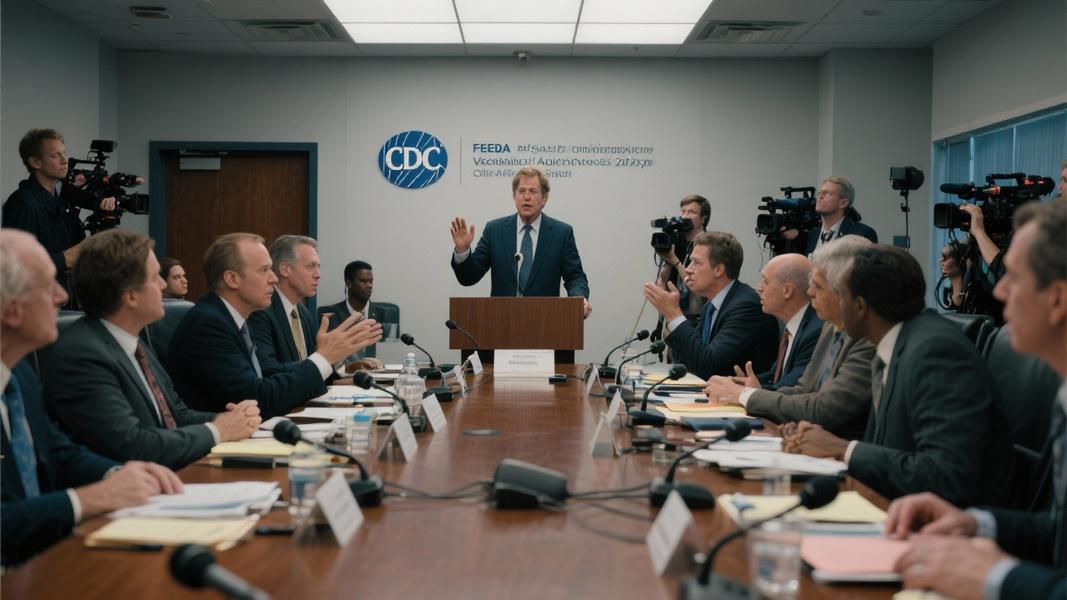
The Biden administration’s vaccine advisory committee threw the brakes on a controversial proposal Wednesday that would have ended the decades-old practice of giving all newborns a hepatitis B vaccine at birth, postponing their vote amid confusion and mounting criticism from medical groups.
The Advisory Committee on Immunization Practices (ACIP), meeting in Atlanta, delayed its decision until Friday after committee members expressed confusion about the voting language — and some voiced deep concerns about abandoning a public health strategy that has dramatically reduced hepatitis B infections in children since it was implemented in 1991.
Kennedy’s Controversial Overhaul
The heated debate marks the latest flashpoint in what many health experts see as a troubling shift in federal vaccine policy under Health and Human Services Secretary Robert F. Kennedy Jr. The longtime anti-vaccine activist fired all 17 members of the previous advisory panel earlier this year, replacing them with individuals who share many of his skeptical views on immunization.
At stake is whether to continue recommending hepatitis B vaccination for all newborns within 24 hours of birth, as has been standard practice for over 30 years, or to limit the birth dose only to babies whose mothers test positive for the virus — effectively returning to a strategy abandoned in the early 1990s.
The universal birth dose recommendation, adopted in 1991, has been a remarkable public health success story. Cases among children have plummeted from about 18,000 annually to roughly 2,200, according to data presented at the meeting.
Potential Consequences
What happens if the committee rolls back this longstanding recommendation? A recent modeling study paints a sobering picture.
Researchers estimate that delaying hepatitis B vaccination by just two months could result in more than 1,400 babies becoming chronically infected with the virus in the first year alone. Over time, these infections could lead to 304 cases of liver cancer and 482 hepatitis B-related deaths among those children, the study found.
The current guidance advises giving the first dose within 24 hours of birth to all medically stable infants weighing at least 4.4 pounds, followed by additional shots at approximately 1 month and 6 months. The committee is weighing language that would recommend starting the vaccination series at 2 months of age if parents refuse the birth dose — a significant departure from decades of practice.
Divided Committee
Committee members appeared deeply divided on the scientific evidence. Some argued that past safety studies of the birth dose were limited in scope, suggesting that larger studies might uncover previously undetected problems. Others, like Dr. Joseph Hibbeln and Dr. Cody Meissner, countered that there’s no documented evidence of harm from the birth doses, characterizing concerns as largely speculative.
“The ACIP is totally discredited. They are not protecting children,” U.S. Sen. Bill Cassidy, a Louisiana Republican and physician, posted on social media Thursday as criticism of the committee mounted.
Medical groups have been increasingly vocal in their criticism of the committee’s recent decisions. During the meeting, Dr. Jason M. Goldman, president of the American College of Physicians, described the proceedings as “political theater,” adding that “you are basing this on concerns of individuals who don’t want the vaccine.”
Shifting Scientific Standards
The November meeting represented a stark departure from previous ACIP gatherings. Notably absent were the scientific presentations from CDC experts that have traditionally formed the backbone of committee deliberations.
Instead, the agenda featured speakers affiliated with anti-vaccine advocacy groups, including Cynthia Nevison and Mark Blaxill, both of whom have had publications retracted and various conflicts of interest noted.
This format shift aligns with other controversial recommendations the committee has made in recent months, including removing thimerosal from flu vaccines and declining to recommend COVID-19 vaccines — decisions many public health experts have characterized as driven by unfounded concerns rather than scientific evidence.
As Friday’s vote approaches, the medical community watches with growing alarm. At stake isn’t just a single vaccine recommendation, but what many see as the credibility of America’s vaccine advisory process itself — and potentially, the health of thousands of newborns who may be left vulnerable to a preventable disease that can lead to liver failure and cancer.
