
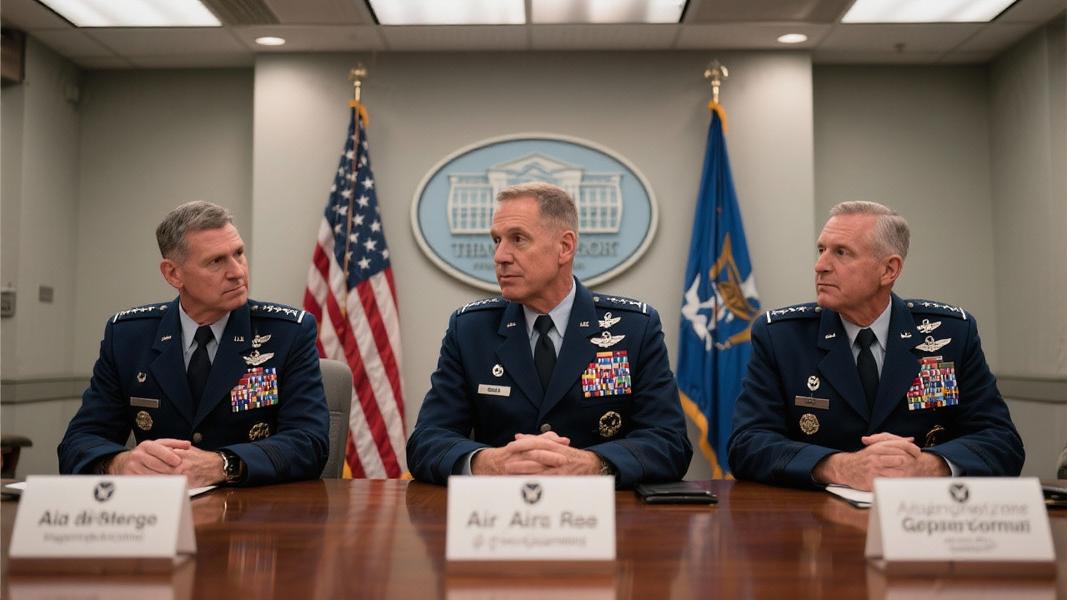
Defense Secretary Pete Hegseth announced Friday that President Biden has nominated three Air Force major generals for promotion to the rank of lieutenant general, signaling key leadership changes in strategic military commands.
The nominations come at a time when the Pentagon is reshaping its leadership structure to address evolving global security challenges, particularly in the Arctic region and nuclear deterrence operations.
Strategic Promotions Across Critical Commands
Maj. Gen. Kenyon K. Bell, currently serving as director of Logistics at Air Force Headquarters, has been tapped for promotion to lieutenant general and assignment as deputy chief of staff for Logistics, Engineering and Force Protection at the Pentagon. This represents an expansion of Bell’s current responsibilities, positioning him to oversee critical supply chain and engineering operations across the Air Force.
In Alaska, leadership changes are also on the horizon. Maj. Gen. Robert D. Davis has been nominated to take command of multiple strategic positions: Alaskan Command under U.S. Northern Command, Eleventh Air Force under Pacific Air Forces, and the Alaskan North American Aerospace Defense Region at Joint Base Elmendorf-Richardson. Davis currently serves as director of Operations at U.S. Northern Command in Colorado.
Why Alaska? The Arctic region has become increasingly important in U.S. defense strategy as Russia expands its military presence there and climate change opens new shipping lanes.
The third nomination went to Maj. Gen. Brandon D. Parker, selected for promotion to lieutenant general with assignment as deputy chief of staff for Strategic Deterrence and Nuclear Integration at Air Force Headquarters. Parker currently directs Global Operations at U.S. Strategic Command at Offutt Air Force Base in Nebraska.
Strengthening Nuclear Deterrence and Arctic Defense
These nominations reflect the Pentagon’s continued focus on bolstering America’s nuclear deterrence capabilities and Arctic presence. Parker’s promotion, in particular, comes as the U.S. is modernizing its nuclear arsenal amid growing tensions with Russia and China’s rapid nuclear expansion.
“The president has made the following nominations,” Secretary Hegseth stated in the announcement, underscoring the White House’s direct involvement in these high-level military appointments.
The Senate must still confirm these nominations before the officers can assume their new ranks and positions. Typically, such high-level military promotions receive bipartisan support, though the confirmation timeline remains uncertain.
For Davis, the Alaskan assignment represents one of the military’s most complex command structures, requiring coordination across multiple chains of command and defense domains spanning air, land, and sea operations in a strategically vital region.
As these generals prepare to step into expanded roles, they’ll face a military landscape increasingly defined by great power competition and technological transformation — all while the Pentagon continues its decades-long effort to improve logistical efficiency and operational readiness in an era of budget constraints.
