
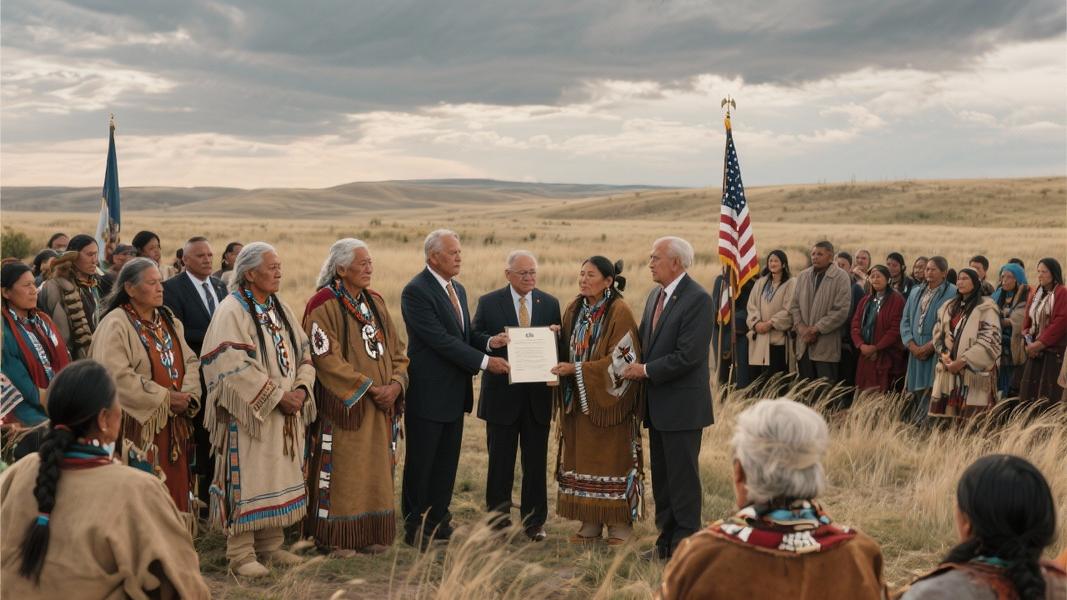
After more than a century, the site of one of America’s darkest chapters will finally receive formal recognition and protection. President Biden signed H.R. 165, the “Wounded Knee Massacre Memorial and Sacred Site Act,” into law on Friday, December 19, 2025, marking a significant milestone for Native American communities seeking acknowledgment of historical injustices.
The legislation directs the Secretary of the Interior to place approximately 40 acres of land in Oglala Lakota County, South Dakota, into restricted fee status for the Oglala Sioux Tribe and the Cheyenne River Sioux Tribe. This designation, as outlined in the bill, prevents the land from being sold, transferred or encumbered without federal approval — essentially ensuring permanent tribal stewardship.
Why does this matter? The Wounded Knee site represents hallowed ground where U.S. Army soldiers killed hundreds of Lakota men, women, and children on December 29, 1890. For generations, tribal leaders have sought proper recognition and protection for what they consider sacred space.
“On Friday, December 19, 2025, the President signed into law: H.R. 165, the ‘Wounded Knee Massacre Memorial and Sacred Site Act,’ which directs the Secretary of the Interior to take actions necessary to place certain land in South Dakota into restricted fee status for the Oglala and Cheyenne River Sioux Tribes,” the White House confirmed in a statement.
Rare Bipartisan Support
In today’s polarized political climate, the bill’s journey through Congress stands out. The House of Representatives passed H.R. 165 by an extraordinary 416-0 vote on January 22, 2025, and the Senate Committee on Indian Affairs subsequently reported the bill favorably without amendment on March 5, 2025.
Such unanimous support reflects the broad recognition of the historical significance of the site and the importance of preserving it for future generations. The enacted legislation specifically requires that the land be “held and maintained as a memorial and sacred site,” referencing a covenant between the two tribes dated October 21, 2022.
Commercial development and gaming activities will be explicitly prohibited on the site, ensuring its character as a place of remembrance and reflection remains intact. This provision addresses concerns that sacred sites might otherwise be vulnerable to development pressures.
A Long-Awaited Recognition
The legislation represents more than just a land transfer. For many Native Americans, particularly descendants of Wounded Knee survivors, the act acknowledges a painful history that has often been minimized in mainstream American narratives.
Under the restricted fee status, the tribes gain a significant measure of control while federal protections remain in place. The designation differs from standard trust land in that the tribes technically own the land but with limitations on how it can be used or transferred.
The law comes after decades of advocacy by tribal leaders and their allies. With the President’s signature, the Interior Department must now complete all necessary actions to formalize the restricted fee status, though the timeline for this process wasn’t specified in the White House announcement.
For the Oglala and Cheyenne River Sioux Tribes, the memorial represents not just a recognition of past trauma, but a step toward healing — and perhaps most importantly, a guarantee that this sacred ground will remain protected for generations to come.
