
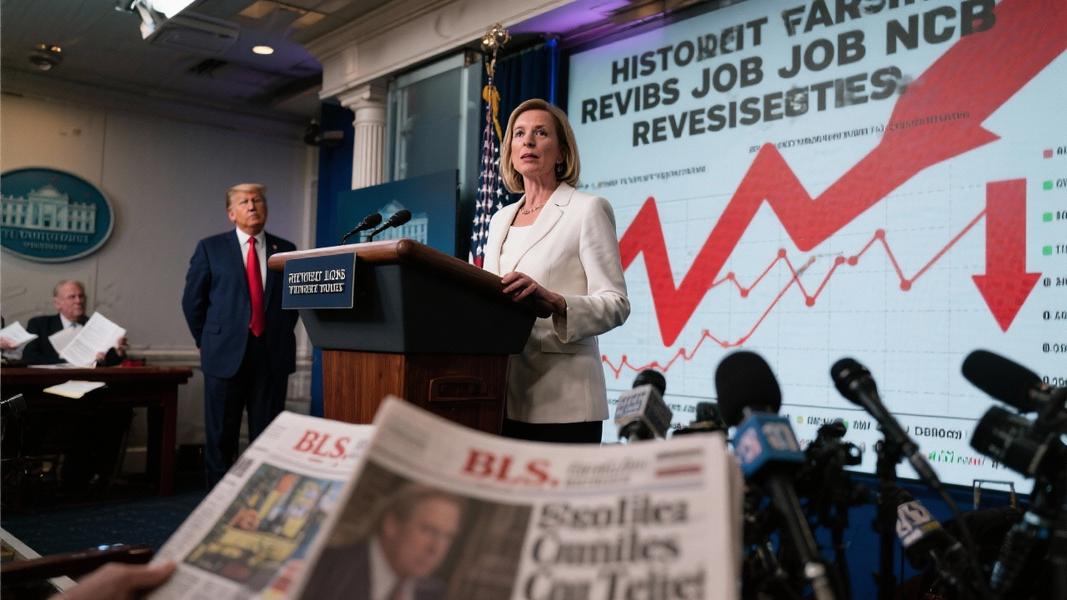
The Bureau of Labor Statistics has issued what officials are calling the largest downward revision on record to U.S. employment figures, slashing previous job estimates by a staggering 911,000 positions and igniting an immediate political firestorm from the Trump White House.
The preliminary benchmark revision, released Monday, reduces employment estimates for the period from April 2024 to March 2025 by approximately 0.6%, essentially cutting in half the job growth previously reported during that timeframe. What was once tallied as robust monthly job creation of 146,500 positions has now dwindled to just 70,600 jobs per month, according to the revised figures.
“The preliminary estimate of the Current Employment Statistics (CES) national benchmark revision to total nonfarm employment for March 2025 is -911,000 (-0.6 percent),” the BLS stated in its official announcement.
White House Pounces on Revision
President Trump’s administration wasted no time seizing on the numbers. White House Press Secretary Karoline Leavitt declared the revision “proves that President Trump was right: Biden’s economy was a disaster and the BLS is broken.”
The statement went further, calling for new leadership at the statistical agency and demanding immediate action from the Federal Reserve. “Much like the BLS has failed the American people, so has Jerome ‘Too Late’ Powell — who has officially run out of excuses and must cut the rates now,” Leavitt said.
Behind the dramatic revision lies a routine but crucial process. These annual adjustments incorporate more comprehensive data from state unemployment insurance tax records and business birth and death records to correct the monthly survey-based employment estimates that markets, policymakers, and the public rely on throughout the year.
Economic experts note that such revisions are part of the BLS’s transparent methodology rather than evidence of manipulation or mistakes. Still, the magnitude of this particular adjustment has raised eyebrows across the political spectrum.
A Political Lightning Rod
Just how significant is this revision? According to the White House, the new figures suggest job growth during the previous administration was overstated by approximately 1.5 million workers — a claim that adds fuel to President Trump’s longstanding criticism of economic data during the Biden years.
The administration attributes the overstated job numbers to several factors, including illegal immigration, poor data collection methods, government handouts, and excessive federal spending under the previous administration.
President Trump is reportedly pushing for the confirmation of his nominee E.J. Antoni as BLS commissioner to address what the White House characterizes as years of inaccuracies and to restore public confidence in the agency’s employment data.
Fed Policy Under Fire
The job revision has also intensified the administration’s pressure on the Federal Reserve. “President Trump is right about the Federal Reserve being TOO LATE,” the White House insisted, arguing that current monetary policy remains overly restrictive with interest rates too high for an economy that was apparently weaker than previously understood.
Could this dramatic revision force the Fed’s hand? Many market watchers now expect the central bank to accelerate its rate-cutting cycle, though the Fed has historically maintained its independence from political pressure.
The administration says President Trump remains focused on revitalizing the economy through pro-growth policies, including tax cuts and job creation measures aimed at what it describes as ushering in a “Golden Age of America.”
For everyday Americans trying to make sense of these statistical adjustments, the bottom line may be straightforward: the job market over the past year was substantially weaker than we were led to believe. What remains to be seen is whether the current administration’s economic approach can genuinely strengthen those numbers — or if we’re simply in for more statistical debates in the months ahead.
