
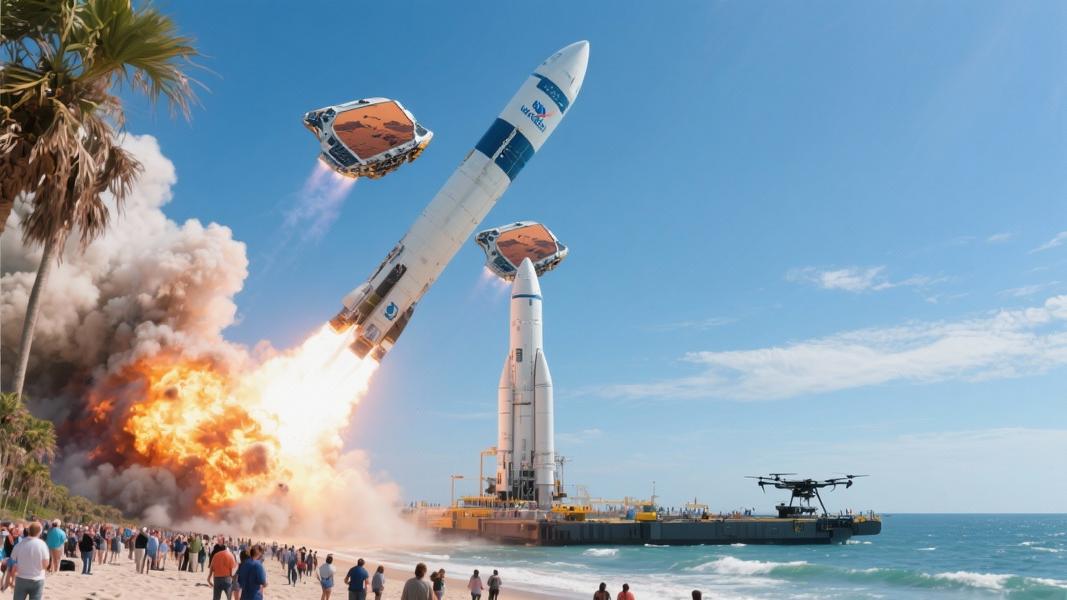
Blue Origin just took a giant leap in the private space race. Jeff Bezos’ aerospace company successfully launched its massive New Glenn rocket on Thursday, delivering two NASA spacecraft toward Mars while sticking a dramatic landing of its first-stage booster.
The 321-foot rocket thundered off the pad at Cape Canaveral Space Force Station on November 13, 2025, marking only the second flight of Blue Origin’s largest vehicle and a crucial milestone for both the company and NASA’s interplanetary ambitions. “Blue Origin launched its huge New Glenn rocket Thursday with a pair of NASA spacecraft destined for Mars,” confirmed space industry observers.
A Perfect Landing, 375 Miles Offshore
What had mission controllers holding their breath? The recovery attempt. In a scene reminiscent of SpaceX’s now-routine booster landings, Blue Origin employees erupted in celebration as the New Glenn’s first stage touched down upright on a barge 375 miles off the Florida coast. This maritime landing, occurring minutes after separation from the upper stage, represents a critical step in Blue Origin’s push to develop fully reusable rockets that can dramatically reduce launch costs.
“It was only the second flight of the rocket that Jeff Bezos’ company and NASA are counting on to get people and supplies to the moon — and it was a complete success,” noted industry experts familiar with the mission.
Company employees “cheered wildly as the booster landed upright” offshore, observers reported. The recovery marks a significant achievement in Blue Origin’s competition with SpaceX, which pioneered the technique of landing and reusing orbital-class boosters.
ESCAPADE: Twin Spacecraft Begin Mars Journey
Meanwhile, high above Earth, the mission’s primary objective was unfolding without a hitch. “Twenty minutes later, the rocket’s upper stage deployed the two Mars orbiters in space,” sources confirmed. These twin spacecraft, collectively named ESCAPADE (Escape and Plasma Acceleration and Dynamics Explorers), now begin a complex trajectory to the Red Planet.
Rather than heading straight for Mars, the spacecraft will spend about a year in Earth’s vicinity, positioned roughly a million miles away. “The identical Mars orbiters, named Escapade, will spend a year hanging out near Earth, stationing themselves 1 million miles away,” reports indicate. This strategic positioning will allow them to use Earth’s gravity next fall to slingshot toward Mars, with arrival expected in 2027.
“We really, really want to understand the interaction of the solar wind with Mars better than we do now,” said Rob Lillis of the University of California, Berkeley, ESCAPADE’s lead scientist, ahead of the launch. “Escapade is going to bring an unprecedented stereo viewpoint because we’re going to have two spacecraft at the same time,” he explained.
Why send two spacecraft instead of one? The dual-orbiter approach will allow scientists to simultaneously observe Mars’ upper atmosphere and scattered magnetic fields from different vantage points, creating a more comprehensive picture of how the planet interacts with solar wind. These insights could help explain Mars’ transformation from a potentially habitable world to the cold, dry planet we see today — crucial knowledge for planning future human missions.
Bargain Science with Big Ambitions
Perhaps most surprising about the ESCAPADE mission is its relatively modest price tag. Coming in at under $80 million, it’s a bargain in the world of planetary exploration, where missions typically cost hundreds of millions or even billions of dollars.
The University of California, Berkeley, manages and operates the mission, with NASA having “saved money by signing up for one of New Glenn’s early flights,” industry watchers point out. This partnership reflects a growing trend of space agencies leveraging commercial launch capabilities to stretch science budgets further.
Blue Origin’s Growing Ambitions
Named after John Glenn, the first American to orbit Earth, New Glenn represents a significant scaling-up of Blue Origin’s capabilities. The rocket stands “five times bigger than the New Shepard rockets sending wealthy clients to the edge of space from West Texas,” sources compare.
Blue Origin isn’t stopping with Mars missions. The company “plans to launch a prototype Blue Moon lunar lander on a demo mission in the coming months aboard New Glenn,” reports indicate, part of its broader lunar ambitions.
These lunar aspirations recently gained new momentum. While Elon Musk’s SpaceX originally secured contracts for NASA’s first two crewed Artemis program moon landings, Blue Origin holds the contract for the third. But a surprising development has reopened the competition: “Last month NASA Acting Administrator Sean Duffy reopened the contract for the first crewed moon landing, citing concern over the pace of Starship’s progress in flight tests from Texas,” insiders reveal.
Both Blue Origin and SpaceX have since presented accelerated landing plans, setting up a renewed race to be the first company to return humans to the lunar surface after more than five decades.
Today’s successful launch and recovery suggests Bezos’ space company is hitting its stride at a critical moment. Created in 2000 with the billionaire’s Amazon fortune, Blue Origin has often moved more methodically than its competitors. But with New Glenn now proving its capabilities and the potential to win an earlier moon landing slot, the tortoise in this space race might be picking up unexpected speed.
