
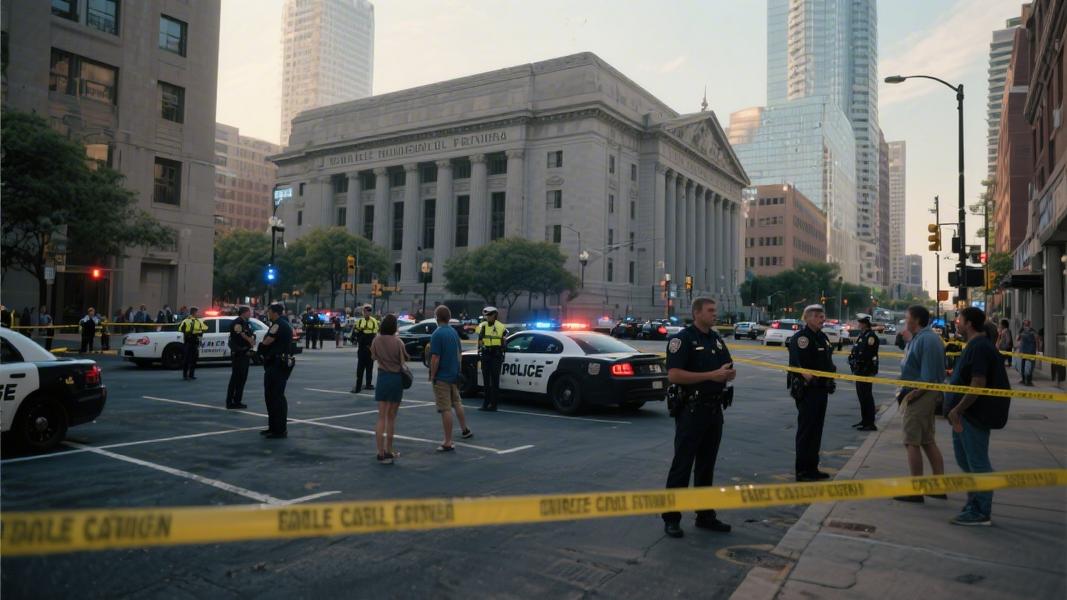
A bomb threat near one of downtown Dallas’s most prominent federal buildings sent law enforcement scrambling Friday morning — and for a building with a long, complicated history of security concerns, it’s a headline that hits a little too familiar.
Dallas police responded to the threat near the Earle Cabell Federal Building at approximately 9:45 a.m., concentrating their investigation on the parking lot outside the structure at the corner of S. Griffin and Jackson streets in the heart of downtown. The building, which sits at the center of the city’s federal infrastructure, was immediately surrounded by law enforcement activity as officers worked to assess the credibility of the threat.
A Building That’s Been Here Before
The Earle Cabell Federal Building isn’t just any government office complex. It houses roughly 4,000 federal employees and carries the distinction — not exactly a flattering one — of being the largest so-called “level four” federal building in the country that operates without lobby screening equipped with X-rays and metal detectors. That detail surfaced in a damning profile decades ago, when an anonymous source warned, “I could easily bring a weapon into this building and gain access to virtually any target. It’s shocking. The lack of security is absolutely ridiculous.” That was 1995. The building is still standing. The questions haven’t entirely gone away.
Friday’s threat isn’t the first time the area has been locked down under serious circumstances. In June 2019, a 22-year-old former U.S. Army soldier named Brian Isaack Clyde opened fire outside the very same building before being shot and killed by federal officers. He was carrying more than 150 rounds of ammunition. The scene that followed was chaotic — an active shooter alert, panicked evacuations, and a bomb squad rolling in to examine and ultimately detonate his vehicle as a precaution.
At the time, FBI Special Agent in Charge Matthew DeSarno tried to keep the public calm. “At this time we have no information indicating that there are other shooters, other threats to the community,” he told reporters. “We are working on one vehicle, we will have that cleared shortly.” But even then, a secondary message about a potential bomb threat had already prompted nearby residents to evacuate the surrounding blocks.
Not Just a Dallas Problem
Bomb threats at government buildings have been spiking across the country. Just days earlier, on February 6, 2026, the Dallas County Courthouse in Iowa — a different Dallas County entirely, but notable for the timing — received a threat of its own at 4:48 a.m. The Dallas County Sheriff’s Office there conducted a thorough search, found nothing suspicious, and had the building reopened by 8:50 a.m. A clean sweep, relatively speaking. Still, it’s the kind of incident that reminds officials — and the public — that these calls can’t be brushed off lightly, even when they turn out to be false alarms.
How seriously should people take threats like these? Seriously enough. Law enforcement agencies don’t have the luxury of assuming the worst won’t happen, particularly at a building that has already been the site of an armed attack. Every call requires the same exhaustive response, the same disruption to thousands of workers, the same calculation of risk versus reassurance.
What Comes Next
As of Friday morning, Dallas police had not announced any arrests or confirmed whether the threat was deemed credible. The investigation remained active and ongoing, with the perimeter around the parking lot at S. Griffin and Jackson still the focal point of law enforcement activity. Federal agencies have not yet issued a separate public statement.
For the roughly 4,000 people who go to work inside the Earle Cabell Federal Building every day, Friday was a reminder that their workplace sits at the intersection of public service and public vulnerability. That’s not a comfortable place to be. And given the building’s decades-long security debate, some of them have known that longer than they’d like.
The parking lot gets cleared. The workers go back inside. And the conversation about what it actually takes to protect a building like this — one that’s been having the same argument since 1995 — quietly continues.
