
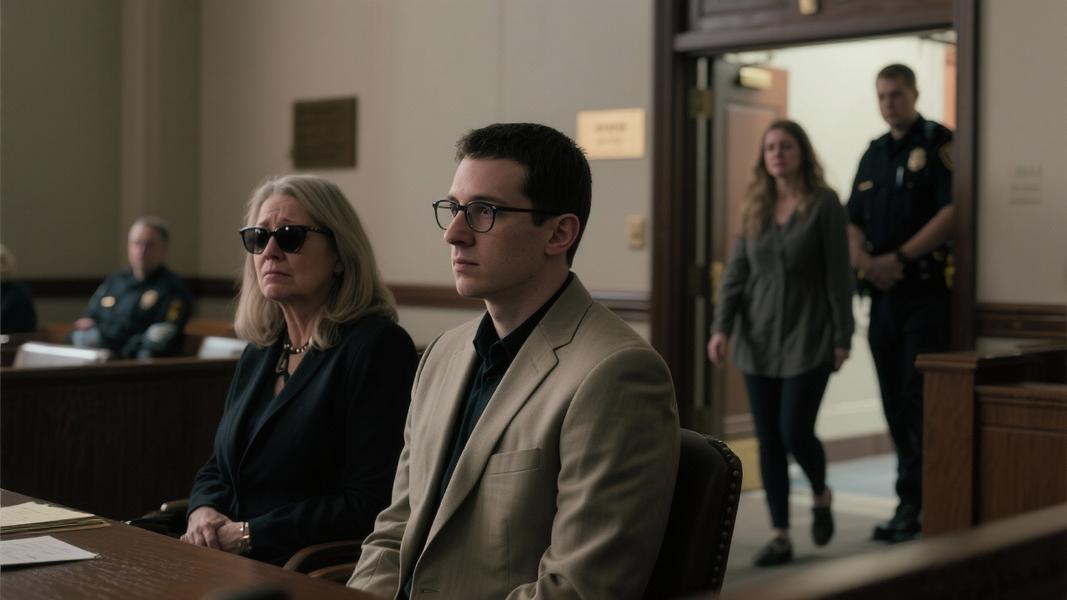
Bryan Kohberger, the man accused of killing four University of Idaho students in a brutal 2022 attack, stared blankly at the ceiling while rocking back and forth during his arraignment Monday — behavior his sister later described as typical of his lifelong struggle with mental health issues.
The 29-year-old former criminology Ph.D. student declined to enter a plea in the quadruple murder case, prompting Judge John Judge of Idaho’s Latah County to enter a not guilty plea on his behalf. Kohberger faces four counts of first-degree murder and one count of burglary in the November 13, 2022, stabbing deaths that shocked the small college town of Moscow, Idaho, and captivated the nation.
A Sister’s Revelations
In a surprising development, Kohberger’s older sister Melissa “Mel” Kohberger has revealed that her brother had battled severe mental health challenges since childhood, including what she described as symptoms of psychosis that went largely untreated.
“Bryan would see things that weren’t there. He would hear voices that weren’t speaking,” Mel told investigators in statements only now becoming public. “The symptoms were obvious to everyone in our family, but my parents didn’t know how to help him, and honestly, I think they were afraid of the stigma.”
The revelations come as prosecutors build their case against Kohberger, whom they allege meticulously planned the murders of Madison Mogen, 21; Kaylee Goncalves, 21; Xana Kernodle, 20; and Ethan Chapin, 20, at an off-campus rental home.
Could these new details about Kohberger’s mental state impact the prosecution’s strategy? Legal experts suggest it might pave the way for an insanity defense, though Idaho has one of the strictest standards for such claims in the country.
Mounting Evidence
Despite the defense’s potential mental health angle, prosecutors have assembled what they call overwhelming evidence against Kohberger. This includes DNA found on a knife sheath at the crime scene, cell phone data placing him near the victims’ residence at least a dozen times before the murders, and surveillance footage of a white Hyundai Elantra matching Kohberger’s vehicle circling the neighborhood in the early morning hours of the killings.
“The evidence we’ve gathered points to a calculated, deliberate act,” said prosecutor Bill Thompson during a press briefing. “This wasn’t random. This wasn’t impulsive.”
Mel Kohberger’s account paints a different picture of her brother — one of a deeply troubled young man whose condition deteriorated over time. “There were periods when he seemed fine, almost normal,” she explained. “Then suddenly, he’d become paranoid, thinking people were following him or plotting against him. It got worse when he went to college.”
A Troubled Past
According to Mel, Bryan’s childhood in eastern Pennsylvania was marked by social isolation and increasingly concerning behavior. By his teenage years, he had developed severe obsessive-compulsive tendencies and would sometimes go days without eating, losing dramatic amounts of weight.
Former classmates have corroborated parts of this account, describing Kohberger as an outsider who was bullied in high school. “He was the kid everyone picked on,” said one former classmate who requested anonymity. “But there was also something off about him that made people uncomfortable.”
That said, Kohberger’s academic trajectory showed no obvious red flags. He earned an associate degree in psychology, followed by a bachelor’s in criminology from DeSales University, and was pursuing a Ph.D. in criminology at Washington State University — just miles from where the murders took place.
His professor at WSU, who spoke on condition of anonymity, described Kohberger as “brilliant but intense” and noted his particular interest in criminal psychology and behavioral analysis. “He was especially focused on understanding the mindset of criminals. In retrospect, it’s chilling.”
The Investigation Continues
Despite the emerging narrative about Kohberger’s mental health, investigators remain focused on what they see as methodical planning behind the murders. Cell phone records indicate Kohberger turned his phone off during the estimated time of the killings — what prosecutors call a deliberate attempt to avoid detection.
“He knew enough about police work to take precautions,” said a law enforcement source close to the investigation who was not authorized to speak publicly. “That doesn’t align with someone completely detached from reality.”
Still, Mel Kohberger insists her brother’s mental state deteriorated dramatically in the months before the murders. “The last time I saw him, about three months before… everything happened, he was talking about government surveillance and how ‘they’ were monitoring him through his computer. He wasn’t sleeping. He looked terrible.”
The families of the victims have largely refrained from commenting on these new revelations. Kaylee Goncalves’ father Steve issued only a brief statement: “Nothing can bring our children back. We trust the justice system to handle this case appropriately.”
As Bryan Kohberger awaits trial, scheduled to begin next spring, the question of his mental state will likely become central to both the prosecution and defense strategies. His sister’s account offers a glimpse into a troubled life that, for reasons still unclear, allegedly culminated in one of the most shocking murder cases in recent memory.
Whether it’s enough to sway a jury remains to be seen. In Idaho, defendants pleading insanity must prove they were unable to understand the wrongfulness of their actions — a standard few have met successfully in the state’s history.
