
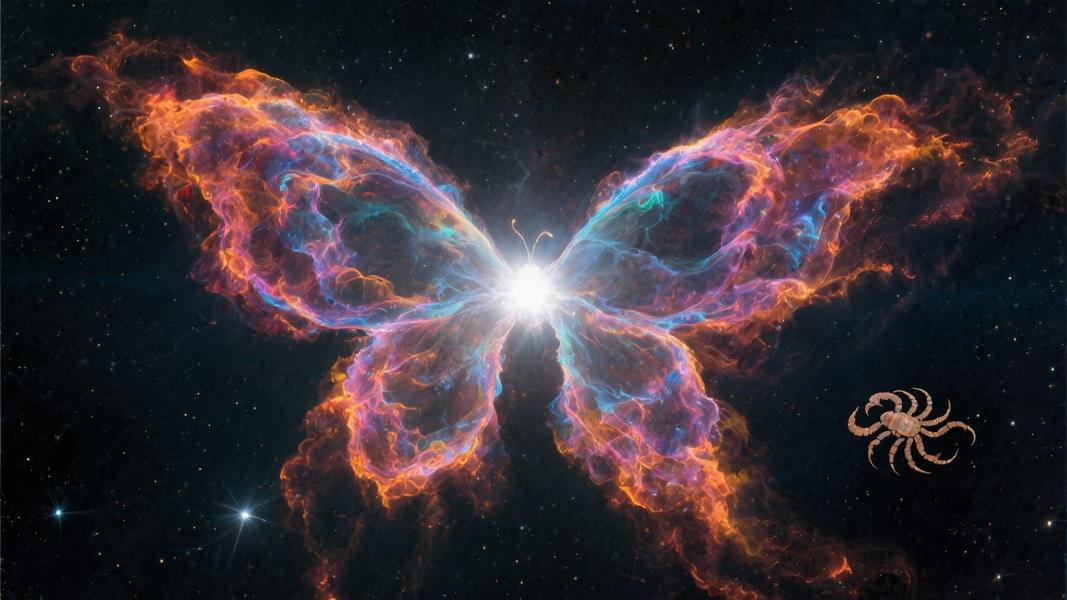
Deep in the constellation Scorpius, a spectacular celestial butterfly spreads its wings across two light-years of space, showcasing one of the universe’s most dramatic end-of-life transformations. The Butterfly Nebula, officially designated NGC 6302, represents the spectacular death throes of a star that once blazed with the energy of 5-6 suns.
A Stellar Death Dance
This dazzling cosmic structure, located between 2,500 and 3,800 light-years from Earth, features superheated gas “wings” that are tearing through space at more than 600,000 miles per hour, according to NASA imagery captured by the Hubble Space Telescope. These gaseous wings aren’t just moving fast — they’re burning hot, with temperatures exceeding 36,000 degrees Fahrenheit.
“The butterfly shape stretches for more than two light-years, which is about half the distance from the Sun to the nearest star, Proxima Centauri,” the European Space Agency noted in its documentation of this remarkable structure.
What’s driving this celestial spectacle? At the nebula’s heart lies one of the hottest stars ever discovered — a white dwarf with a surface temperature over 250,000 degrees Celsius. “The spectrum of Butterfly Nebula shows that its central star is one of the hottest stars known,” according to astronomical records, “implying that the star from which it formed must have been very large.”
The Hourglass in the Sky
The nebula’s distinctive butterfly shape isn’t random. It’s the result of a complex interaction between the dying star and the material it’s shedding. “The star has a current mass of around 0.64 solar masses. It is surrounded by a dense equatorial disc composed of gas and dust. This dense disc is postulated to have caused the star’s outflows to form a bipolar structure similar to an hourglass,” explains research on the formation.
This cosmic butterfly isn’t static. The nebula contains a prominent northwest lobe extending up to 3.0 arcminutes from the central star, formed roughly 1,900 years ago. At its edges, the gas reaches extraordinary speeds. “At the extreme periphery of the lobe, the outward velocity exceeds 600 km/s,” scientists have measured.
Also known as the Bug Nebula, this celestial wonder has a catalogued size of 1.4×0.4 arcminutes for its brighter parts, though fainter regions extend much further, reaching up to 4.8×1.4 arcminutes according to astronomical catalogs.
A Fading Light
The central star’s story is one of dramatic transformation. Once a massive stellar body 5-6 times the mass of our sun, it has now shed most of its material, leaving behind a white dwarf of about 0.64 solar masses. Perhaps most striking, this stellar remnant is cooling and fading at a rate of about 1% per year, as documented by astronomers tracking its evolution.
Want to see this celestial spectacle yourself? Good luck. While technically visible from locations like Las Vegas, the nebula sits low on the horizon, making imaging challenging due to atmospheric disturbance, as astrophotographers have reported. For precise spotting, look to coordinates RA 17h 13m 44s, Dec -37d 06m 12s, where this celestial butterfly hovers against the backdrop of the Scorpius constellation.
Recent observations using the James Webb Space Telescope have unveiled new details about the central star and the flowing strands of gas, according to ongoing research projects working with NASA. These observations promise to deepen our understanding of this spectacular example of stellar transformation.
In the vastness of space, the Butterfly Nebula offers a stunning reminder: even in death, stars create some of the most beautiful structures in our universe, their final acts of stellar evolution painting the cosmos with wings of fire.
