
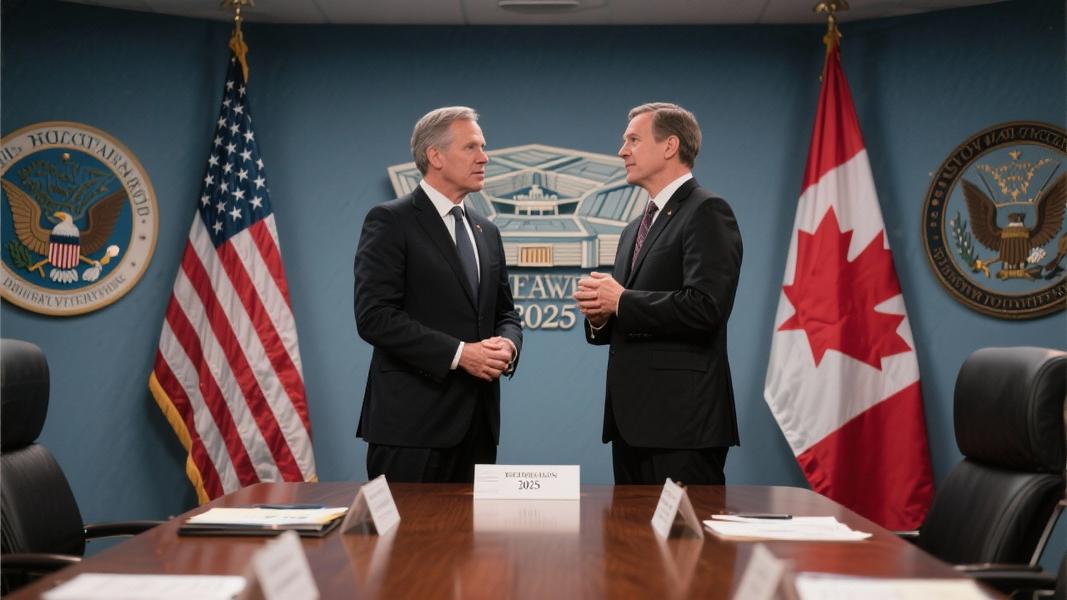
U.S. and Canada forge stronger defense ties as Ottawa pledges historic military spending increase to 5% of GDP by 2035, officials announced during high-level Pentagon talks Monday.
Secretary of War Pete Hegseth hosted Canada’s National Defense Minister David McGuinty at the Pentagon on September 22, 2025, where the two defense chiefs reaffirmed their commitment to North American security amid evolving global threats. The meeting highlighted the unique nature of U.S.-Canadian defense cooperation, particularly through NORAD, the only binational military command of its kind.
Canada Makes “Incredible” Defense Commitment
Perhaps the most significant outcome from the talks was confirmation of Canada’s ambitious defense spending trajectory. “The threats to North America require a strong U.S.-Canada defense relationship — there’s no doubt,” Hegseth said during the bilateral discussion. “And I know Canada has committed at the [NATO] summit to increasing defense spending to 5% of [gross domestic product] by 2035, which is incredible to see. A very strong step,” he added.
The commitment represents a dramatic shift in Canadian defense policy. For decades, Canada has faced criticism from U.S. officials and NATO allies for maintaining military spending well below the alliance’s 2% GDP target. This new 5% benchmark would place Canada among NATO’s top military spenders — a transformative change for a nation that has historically relied heavily on U.S. security guarantees.
Why such a dramatic increase now? Growing concerns about Arctic sovereignty, Russian military activity near North American airspace, and pressure from the U.S. appear to be driving factors. Secretary Hegseth has repeatedly urged Canada to restore its military capacity in line with shared defense interests.
$9.3 Billion in New Defense Investments
Canadian Prime Minister Mark Carney has already begun backing these commitments with concrete funding. His administration recently announced $9.3 billion in additional defense investments focused on strengthening Arctic sovereignty and NORAD modernization.
“Canada’s where our sovereignty, our national security and our partnership with the U.S. comes together strongest,” Carney stated when announcing the funding package. “So, from NORAD modernization to Arctic surveillance and infrastructure, we’re taking major and fast, bold, decisive action to shore up our collective defense.”
The bilateral discussions at the Pentagon emphasized the historical depth of U.S.-Canadian military cooperation. “Our great nations have served together in many wars,” Hegseth observed during the meeting. “And today our warfighters continue that, serving together through joint exercises, defending the homeland and really the only binational command of its kind, which is NORAD.”
That shared history now faces new tests. The North American Aerospace Defense Command (NORAD) was established during the Cold War primarily to detect Soviet bomber threats. Today, it must contend with advanced hypersonic weapons, unmanned systems, and increasing military activity in the warming Arctic region.
Looking North: The Arctic Challenge
Defense analysts note that the Arctic has become a particular focus of U.S.-Canadian security cooperation. Climate change has opened new shipping lanes and resource opportunities in the region, attracting increased attention from Russia and China.
While neither Hegseth nor McGuinty explicitly mentioned these nations during their public remarks, the subtext was clear: North America’s northern approaches require significantly more investment and attention than they’ve received in the past.
As the ice recedes and Arctic waters become more navigable, both nations appear to recognize the need for enhanced surveillance and rapid response capabilities across the vast northern frontier they share.
For Canada, which has the world’s longest coastline, the commitment to 5% GDP defense spending signals a radical departure from decades of modest military budgets. Whether future governments will maintain this trajectory remains an open question, but the current administration’s rhetoric suggests a fundamental shift in Ottawa’s approach to national security.
As Secretary Hegseth escorted Minister McGuinty through the Pentagon’s corridors, the symbolism was unmistakable: two neighbors with the world’s longest undefended border now preparing, together, for a more contested future.
