
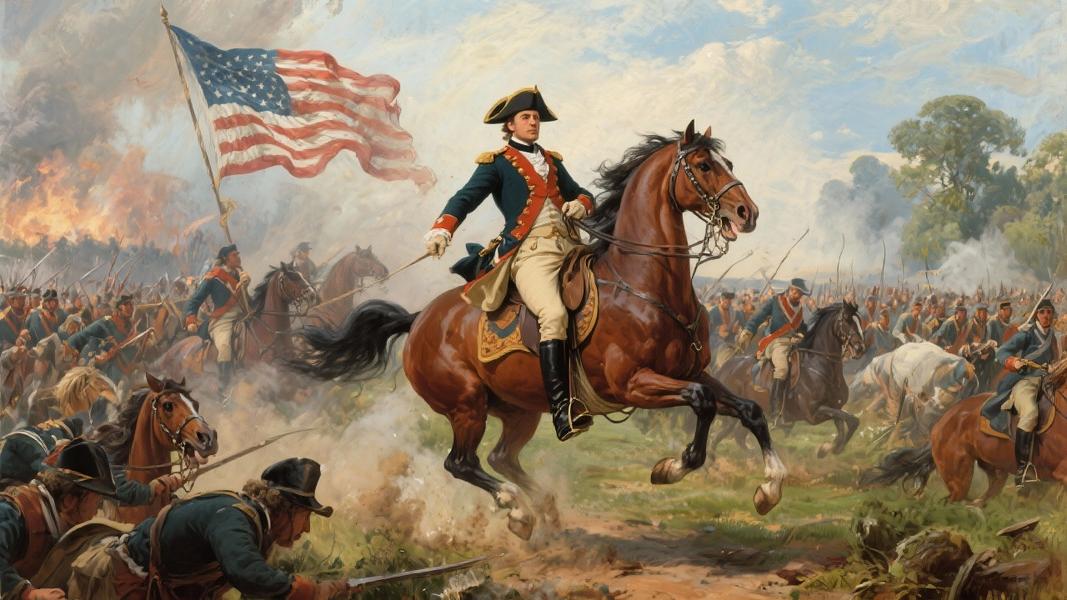
He saved George Washington’s life with 30 horsemen and became known as the “Father of the American Cavalry” — yet many Americans may not recognize the name Casimir Pulaski, the Polish nobleman whose battlefield heroics changed the course of the American Revolution.
Born in Warsaw in 1745, Pulaski arrived in America during the summer of 1777, eager to join the colonists’ fight against Britain after meeting with American envoys Benjamin Franklin and Silas Deane in Paris. Franklin had already praised Pulaski to George Washington as “an Officer famous throughout all of Europe for his Bravery and Conduct in Defense of the Liberties of his Country.”
From Polish Freedom Fighter to American Revolutionary
What drove a Polish nobleman to cross an ocean and fight in another country’s war? By the time he reached American shores, Pulaski was already a seasoned military commander. At just fifteen years old, he had joined his father and other members of the Polish fighting class in their struggle against Russian domination. His reputation as a freedom fighter was well-established in Europe before he ever set foot on American soil.
After arriving in Boston in July 1777, Pulaski wasted no time with bureaucracy. He rushed to join the Continental Army, meeting General Washington and quickly inserting himself into the fight for American independence. The timing couldn’t have been better — or more desperate — for Washington’s struggling forces.
The defining moment of Pulaski’s American service came just months after his arrival. During the Battle of Brandywine on September 11, 1777, British forces were on the verge of overwhelming the Continental Army. With Washington himself in danger, Pulaski charged into action: “With no time to argue, Washington entrusted Pulaski with his own mounted guard, about thirty in number, and watched as the Polish volunteer led his band directly into the fray, delaying the British long enough for the Continentals to retreat and possibly saving Washington’s life.”
The Cavalry Commander
That battlefield audacity earned Pulaski immediate respect. In the chaos of battle, formal protocols were set aside. “Pulaski begged Washington for command of an unorganized cavalry detachment. In the fury of the moment, Washington assented, and Pulaski whipped 30-odd men and their horses into a diversion against the British,” notes the Smithsonian Magazine.
Congress soon recognized his value, appointing him brigadier general and placing him in charge of four horse brigades. He became distinguished throughout the revolution, most notably for saving Washington’s life. Alongside fellow European volunteer Michael Kovats, Pulaski raised what became known as “Pulaski’s Legion” and set about transforming the American cavalry into a disciplined fighting force modeled after European standards.
How dedicated was Pulaski to the American cause? When Congress couldn’t provide adequate funding, he spent his own money “in order to assure his forces of the finest equipment and personal safety.” This commitment to his men and the revolutionary cause earned him the nickname “The Soldier of Liberty.”
A Hero’s Short but Impactful Life
Pulaski’s American career was brilliant but brief. The Polish patriot died in October 1779, either on the 11th or 15th, aboard a ship between Savannah, Georgia, and Charleston, South Carolina. He was just 34 years old. His death came after being wounded during the Siege of Savannah, cutting short what might have been an even more remarkable American military career.
Today, Pulaski is remembered as a cavalryman of extraordinary skill, whose leadership and personal courage made their mark on the American Revolution. His legacy lives on in numerous monuments, place names, and celebrations across the United States.
In a war where foreign volunteers played crucial roles in America’s fight for independence, Casimir Pulaski stands out as a man who not only offered his military expertise but risked — and ultimately gave — his life for a young nation’s cause, thousands of miles from his homeland.
