
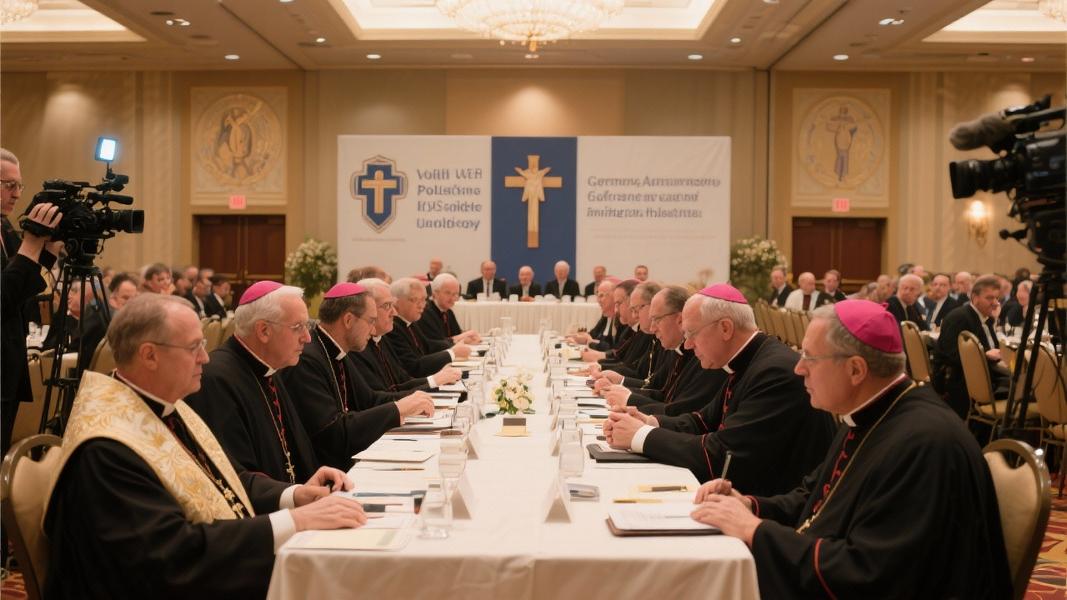
U.S. Catholic bishops have formalized a ban on gender-affirming care for transgender patients at Catholic hospitals, cementing a policy that affects thousands of health care institutions nationwide.
The vote, which took place Wednesday, puts an official stamp on what has been a yearslong process of revising ethical and religious directives that guide Catholic health facilities across the country. The move comes amid a broader national debate over transgender rights and religious freedom that has increasingly drawn Catholic leadership into direct confrontation with the Biden administration’s health policies.
Religious Freedom vs. Anti-Discrimination Policies
The U.S. Conference of Catholic Bishops has strongly objected to a proposed Health and Human Services regulation that would enforce anti-discrimination policies based on sexual orientation and gender identity. Their argument? Such regulations could force Catholic organizations to choose between adhering to religious beliefs or losing federal contracts.
This tension has already played out in the courts. A district judge recently ruled that federal agencies cannot require healthcare providers with religious objections to deliver or cover gender-transition procedures, effectively striking down the Biden administration’s interpretation of Title IX that included gender identity protections.
Meanwhile, some Catholic leaders have embraced the Trump administration’s approach to transgender healthcare. Bishop Robert Barron of Winona-Rochester, Minnesota publicly praised Trump’s executive order prohibiting medical institutions receiving federal funds from providing gender-affirming care to those under 19.
“Catholic health care services must not perform interventions, whether surgical or chemical, that aim to transform the sexual characteristics of a human body into those of the opposite sex, or take part in the development of such procedures,” states the bishops’ doctrinal note from 2023, which provided the foundation for Wednesday’s formal ban.
The Human Impact
What does this mean for transgender Catholics seeking care? The Catholic Health Association has emphasized that Catholic providers will continue to “welcome those who seek medical care from us and identify as transgender” and “treat these individuals with dignity and respect,” as reported by the Associated Press.
But for many transgender Catholics, the ban represents a painful rejection. Michael Sennett, a transgender man active in his Massachusetts parish, argues that gender-affirming care is essential. “Catholic teaching upholds the invaluable dignity of every human life, and for many trans people, gender-affirming care is what makes life livable,” he told reporters.
Francis DeBernardo, executive director of New Ways Ministry, which advocates for LGBTQ+ Catholics, explained that many transgender Catholics view their transitions as spiritually necessary. For them, “the transition process was not just a biological necessity, but a spiritual imperative. That if they were going to be living as authentic people in the way that they believe God made them, then transition becomes a necessary thing,” DeBernardo stated.
Religious Divide
The Catholic position stands in stark contrast to that of several other major religious denominations. Ten progressive religious groups recently issued a joint statement affirming transgender, intersex, and nonbinary people. Leaders from the Unitarian Universalist Association, Episcopal Church, Union for Reform Judaism, and Presbyterian Church (U.S.A.) were among those who declared: “During a time when our country is placing their lives under increasingly serious threat, there is a disgraceful misconception that all people of faith do not affirm the full spectrum of gender – a great many of us do.”
Is this a sign of deeper divisions within American Christianity? Absolutely. As religious institutions grapple with questions of gender identity, the theological responses have varied dramatically, leaving transgender people of faith in vastly different positions depending on their denomination.
Immigration Stance Shows Complexity
Interestingly, the same gathering of bishops that formalized the transgender care ban also overwhelmingly approved a “special message” on immigration — a rare pastoral statement opposing mass deportations. “We are disturbed when we see among our people a climate of fear and anxiety around questions of profiling and immigration enforcement,” the bishops wrote.
This seemingly contradictory stance — restricting healthcare for one vulnerable population while advocating for another — highlights the complex and sometimes inconsistent application of Catholic social teaching in contemporary American politics.
For transgender Catholics caught in the middle, the message is clear but painful: they remain welcome in Catholic hospitals, but the medical care many consider essential to their wellbeing will not be available within those walls.
