
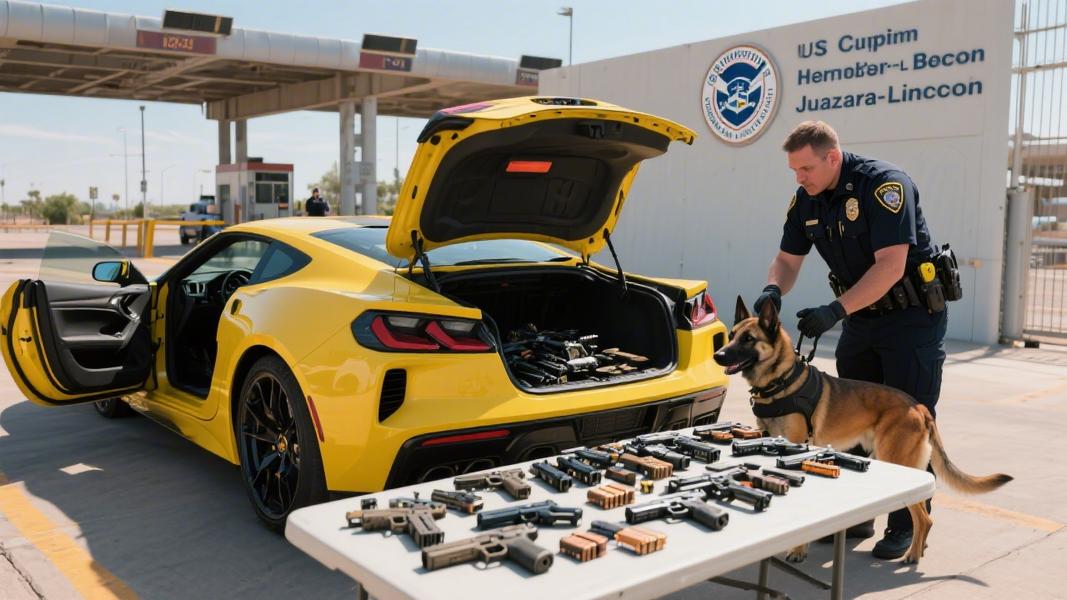
Hundreds of handguns. Half a million rounds of ammunition. Hidden behind false walls, tucked inside luxury sports cars, and stuffed into utility trailers — all of it headed south into Mexico. U.S. Customs and Border Protection officers have been intercepting a staggering flow of illegal weapons at ports of entry across the southern border, and the numbers are difficult to overstate.
In recent months, CBP has recorded some of its most significant outbound weapons seizures in years, raising urgent questions about the scale of arms trafficking into Mexico and whether the cartels sourcing these weapons are growing bolder — or just better at hiding them. Federal officials say they’re catching more. But every seizure also serves as a reminder of what might be getting through.
A Corvette Full of Contraband
On February 3, CBP officers at the Juarez-Lincoln Bridge in Laredo made a find that would have seemed almost cinematic if it weren’t so alarming. A 2021 Chevy Corvette — the kind of vehicle that tends to draw attention for all the wrong reasons at a border checkpoint — rolled up for inspection. A non-intrusive imaging scan flagged anomalies. A K-9 unit confirmed something was off. When officers searched the vehicle, they pulled out 44 handguns and 79 magazines, all concealed inside the car’s body panels and compartments.
“Significant outbound weapons seizures, like the one realized by our officers at Juarez-Lincoln Bridge, reflect the relentless dedication of our officers to upholding CBP’s border security mission and keeping our border communities safe,” said Port Director Alberto Flores of the Laredo Port of Entry, as reported by Fox4 News. It’s a line you’d expect from a press release — but the seizure itself speaks louder than any statement.
The October Haul That Dwarfed Everything Else
Still, even that Corvette bust looks modest by comparison to what officers uncovered last October. On the 23rd, at the same Juarez-Lincoln Port of Entry in Laredo, CBP officers stopped two vehicles towing trailers. The trailers had false walls. And behind those walls — 534 firearms, 31,482 rounds of ammunition, 525 magazines, 40 scopes, four lasers, and 10 rifle slings. The suspects were identified as Ramirez Diaz and his father, who had apparently turned arms smuggling into something of a family enterprise.
That’s not a cache. That’s an arsenal. The kind of firepower that doesn’t end up at a target range — it ends up fueling cartel violence on the other side of the border. The seizure stands as one of the largest single outbound weapons intercepts in recent CBP history and underscores just how sophisticated — and brazen — these smuggling operations have become.
Del Rio, December: Another Van, Another Stash
It’s not just Laredo. On December 21, 2025, officers at the Del Rio Port of Entry stopped a 2016 Chevrolet passenger van pulling a utility trailer. Inside: three weapons, nine magazines, and 1,389 rounds of ammunition, all hidden within the vehicle. Flores, whose jurisdiction covers multiple Texas ports, struck a firm tone in the agency’s release. “As this seizure illustrates, we will continue to leverage every resource to deter and disrupt illegal activities that threaten public safety,” he stated.
Three weapons and a box of ammo might not grab headlines next to 534 guns — but that’s the point. The volume of these stops, spread across different ports and different weeks, suggests this isn’t a series of isolated incidents. It’s a pipeline.
It’s Not Just Weapons
How bad is the broader contraband picture? Bad enough that on February 25, 2026, CBP officers at the Laredo Port of Entry separately seized over $602,000 worth of methamphetamine in a drug trafficking bust — a stark reminder that the border’s outbound weapons problem exists alongside an equally relentless inbound drug crisis. Officers are essentially working both directions at once, under enormous pressure, with finite resources.
Jacksonville: Taking the Fight Inland
Federal enforcement isn’t limiting itself to the southern border, either. In a joint operation at Jacksonville’s Blount Island Marine Terminal, CBP teamed up with other federal agencies to sweep outbound vehicle shipments — the kind of cargo that can quietly carry contraband across oceans if nobody’s looking hard enough. Officers found three unmanifested vehicles hidden inside shipping containers.
Supervisory CBP Officer Richard DeCapite didn’t mince words about the scope of the effort. “Basically, we went through every single vehicle that was in the lot looking for contraband,” he explained. It’s the kind of brute-force thoroughness that produces results — but it also can’t be replicated everywhere, every day. That’s the uncomfortable math of border enforcement.
A Pattern That Demands Attention
Taken together, these seizures paint a picture of a well-organized, multi-vector smuggling economy — one that uses luxury cars, family road trips, and commercial shipping containers as cover. CBP officers are catching significant hauls. But the frequency of these busts also suggests that the demand for weapons south of the border isn’t slowing down, and neither are the people trying to meet it.
The guns seized at Laredo’s Juarez-Lincoln Bridge won’t reach a cartel armory. The 534 firearms stopped in October won’t be used to outgun law enforcement in Tamaulipas or Sinaloa. That’s the work. That’s what the press releases are really saying, underneath the official language and the port director quotes. And yet, as any veteran border officer will tell you off the record — for every load they catch, the question that keeps them up at night is the one they can’t answer: how many made it through?
