
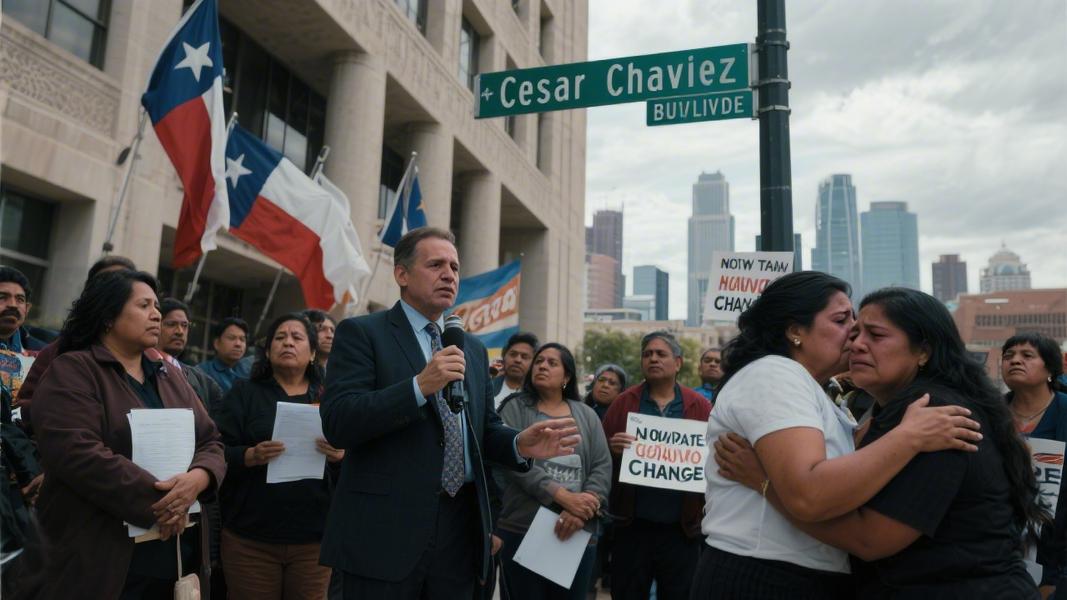
The legacy of César Chávez is fracturing in real time — and the communities that built monuments to him are now debating whether to tear them down.
Explosive allegations published by The New York Times have sent shockwaves through Latino communities across the country, after Dolores Huerta — co-founder of the United Farm Workers and one of the most respected figures in American labor history — accused Chávez of sexually assaulting her in the 1960s, resulting in two pregnancies. The children, she said, were placed with other families. Victims described in the reporting include girls as young as 13 and 15. The fallout has been swift, painful, and far from over.
A Sense of Betrayal Takes Hold
In North Texas, community leaders who spent years fighting to honor Chávez’s name are grappling with something close to grief. Ramiro Luna, who served on the Cesar Chavez Blvd Task Force and helped get the street renamed in Dallas, didn’t mince words. “I feel disheartened, I feel betrayed,” he said. “Every single one of our leaders needs to be held accountable, especially when there’s an abuse of women and children involved.”
That’s not a small statement from someone who dedicated years of organizing to Chávez’s memory. Luna is now calling for a full reassessment of the legacy — and he has a concrete proposal. He wants Cesar Chavez Boulevard in Dallas renamed to Dolores Huerta Boulevard. “I would love for us to start considering renaming it to Dolores Huerta,” he told reporters. “My goal is that I would no longer do any more parades on behalf of Cesar Chavez and instead focus my attention on putting more light and honor to Dolores Huerta, and the movement as a whole.”
Dallas city officials, for their part, say they have no current plans to rename the street — but they’re watching how things develop. That’s a diplomatic non-answer that probably won’t hold for long.
Governors Act, Institutions Scramble
The political response has been unusually fast. Texas Governor Greg Abbott announced that the state will no longer observe Cesar Chavez Day and will work to remove it from state law entirely. In Arizona, Governor Hobbs’ office said it would not recognize the holiday this year, citing the severity of the allegations. “As a social worker who worked with homeless youth and victims of domestic violence, Governor Hobbs takes allegations of inappropriate sexual behavior against women and minors very seriously,” a spokesperson said.
Meanwhile, Fresno State — in the heart of California’s Central Valley, where Chávez’s movement was born — quietly covered its Cesar Chavez statue following the revelations. No ceremony, no announcement. Just a tarp over the bronze.
In California, where Chávez Day has been a state holiday since 2000, leaders are visibly struggling. Governor Gavin Newsom didn’t hide how hard he’s taking it. “How many days I’ve marched, how many times I’ve been with students, talking about the movement, how many photographs I have in my house of Bobby Kennedy and César Chávez,” he told reporters. “It’s been hard to absorb this.” His wife, Jennifer Siebel Newsom, offered support for victims in Spanish: “The women are in our hearts.”
The Union He Built Responds
The United Farm Workers — the organization Chávez co-founded with Huerta — called some of the accusations “profoundly shocking,” particularly those involving minors, and canceled its Cesar Chavez Day activities. “Allegations that very young women or girls may have been victimized are crushing,” the union’s statement read. The union also announced plans to provide support services in response.
Huerta herself, now 95, did not soften her words. “Unfortunately, he used some of his great leadership to abuse women and children — it’s really awful,” she said.
Chávez’s family released a statement expressing devastation and extending empathy to survivors. “We wish peace and healing to the survivors and commend their courage to come forward,” the family wrote. “As a family steeped in the values of equity and justice, we honor the voices of those who feel unheard and who report sexual abuse.” They asked for privacy while they processed what they called “deeply painful” information.
A Cultural Reckoning, Not Just a Political One
Why did it take this long? That’s the uncomfortable question hanging over all of it. Liliana Leyva, a sexual assault therapist working in North Texas, said the answer isn’t simple — but it’s not surprising either. “Sadly, I’m not shocked. This is something that has been alluded to within the Chicano community,” she explained. “I think one of the reasons why Latinas do not report, it’s the cultural atmosphere that we have, that we grew up with. There’s a lot of machismo… with silence, complicity, a lot of things that come with it.”
Leyva noted that waitlists for sexual assault services in North Texas are already growing — a sign that the story is resonating far beyond the headlines, reaching people who’ve been carrying their own wounds quietly for years.
The Street Sign Question Spreads West
It’s not just Dallas asking what to do with Chávez’s name on public property. In Portland, Oregon, City Councilor Candace Avalos has already begun the process of renaming Cesar Chavez Boulevard — also to Dolores Huerta Boulevard. “I have begun looking into the process and talking with community leaders,” Avalos wrote on Bluesky, noting that city code requires a petition of 2,500 signatures as a first step. “Stay tuned for ways to be involved in this effort.”
Still, not every community is moving at the same speed. Some are waiting. Some are grieving. Some are angry in ways that don’t fit neatly into any political category — people who marched under Chávez’s banner, who named their children after him, who saw in him something worth fighting for.
Luna put it plainly: “We’re working with different groups to try to figure how we can move away from continuing to build the legacy of someone who betrayed us.”
That word — betrayed — keeps coming up. And maybe that’s the truest measure of what’s been lost here. Not a holiday, not a street name. But the uncomplicated pride that once came with claiming this particular piece of history as your own.
