
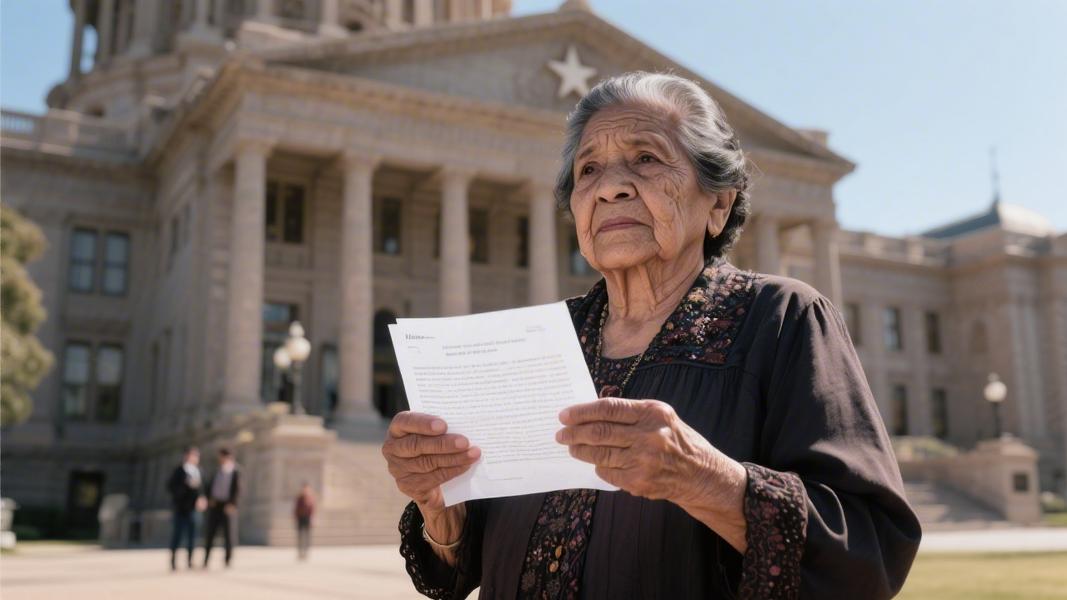
One of the most celebrated figures in American labor history is now at the center of allegations that could fundamentally reshape his legacy — and the woman who helped build that legacy alongside him is the one speaking out.
Dolores Huerta, 95, the iconic co-founder of the United Farm Workers union, has disclosed that she was sexually assaulted twice by Cesar Chavez in the 1960s when she was a young mother in her thirties. Both encounters, she says, were non-consensual, resulted in pregnancies, and left her carrying a secret she kept buried for decades while continuing to organize alongside the man she says violated her. The children from those pregnancies, she has said, were quietly placed with other families.
“I carried this secret for as long as I did because building the movement and securing farmworker rights was my life’s work,” Huerta stated. “The formation of a union was the only vehicle to achieve and secure those rights and I wasn’t going to let Cesar or anyone else get in the way.” It’s a devastating sentence — the kind that takes a moment to fully land.
A Deeper Pattern of Abuse
Huerta’s account doesn’t stand alone. A New York Times investigation has revealed that Chavez sexually assaulted two underage girls during the 1970s — one of whom was raped repeatedly — and that he raped Huerta in 1966 in a secluded grape field in Delano, California. That last detail is chilling in its specificity. Delano is, of course, the very town where the farmworker movement was born — where Chavez and Huerta launched the Delano grape strike in 1965, one of the defining moments in American labor history.
How bad is it? Bad enough that the institutions built around Chavez’s name are now scrambling to respond — and in some cases, stepping back entirely.
The UFW Steps Away
The United Farm Workers, the union Chavez and Huerta co-founded in 1962, which currently represents nearly 5,000 farm workers, is distancing itself from its founder. The organization says it’s abstaining from Cesar Chavez Day activities — a public holiday recognized in California, Utah, Arizona, and Washington. “Allegations that very young women or girls may have been victimized are crushing,” the union said in a statement, adding that it has not received direct reports or has firsthand knowledge of the allegations. Still, the symbolic weight of the UFW stepping away from its own founder’s namesake holiday is hard to overstate.
The Cesar Chavez Foundation — the nonprofit that carries his name and mission forward — issued a statement that was short on answers but heavy on emotion. “We are deeply shocked and saddened by what we are hearing,” the organization acknowledged, noting it was working with farmworker leaders to determine how to respond. It described the allegations as involving inappropriate sexual behavior with women and minors during his presidency of the UFW. That’s a carefully worded sentence. It’s also an extraordinary one.
Cancellations Spread Across the Country
On the ground, the fallout has been swift and visible. A march in San Antonio scheduled for March 6, 2026 was called off. A festival in Corpus Christi on March 13 followed. Then came Tucson, then events in Houston and San Bernardino — a cascade of cancellations that, taken together, map out just how deeply Chavez’s name had been woven into Latino civic life and how quickly communities are now pulling at that thread.
That’s the uncomfortable reality here. Chavez wasn’t just a union organizer. He was a symbol — of dignity, of resistance, of the possibility that ordinary people could take on powerful agricultural interests and win. His image hangs in schools, community centers, and government offices. His birthday is a state holiday. Disentangling the man from the movement he helped build is going to be painful, messy, and probably incomplete.
What Comes Next
Huerta, for her part, spent decades absorbing that silence — continuing to march, to organize, to speak — even as she carried what she’s now describing publicly for the first time at 95 years old. She didn’t let it stop the work. Whether that’s an act of extraordinary discipline or extraordinary cost — or both — is something only she can answer.
The farmworker movement she helped build is still real. The rights it secured are still on the books. But the man whose name has been synonymous with that struggle is now something far more complicated. And the woman who arguably sacrificed the most for it is still, somehow, the one left explaining why she stayed quiet.
