
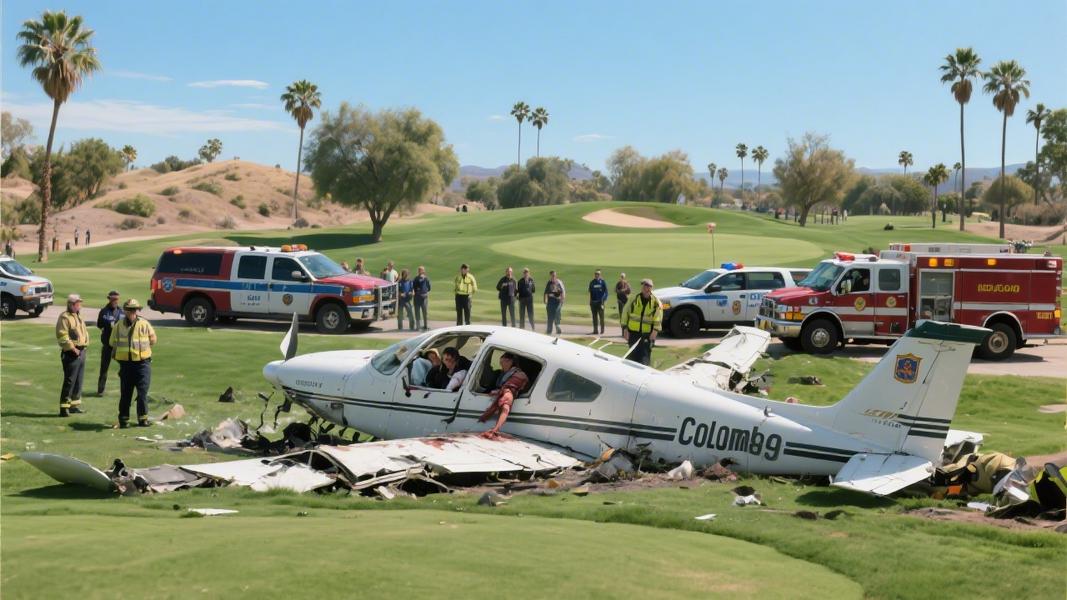
An emergency landing went catastrophically wrong Thursday morning when a small plane came down on a busy Albuquerque golf course, killing one person and leaving another fighting for their life.
The crash at Los Altos Golf Course — tucked near the intersection of Eubank and Interstate 40 — unfolded just before noon on March 6, 2026, turning what should have been a routine midday round of golf into a scene of wreckage and emergency response. The aircraft, identified as a single-engine Cessna 400, was attempting an emergency landing when it went down, confirming what investigators would later describe as a rapidly deteriorating situation in the cockpit.
What Happened on the Course
The call came in fast. Albuquerque Fire Rescue was dispatched at approximately 11:39 a.m., and Engine 9 was on scene within five minutes. What crews found wasn’t pretty. According to an AFR statement, “a small prop plane with two people stuck inside” had sustained significant damage — though, notably, the aircraft was not on fire. “A total of 12 AFR units were dispatched to the scene to establish treatment, triage and transport operations,” the department noted. “Two people were extricated from the plane and transported code 3 to UNMH.”
Code 3. Lights and sirens. That’s as urgent as it gets.
Both occupants were rushed to University of New Mexico Hospital. One did not survive. The other remains in critical condition, according to multiple outlets that covered the aftermath. The identities of neither victim have been publicly released as of this writing.
Investigators Move In
This isn’t the kind of crash that gets wrapped up in an afternoon. The Federal Aviation Administration and the National Transportation Safety Board are both assisting in the investigation, alongside New Mexico State Police, who are leading on the ground, according to local reporting. That three-agency response signals the seriousness with which officials are treating the incident — standard protocol for fatal aviation accidents, but still a considerable deployment for a mid-sized city on a Thursday morning.
The golf course itself was shut down following the crash, which, given the circumstances, goes without saying. Still, it’s a reminder of how quickly an ordinary public space can become a federal investigation site. One moment, someone’s lining up a putt. The next, there’s a downed Cessna in the fairway.
The Aircraft and the Questions That Remain
The Cessna 400 — sometimes marketed as the Cessna Corvalis — is a high-performance, single-engine aircraft popular among private pilots. It’s fast, capable, and generally well-regarded. What triggered the emergency that forced the pilot to attempt a landing on a golf course rather than at nearby Double Eagle II Airport or Albuquerque International Sunport hasn’t been publicly disclosed. The NTSB’s investigation will almost certainly focus on that question first.
Why a golf course? That’s not a rhetorical question — it’s the one investigators will need to answer. Pilots in distress sometimes have only seconds to identify a flat, open stretch of ground. A golf course, from altitude, can look a lot like a runway. Whether this one gave the pilot any real chance at survival is something the data recorders and wreckage analysis will have to tell us.
The FAA has documented the crash time as approximately 11:44 a.m., a slight discrepancy from the fire department’s dispatch log — not unusual in the chaotic early minutes of an emergency response. What’s consistent across every account is the outcome: one life lost, one life hanging in the balance, and a community left processing the kind of accident that feels both sudden and, in the world of small aviation, not entirely rare.
A Community Responds
News of the crash spread quickly through Albuquerque, with residents near the Eubank corridor reporting a visible emergency response that stretched across the golf course grounds. Local outlets were quick to note the scale of the scene — a dozen fire units, police cordons, and the kind of controlled chaos that emergency responders train for but hope never to use.
The NTSB’s preliminary report, which typically surfaces within a few days of a fatal crash, will be the next major development to watch. That report won’t assign blame — that comes later, sometimes years later — but it will begin to sketch the factual outline of what went wrong somewhere above the East Mountains or the Rio Grande Valley before that Cessna came down on the 18th hole, or wherever it landed, of a golf course that nobody expected to make the news today.
For now, a family is grieving, a survivor is clinging on, and somewhere in the wreckage, the answer to what went wrong is waiting to be found.
