
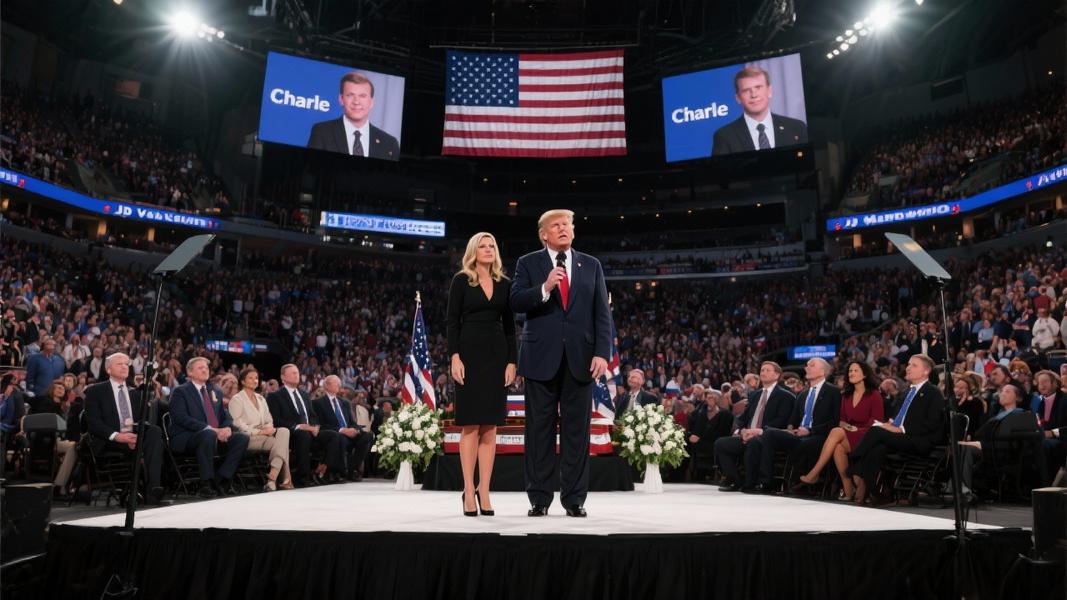
The assassination of conservative activist Charlie Kirk on a university campus has sparked a firestorm of political controversy, with President Donald Trump eulogizing him as “a martyr for American freedom” and vowing to defend the tradition of open debate that Kirk championed.
Kirk, 31, was shot and killed on September 10, 2025, while speaking at an outdoor event at Utah Valley University in Orem, Utah. The event was the first stop of the American Comeback Tour, a speaking series organized by Turning Point USA, the conservative organization Kirk founded at age 18.
The shooter, identified as 22-year-old Tyler James Robinson, fired from approximately 142 yards away on a building rooftop before surrendering the next day. Robinson has been charged with murder, and prosecutors are seeking the death penalty.
A Divisive National Moment
The killing has quickly become one of the most polarizing events in recent American political history. Kirk, who rose to prominence as a right-wing media personality and close ally of former President Trump, was known for promoting conservative views on issues including gun rights, abortion, and gender identity while encouraging open debate on college campuses.
“The gun was pointed at him, but the bullet was aimed at all of us,” Trump declared during a memorial service at State Farm Stadium in Glendale, Arizona, on September 21. “It was an assault on our most sacred liberties and God-given rights.”
In his eulogy, Trump described Kirk as “heinously murdered by a radicalized, cold-blooded monster for speaking the truth that was in his heart,” while characterizing the shooting as an attack on American liberty and free speech.
Why has this assassination touched such a nerve? Beyond the horror of political violence, the aftermath has exposed deep fissures in American society, with reactions often falling along partisan lines.
Media Controversies Intensify
The fallout has extended to mainstream media, where ABC pulled late-night host Jimmy Kimmel off the air for comments he made regarding the response to Kirk’s death — a move that itself became part of the national debate about free expression.
Trump used the memorial to condemn both media outlets and political opponents who he claimed had tried to silence Kirk “because he was winning, and he was winning big.” He also criticized those who he said celebrated the murder, pointing to what he described as a troubling hypocrisy.
“Some of the very same people who spent the last eight years trying to sit in moral judgment of anyone who disagreed with them about politics suddenly started cheering for murder,” Trump said, adding that “some of the very people who call you a ‘hater’ for using the wrong pronoun were filled with glee at the killing of a father with two young children.”
Kirk’s Legacy and Method
Throughout the memorial service, speakers highlighted Kirk’s approach to political engagement. Trump specifically noted Kirk’s practice of inviting dissenters to speak during campus events rather than attempting to silence them.
“At every campus event, Charlie asked the people who disagreed with him to come forward — and instead of silencing them, he handed them a microphone and let them speak,” Trump said.
Born in Arlington Heights, Illinois, on October 14, 1993, Kirk founded Turning Point USA in 2012, growing it from a campus initiative into a national organization with multiple affiliated groups. He authored three books and became a recognized conservative voice across multiple media platforms.
Trump has used the assassination to call for a crackdown on left-wing groups — a move that has itself drawn criticism from opponents who argue it amounts to stifling political opposition.
A Call for Spiritual Renewal
In his remarks, Trump also touched on Kirk’s belief that America needed “not just a political re-alignment, but also a spiritual reawakening,” suggesting that Kirk would have appreciated the faith-based testimonies shared during the memorial.
Kirk is survived by his wife, Erika Frantzve, whom he married in 2021, and their two children.
The president concluded his eulogy by framing Kirk’s life as a testament to the power of individual determination: “The lesson of Charlie’s life is that you should never underestimate what one person can do with a good heart, a righteous cause, a cheerful spirit, and the will to fight, fight, fight.” What began as “only an idea to change minds on college campuses,” Trump reflected, ended with “a far greater achievement — changing history.”
