
Chicago Mayor Brandon Johnson has thrown down the gauntlet against federal immigration authorities, declaring parts of the city off-limits to ICE in a move that dramatically escalates tensions between local and federal officials.
The mayor’s executive order establishes “ICE-free zones” on city-owned properties and at private businesses that don’t consent to federal immigration enforcement activities, setting up what could become a protracted legal and political battle in one of America’s largest sanctuary cities.
City Hall vs. Washington: A Growing Standoff
“The fact is, we cannot allow them to rampage throughout our city with no checks or balances. Nobody is above the law,” Johnson declared on Monday. “If Congress will not check this Administration, then Chicago will.”
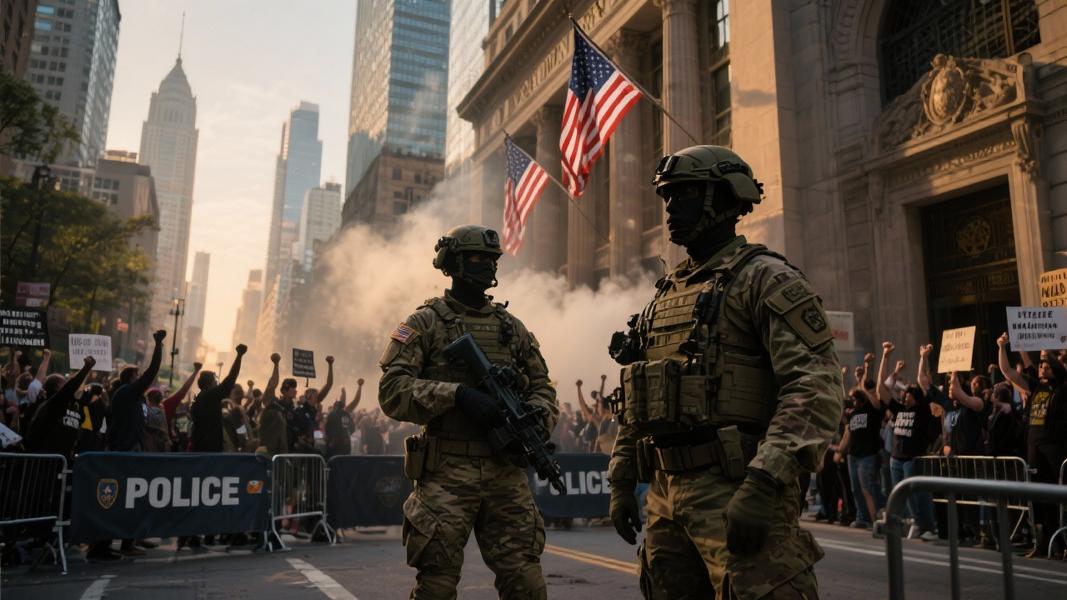
The mayor’s defiant stance comes amid reports of increased federal law enforcement presence in Chicago, part of what critics view as a broader pattern of federal intervention in major cities across the country. The White House has deployed masked agents to conduct immigration raids and used force against protesters in several urban centers, including Chicago.
Federal authorities have blasted Johnson’s order as dangerous, claiming it shields “the most depraved, violent criminal illegal aliens from justice” and calling it “not only an insult to every Chicagoan,” but a “dangerous intensification of Democrats’ lunatic ‘sanctuary’ agenda where criminal illegals come before American citizens.”
On the Ground: Tensions Escalate
The conflict isn’t just playing out in press conferences and political statements. At the Broadview ICE facility on Chicago’s west side, new security barriers now separate protesters from federal agents and transport vehicles — a direct response to recent confrontations where authorities used pepper balls and tear gas against demonstrators, resulting in multiple arrests.
Such clashes represent the physical manifestation of a deepening ideological divide over immigration enforcement, with local communities increasingly resistant to federal operations they view as heavy-handed and disruptive.
How far will this standoff go? The deployment of at least 300 National Guard members to Illinois suggests federal authorities are preparing for prolonged resistance. Similar deployments in Oregon and other states have previously escalated tensions rather than resolving them.
University Communities Caught in the Middle
The ripple effects of these tensions extend beyond city politics into educational institutions. The University of Illinois Chicago’s Office of International Services is monitoring potential ICE activity and preparing support systems for international students and employees who might be affected.
While the university acknowledges it has no authority to prevent federal enforcement actions on campus, administrators are working to provide resources and information to vulnerable community members — a tacit recognition of the anxiety caused by increased immigration enforcement.
“Students are scared,” said Maria Gonzalez, a graduate student organizer who asked to use a pseudonym. “They’re skipping classes, missing lab work. Some are afraid to even leave their apartments.”
Illinois Security Strategy: Caught Between Priorities
Complicating matters further is Illinois’ statewide homeland security strategy, known as Vision 2025, which emphasizes cybersecurity, intelligence sharing, critical infrastructure protection, and terrorism prevention. The strategy, developed before the current immigration enforcement push, doesn’t specifically address immigration issues — creating potential conflicts between state security priorities and federal operations.
State officials have found themselves walking a tightrope, attempting to maintain cooperative relationships with federal security partners while respecting local concerns about immigration enforcement tactics.
Legal Battlegrounds
Legal experts point to several key questions that will likely determine the outcome of this federal-local standoff. Federal authorities operate under Title 8 of the U.S. Code regarding immigration enforcement, while National Guard deployments fall under Title 10 (federal control) or Title 32 (state control with federal funding).
The ACLU has raised significant civil liberties concerns about the increased use of military and paramilitary forces for domestic law enforcement, particularly in immigration contexts.
“There’s a reason we have posse comitatus laws limiting military involvement in civilian policing,” said constitutional law professor Eleanor Ramirez at Northwestern University. “When you militarize immigration enforcement, you fundamentally alter the relationship between government and the communities it serves.”
A National Pattern
Chicago isn’t alone in its resistance to federal immigration operations. Similar sanctuary policies exist in New York, San Francisco, and Los Angeles, creating what some observers have called “parallel immigration systems” across the country.
But Chicago’s explicit designation of “ICE-free zones” represents a significant escalation compared to previous sanctuary policies that merely limited information-sharing or cooperation between local police and federal authorities.
The standoff in Illinois reflects a broader national debate about federalism, local control, and immigration policy — one that shows no signs of resolution as positions on both sides harden.
For residents caught in the middle, the consequences are immediate and personal. As federal agents and local officials continue their political and legal battle, Chicago’s immigrant communities find themselves navigating an increasingly uncertain landscape where a trip to city hall, a public school, or even a local grocery store could have life-changing implications.
