
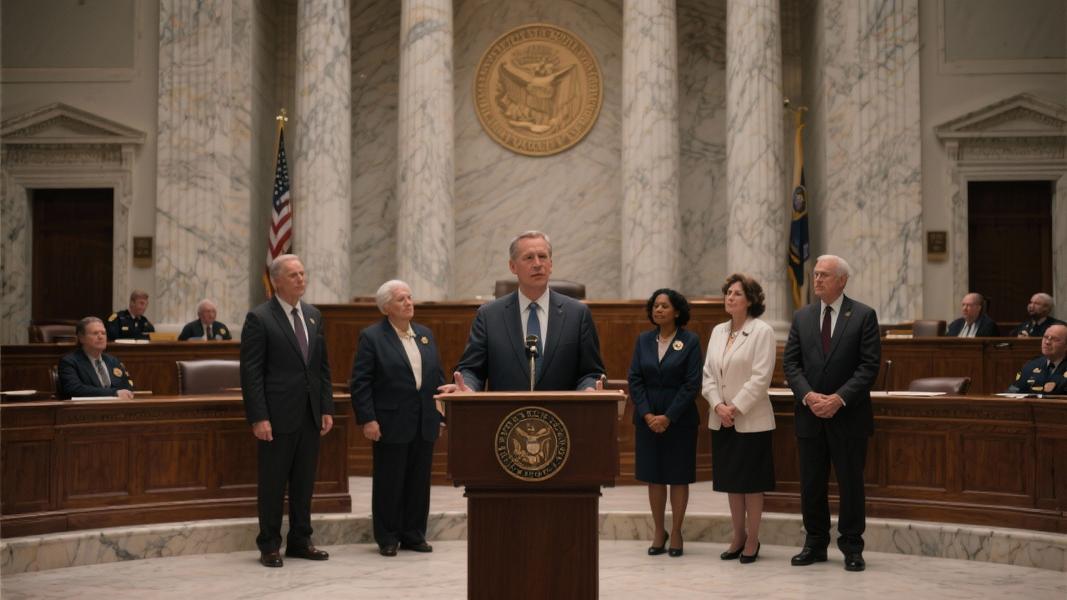
Chief Justice Roberts Adjourns Supreme Court Term, Honors Retiring Staff
Chief Justice John G. Roberts, Jr. announced Thursday that the Supreme Court has completed its work for the October 2019 Term, with all cases decided and an order list released at 2 p.m. The Court now enters its summer recess until the first Monday in October, when the 2020 Term will begin.
In a statement marking the occasion, Roberts expressed gratitude to the Court’s staff and members of the bar for their dedication during a term that saw the Court navigate unprecedented challenges, including holding oral arguments remotely for the first time in its history.
“On behalf of my colleagues, I would like to thank the Supreme Court employees for their outstanding work and dedication to their important responsibilities this Term,” Roberts stated. “The commitment and professionalism of all the Court staff contribute significantly to the accomplishments of the Court’s mission. The Court also thanks the members of the Court’s bar for their professionalism and cooperation.”
Notable Retirements
The announcement highlighted six long-serving Court employees who are retiring. Among them is Christine Luchok Fallon, the Reporter of Decisions, who made history as the first woman to hold that position. During her nine-year tenure, Fallon oversaw the publication of nearly 30 volumes of the United States Reports before her scheduled retirement on September 25.
Perhaps most notable is the departure of Pamela Talkin, who served as the Court’s Marshal for 19 years and was the first woman to hold that position. Talkin, who supervised 260 employees and will retire on July 31, was responsible for maintaining order and decorum during Court sessions, among other duties.
The retiring staff represent decades of institutional knowledge. James Baker from the Marshal’s Office served for over 35 years, while Kathleen Tycz from the Clerk’s Office dedicated more than 40 years to the Court. Agent Andrew Ruggles of the Supreme Court Police served for over 28 years, and Melissa Walters of the Clerk’s Office, who retired last July, contributed nearly 28 years.
“Mr. Baker, Agent Ruggles, Ms. Walters, Ms. Tycz, Ms. Fallon, and Marshal Talkin, the Court thanks each of you for your dedicated public service to Court and Country. We wish each of you well in your retirement,” Roberts noted.
A Consequential Term
The announcement comes at the end of what many court watchers consider a defining term for Roberts’ leadership. The Chief Justice, who has served since 2005, authored majority opinions in two high-profile cases on the same day as this announcement—Trump v. Vance and Trump v. Mazars USA, LLP—both rejecting claims of absolute presidential immunity from subpoenas.
“In our judicial system, ‘the public has a right to every man’s evidence,'” Roberts wrote in the Vance decision. “Since the earliest days of the Republic, ‘every man’ has included the President of the United States.”
What makes this term particularly significant? Roberts found himself in the majority in an extraordinary 56 of 58 cases, demonstrating his growing influence as the Court’s ideological center and consensus builder.
The Chief Justice has increasingly positioned himself as a defender of the Court’s institutional legitimacy. When Senate Majority Leader Chuck Schumer made remarks that Roberts considered threatening to justices during a rally, he issued a rare public rebuke, saying, “Justices know that criticism comes with the territory, but threatening statements of this sort from the highest levels of government are not only inappropriate, they are dangerous.”
Similarly, he has pushed back against political characterizations of the judiciary. “We do not have Obama judges and Trump judges, Bush judges or Clinton judges,” Roberts insisted in response to criticism from President Trump.
The Court now enters its summer recess with several of its longtime staff members departing and after having navigated both contentious cases and the logistical challenges of operating during a pandemic. When it reconvenes in October, it will do so with a slightly different composition of personnel behind the scenes who make the Court’s work possible.
