
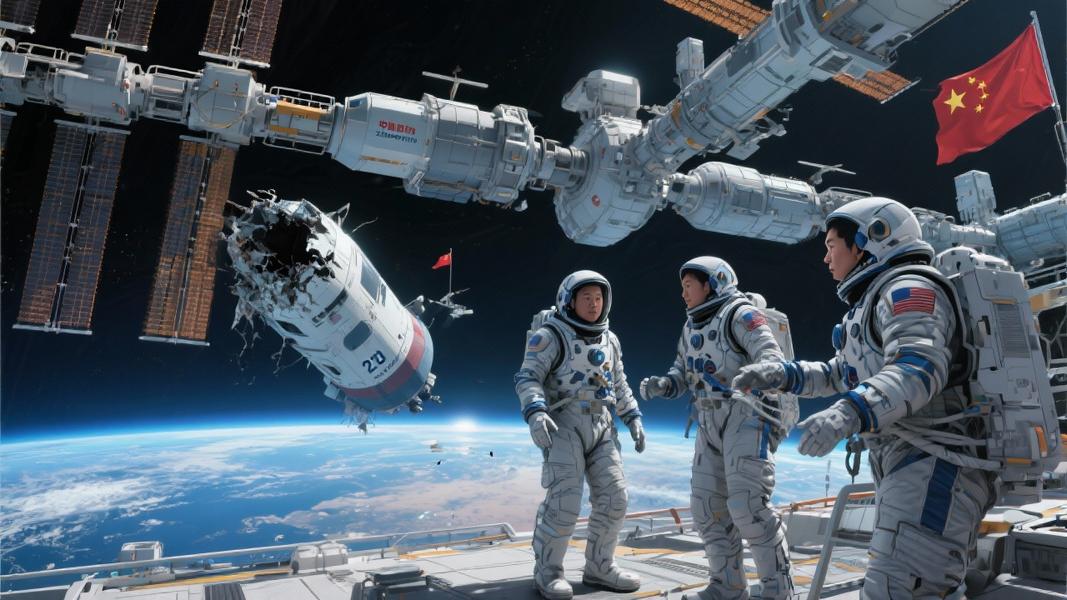
China has launched an emergency spacecraft to rescue three astronauts stranded aboard its orbiting Tiangong space station after their return vehicle was damaged by space debris, marking an unprecedented rescue mission in the nation’s space program.
The unmanned Shenzhou-22 spacecraft blasted off from the Jiuquan Satellite Launch Center at 04:11 UTC on November 25, 2025, riding a Long March-2F rocket into orbit to address what officials are calling a “safety crisis” at the Chinese space station, according to sources who confirmed the mission’s emergency status. The spacecraft successfully docked with Tiangong approximately 11 hours later at 15:50 local time (07:50 GMT), attaching to the forward port of the central Tianhe module.
Damage That Couldn’t Be Ignored
What exactly prompted this urgent launch? The Shenzhou-20 return capsule, which had been docked at the station since earlier this year, suffered critical damage from a space debris impact that rendered it unsafe for human transport. This left the three Shenzhou-21 astronauts who arrived on November 1 effectively stranded without a reliable way home — a scenario space agencies worldwide have long feared but rarely faced so directly.
Chinese space officials revealed that the Shenzhou-22 will now serve as the return vehicle for the crew when their mission concludes. The rapid response to the crisis has drawn attention from space experts globally — China executed the emergency launch just 16 days after identifying the problem, demonstrating remarkable operational efficiency under pressure.
“From problem identification to launch in just over two weeks — that’s an impressive turnaround for any space agency,” said one space analyst familiar with Chinese operations who requested anonymity. “It shows how seriously they took the safety threat.”
A Spacecraft Ahead of Schedule
The Shenzhou-22 wasn’t supposed to fly until next year. Originally scheduled for a crewed launch in 2026, the spacecraft was repurposed and accelerated as an uncrewed emergency mission to restore normal operations at Tiangong, sources noted. This required significant logistical adjustments at China’s space facilities, as hardware intended for future missions had to be readied ahead of schedule.
Beyond serving as an escape vehicle, the Shenzhou-22 carries critical cargo: spare parts, specialized repair equipment for the damaged capsule, and fresh supplies needed to support the crew through what could be an extended stay. The astronauts are now expected to remain aboard Tiangong until approximately April 2026, several months longer than initially planned.
Is this the first such rescue mission in space history? Not quite. NASA faced similar challenges during the early Space Shuttle era, most notably following the Columbia disaster, but the Chinese response represents one of the fastest turnarounds for an emergency space vehicle launch in recent memory.
Growing Concerns About Space Debris
The incident underscores the increasing hazards posed by orbital debris. With thousands of defunct satellites, spent rocket stages, and fragments circling Earth at speeds exceeding 17,500 mph, even tiny objects can cause catastrophic damage to spacecraft — a reality the Tiangong crew now knows firsthand.
China hasn’t released specific details about the size or origin of the debris that damaged the Shenzhou-20 capsule, but experts suggest it was likely a fragment measuring just centimeters across — enough to compromise critical systems when traveling at orbital velocities.
Though the situation appears stabilized for now, the incident highlights the vulnerabilities of permanent orbital outposts. As more nations and private companies expand their presence in low Earth orbit, the challenges of navigating an increasingly crowded and debris-filled environment will only intensify — making emergency capabilities like those demonstrated by China’s rapid response increasingly essential to human spaceflight operations.
