
A man who worked security for a sitting member of Congress was shot and killed by a Dallas SWAT team last week — and investigators say he’d been hiding a criminal past the entire time.
The incident has thrown an uncomfortable spotlight on Rep. Jasmine Crockett (D-TX) and the systems designed to protect federal lawmakers. Diamon-Mazairre Robinson, who went by the alias Mike King, was a 39-year-old convicted felon who allegedly ran a security company, impersonated law enforcement officers, and somehow managed to land a spot on a sitting congresswoman’s personal security detail. He was killed on March 11, 2026, after a tense SWAT standoff near Medical District Drive in Dallas.
A Double Life, Hiding in Plain Sight
How does something like this happen? That’s the question Dallas investigators and Crockett’s own office are now grappling with. Robinson, it turns out, had been living what sources describe as a double life — a suspected criminal operating in the open, hiring off-duty Dallas police officers through his security firm while simultaneously being wanted for impersonating law enforcement. He wasn’t some shadowy figure lurking at the margins. He was standing next to a member of Congress.
Multiple sources confirmed that Robinson concealed his criminal background while serving on Crockett’s detail. Investigators say he owned a security company and used it as cover, even bringing in off-duty officers to lend the operation a veneer of legitimacy. It’s a striking portrait — and a deeply unsettling one for anyone who thinks about what access to a federal lawmaker actually means.
The Standoff at Children’s Medical Center
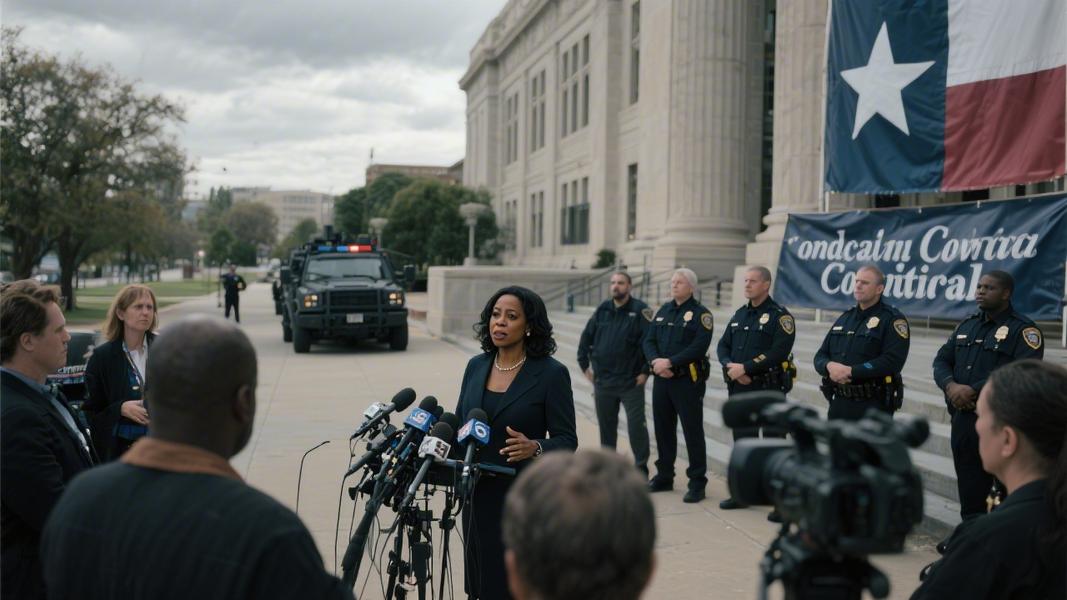
The end came quickly, and violently. Dallas SWAT officers located Robinson near the parking garage of Children’s Health hospital on March 11, where he had barricaded himself inside a vehicle. Dallas Police Chief Daniel Comeaux laid out the sequence of events at a press briefing. “They came across a target that ended up being a barricaded suspect,” Comeaux said. “At that time, they tried to use tear gas to bring the suspect out. He came out of the vehicle, he had a gun, he pointed a gun toward officers. Officers shot and fired… He was pronounced dead at the scene.”
Robinson was 39 years old. Dallas police identified him by his legal name shortly after the standoff concluded. The connection to Crockett’s office emerged in the hours that followed, sending the story spiraling well beyond a routine officer-involved shooting.
Crockett’s Office Responds
Crockett’s team didn’t dodge the story. Her office issued a statement acknowledging Robinson had worked on her security team and pointing directly at the systemic failures that made it possible. “The fact that an individual was able to somehow circumvent the vetting processes for something as sensitive as security for members of Congress highlights the loopholes and shortcomings in many of our systems,” the statement read.
That’s a frank admission — and it raises more questions than it answers. Who is responsible for vetting the people who guard federal representatives? Is it the member’s office? A contractor? Some patchwork of both? The statement doesn’t say, and so far, no one has stepped forward with a clear answer. Still, the acknowledgment that something broke down is itself notable. These kinds of admissions don’t always come this quickly or this plainly.
Bigger Questions About Congressional Security
A convicted felon running a security firm. Off-duty cops on the payroll. A wanted impersonator standing guard over a U.S. congresswoman. It reads like something out of a crime drama — but investigators and sources say that’s exactly what was happening on the ground in Dallas.
The case cuts to the heart of a long-simmering concern: that the informal, often decentralized way many lawmakers arrange their personal security creates real vulnerabilities. Members of Congress aren’t automatically assigned federal protection the way the president or vice president are. Many rely on local arrangements, private contractors, or constituent-funded staff — a system that, in this case, apparently left a significant gap wide enough for Robinson to walk right through.
The incident has been described by Dallas sources as a cautionary tale about exactly those gaps. And with Robinson now dead and the investigation still unfolding, it’s not yet clear whether any charges will be brought against others connected to his security operation, or whether any formal review of congressional vetting procedures will follow.
What is clear is that for a brief, dangerous stretch of time, a man wanted by law enforcement wasn’t hiding from authorities at all. He was standing right next to power — and nobody noticed.
