
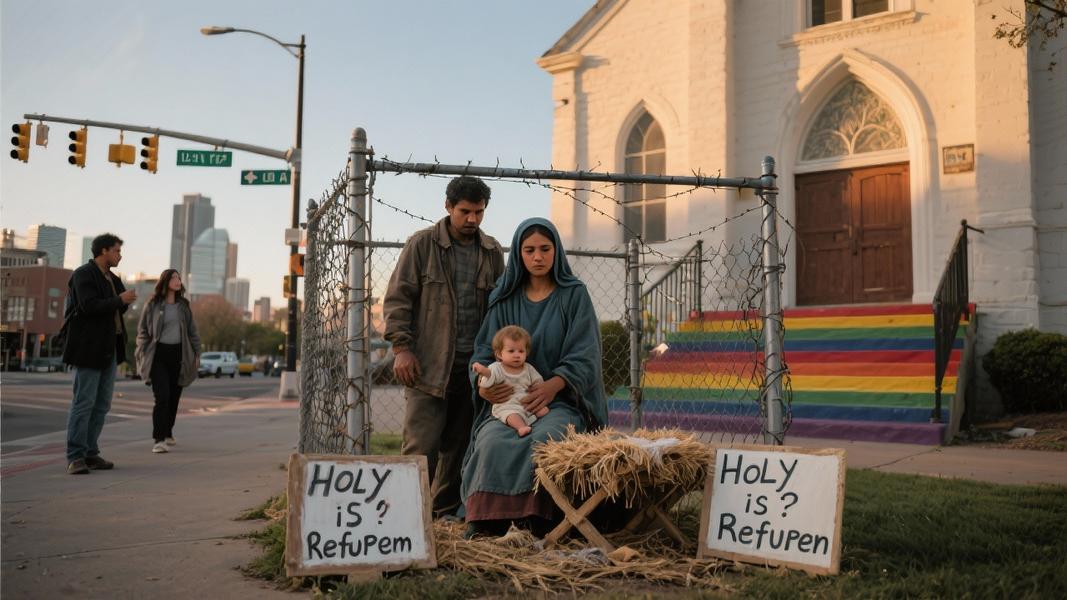
In the heart of Dallas, Texas, a nativity scene is turning heads and hearts — not with its traditional depiction of the birth of Jesus, but with barbed wire, chain-link fencing, and bicycle wheel halos. Oak Lawn United Methodist Church has reimagined the Holy Family as modern-day migrants detained at the border, creating a striking visual commentary on immigration policy right at the busy intersection of Oak Lawn Avenue and Cedar Springs Road.
The installation features silhouettes of Mary, Joseph, and baby Jesus enclosed behind razor wire-topped fencing, surrounded by shopping carts and metal bins commonly used by unhoused people. It’s a far cry from the peaceful stable scene most Americans recognize, and that’s exactly the point, according to church leadership.
“God is with us, especially on the margins,” Rev. Rachel Griffin-Allison explained. “And what better way to truly lean into that kind of theology than to paint a very real picture of what the holy family would be experiencing in our culture right now today.”
The display, prominently positioned on the church’s front steps during the Advent and Christmas season, includes posters from the hymn “Holy is the Refugee” with phrases like “Holy are the profiled and patrolled” and “Holy are our unsheltered neighbors” in both English and Spanish — a nod to the trilingual congregation that worships there.
What makes this nativity particularly powerful?
For many Christians, the biblical narrative already contains themes of displacement — Mary and Joseph traveled to Bethlehem for a government census and later fled to Egypt to escape violence. The Oak Lawn display simply updates this journey to reflect contemporary realities. “The Holy Family were migrants seeking safety. In Dallas, many families face the same uncertainty,” reads the church’s explanation of the installation.
Associate Pastor Rev. Isabel Marquez sees the display as more than just seasonal decoration. “This topic is sending a message to everyone,” Marquez told local media. “It is a way to say what is a reality happening here for many people.”
Oak Lawn United Methodist describes itself as a “radically inclusive” community, emphasizing unconditional love and justice as core values. The congregation meets for Sunday worship at 11 a.m. at their location on Oak Lawn Avenue, where the controversial nativity now stands as both religious symbol and political statement.
The display’s message resonates differently depending on who’s viewing it. For some, it’s a provocative challenge to consider immigration policy through a religious lens. For others, it’s a reminder that the Christmas story has always been about finding room for the vulnerable in a world that often turns them away.
Either way, as thousands of Dallas commuters pass by this unusual nativity scene each day, the barbed wire gleaming in the Texas sun accomplishes something increasingly rare in religious discourse — it makes the ancient story feel urgently, uncomfortably relevant.
