
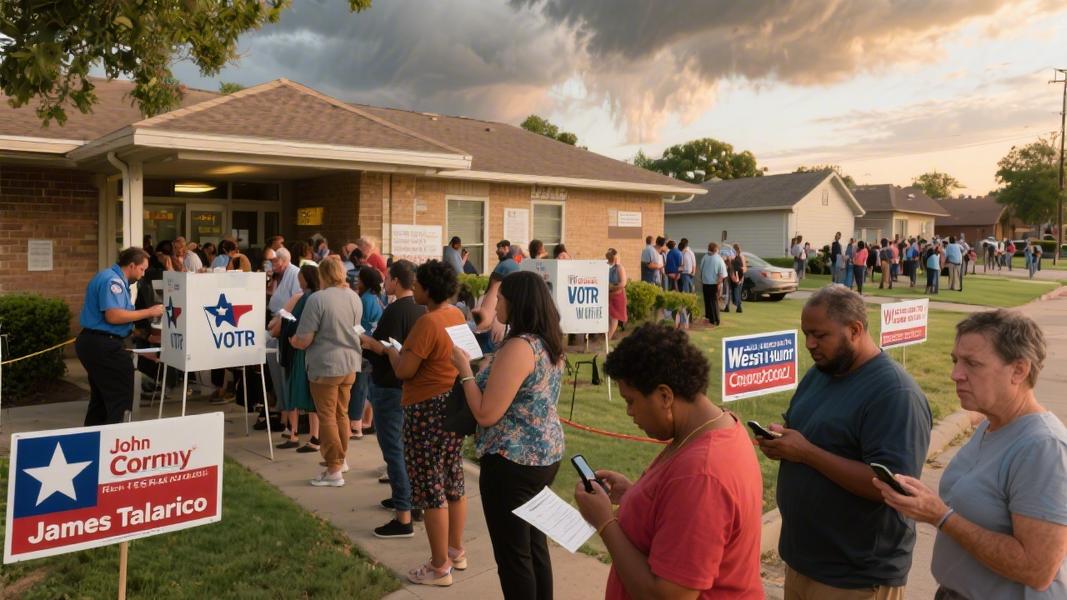
Voters in Dallas County showed up to cast their ballots Tuesday — only to find out they were at the wrong polling place. And for some, that was the end of it.
Texas held its March 3, 2026 primary elections statewide, with high-profile races drawing millions to the polls. But the day was quickly overshadowed in Dallas County by a wave of voter confusion, misdirected residents, and a political blame game that started before the final ballots were even counted. It’s a mess that raises uncomfortable questions about whether the system is working — or whether, as some Democrats allege, it was never meant to.
A Split Primary, A Messy Rollout
Here’s the backdrop: this is the first time in 15 years that Dallas County voters have been required to vote at precinct-specific polling locations based on their party primary. The shift was triggered by the Dallas County Republican Party, which formally requested a split primary — a move that, under state law, forced the local Democratic Party to follow the same rules whether they wanted to or not. They didn’t. Reported by the Texas Tribune, it’s the kind of procedural wrinkle most voters never see coming until they’re standing outside the wrong building on Election Day.
Making things worse, the Texas Secretary of State’s website listed incorrect polling locations for some Dallas County voters. The Secretary of State’s office didn’t exactly fall on its sword over that one. “The polling location data in this portal is maintained by the counties, not the Office of the Texas Secretary of State,” the office said in a statement. “Dallas County identified issues with their polling location data, and our office has been working with Dallas County to address these issues. We have included a notice on the voter portal directing voters registered in Dallas County to the county website for more information.” In other words: not our problem, check elsewhere. Noted KSAT, Dallas County Democrats wasted no time requesting an extension of polling hours until 9 p.m. in response.
Democrats Cry Suppression
The frustration boiling over from the Democratic side was sharp and pointed. In a lengthy statement that made the rounds Tuesday, party leaders didn’t mince words — calling the precinct-specific voting requirement a deliberate effort to confuse and disenfranchise voters. “The Dallas County Republicans and Williamson County GOP chose to implement precinct-specific voting locations for election day,” the statement read. “Under state law, this forced the local Democratic parties to follow suit against our will. Both Dallas and Williamson county voters have grown accustomed to countywide voting, including on election day. This effort to suppress the vote, to confuse and inconvenience voters is having its intended effect as people are being turned away from the polls.” The message closed with a rallying cry: “Do not give up and do not give in.” Covered extensively, the statement came as Democratic U.S. Senate candidates Jasmine Crockett and James Talarico were locked in a tight nomination fight — a race where every vote mattered.
Still, the early numbers told a different story about Democratic enthusiasm. Roughly 2.5 million Texans cast ballots during the early voting period statewide, with Democrats actually outpacing Republicans in that window. Dallas County Democrats alone shattered their own record with nearly 188,000 early votes — a figure that suggests the base was fired up long before Tuesday’s chaos began.
The Senate Race Everyone’s Watching
Whatever happens with the logistics, the stakes in the actual races couldn’t be higher. On the Republican side, U.S. Senator John Cornyn — who’s held his seat since 2002 and won re-election three times — is facing the most serious challenge of his Senate career. He’s up against Attorney General Ken Paxton, who survived his own impeachment trial and came out swinging, and Congressman Wesley Hunt, a rising star in the state party. If no candidate clears 50 percent, a runoff in May is all but certain. Outlined Click2Houston, it’s a three-way race with no obvious runway to a first-round win.
On the Democratic side, Crockett has leaned hard into her reputation as a sharp, combative voice — someone willing to throw elbows in a political climate that rewards exactly that. Talarico, meanwhile, has built his campaign around mobilizing younger voters, betting that a generational pitch can carry him past a more established opponent. It’s a classic contrast: fire versus future.
Elsewhere, More Wrinkles
Dallas wasn’t the only county with election day headaches. In Collin County, officials had made the switch to hand-marked paper ballots ahead of the primary — a move framed as a security upgrade. But long lines formed at several locations after poll workers ran into machine troubles, slowing things down considerably. Tracked by the Secretary of State’s results portal, it was the kind of irony that writes itself: a system designed to inspire more confidence in the process creating more friction on the ground.
That’s the catch, really. Whether it’s outdated website data, precinct-level rule changes that most voters never heard about, or new equipment that wasn’t quite ready for prime time — the machinery of democracy in Texas showed its age on Tuesday. And for the voters who got turned away, the reason probably didn’t matter much. They came. They tried. They were told to go somewhere else.
The question that lingers isn’t just who wins these races — it’s whether, by the time the runoffs roll around in May, anyone bothers to fix what broke today.
