
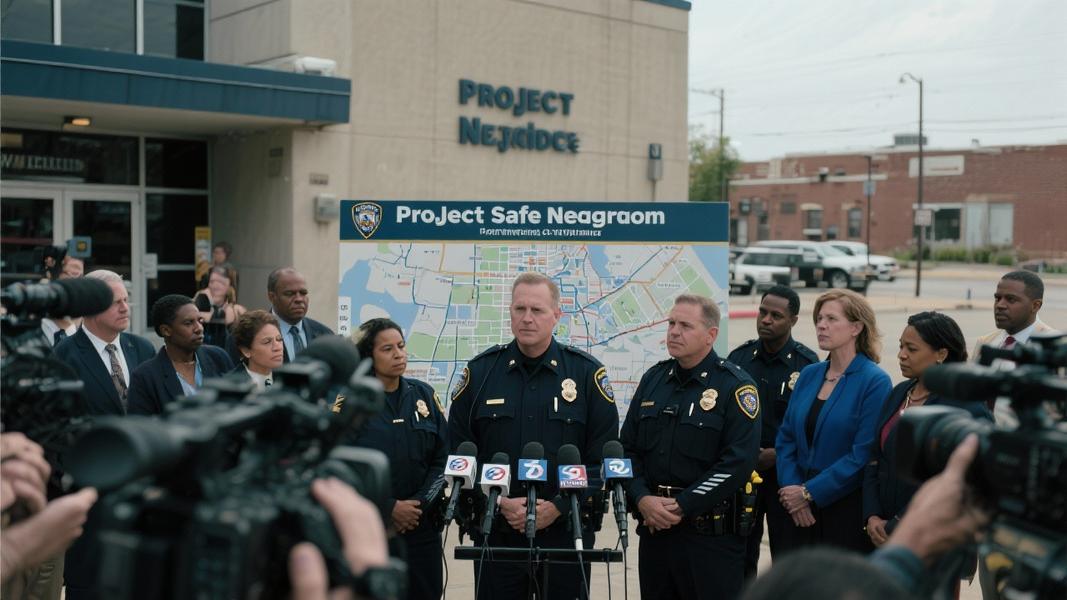
Federal and local authorities have drawn a line in the sand across a troubled stretch of Northwest Dallas, announcing an aggressive expansion of Project Safe Neighborhoods to combat organized crime, human trafficking, and illegal firearms.
The initiative, revealed at Marcus Park Recreation Center on February 3, targets a specific area from Forest Lane south to Loop 12 and from North Walton Walker Boulevard east to Webb Chapel Road — with special attention to the blocks surrounding Harry Hines Boulevard, long known as a hotspot for criminal activity.
A Coalition of Force
The announcement brought together an impressive array of law enforcement brass, signaling the seriousness of the effort. U.S. Attorney Ryan Raybould stood alongside representatives from the ATF, DEA, FBI, Homeland Security Investigations, Dallas Police, IRS Criminal Investigation, and Texas Department of Public Safety.
“Our goals for NW Dallas are direct and measurable,” said Raybould. “Disrupt and reduce violent crime linked to narcotics, firearms and human trafficking. Increase early victim identification.”
Dallas Police Chief Daniel Comeaux didn’t mince words about what awaits those engaged in criminal enterprises. “There’s definitely groups we’re looking at. But that’s something that we won’t share because, like I’ve been saying since I’ve got here, if you’re committing crimes and you’re doing criminal activity in Dallas, we’re going to come after you,” Comeaux stated. “We’re going to get you. We’re gonna put you in jail. And this is just a collaboration and the partnership that we have to make that happen.”
Not Just Another Initiative
What makes this different from previous crime-fighting announcements? According to Raybould, “This expansion is not symbolic. It is strategic.”
Project Safe Neighborhoods isn’t new — it was launched federally in 2001 and is already active in Northeast Dallas and other Texas cities. But its research-driven approach has evolved over two decades, focusing on a four-pronged strategy: community engagement, prevention and intervention, focused enforcement, and accountability.
The FBI’s Jeremy Wright clarified the mission in stark terms: “We’re going to reduce violent crime. We’re going to go after human trafficking. We’re going to go after firearms trafficking. And we’re going after narcotics distribution.”
While immigration enforcement isn’t the primary focus, Wright added that “if someone is an illegal alien, they’re committing a crime. They will be arrested and prosecuted.”
Resources and Strategy
How exactly will this work? The program provides funding for additional prosecutors, investigators, training, gun safety kits, and community outreach initiatives. Projects under the latest funding cycle can start as early as October 1, 2025, and run for up to 12 months.
But officials emphasize that PSN isn’t just about arrests and prosecutions. The initiative aims to build safer neighborhoods through comprehensive, coordinated, and community-based principles that address the root causes of violent crime.
Harry Hines Boulevard has long been a trouble spot for Dallas authorities. The area has become notorious for sex trafficking operations, drug dealing, and gun violence — a perfect storm of criminal activity that has proven resistant to previous enforcement efforts.
“This is an area that’s been suffering from violent crime, drug dealing, firearms trafficking, and human trafficking,” Raybould noted. The coordinated approach under PSN aims to change that reality by bringing unprecedented resources and attention to the neighborhood.
For residents and businesses in Northwest Dallas, the initiative represents a potential turning point — if the strategic promises translate into tactical success on streets that have waited too long for relief.
