
A man shot and killed by Dallas police this week wasn’t just a fugitive with an outstanding warrant — he was also working as a personal security guard for a sitting member of Congress.
The incident has raised serious questions about how Diamon-Mazairre Robinson, a 39-year-old convicted felon, managed to embed himself in the orbit of U.S. Rep. Jasmine Crockett while simultaneously operating what authorities describe as a sprawling impersonation scheme built on fake badges, stolen license plates, and borrowed identities. Robinson was shot and killed by Dallas police late Wednesday night after barricading himself in a vehicle at a parking garage at Children’s Health Hospital in Dallas.
A Standoff at the Hospital
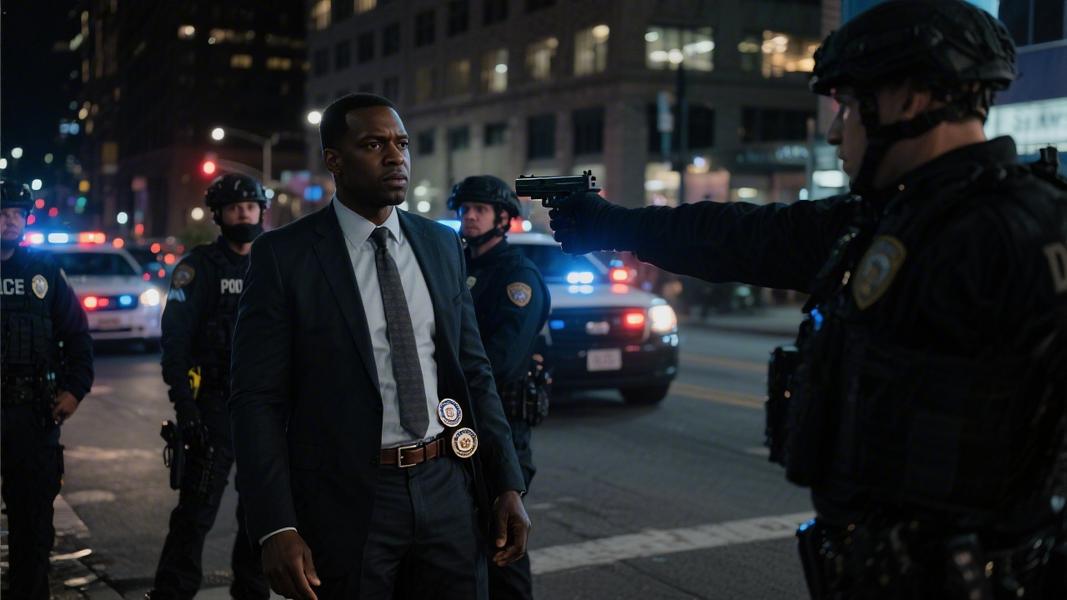
It ended the way these things rarely do — with tear gas and gunfire in a hospital parking garage. According to Dallas police, their fugitive unit had been tracking Robinson as part of an active investigation when he barricaded himself inside a vehicle sometime around 11 p.m. Wednesday. Officers deployed tear gas to force him out. When Robinson emerged, he was armed. “He came out of the vehicle, he had a gun, he pointed a gun towards officers. Officers shot and fired,” a department spokesperson stated. Robinson died at the scene.
By Saturday, sources had publicly identified the suspect — a man most people knew not as Diamon-Mazairre Robinson, but as “Mike King.” That alias, it turns out, was just one piece of a much larger fiction.
The Man Behind the Badge — Except There Was No Badge
Robinson wasn’t a cop. He never was. But he apparently worked hard to make sure people thought he was. Sources told CBS News Texas that Robinson told officers he knew — officers he’d hired through his own private security firm — that he was a detective with U.S. Capitol Police. That claim, investigators believe, may have triggered the federal probe that ultimately led to this week’s manhunt.
It gets stranger. Robinson drove a replica undercover police vehicle and reportedly used license plates stolen from cars parked outside a military recruiting office, according to sources cited by CBS News Texas. He also ran a business that placed off-duty law enforcement officers in private security jobs — a setup that gave him constant, credible proximity to real police while he posed as one himself. All of this, sources say, while being a convicted felon.
Investigators found weapons inside Robinson’s vehicle. He had also reportedly been carrying a firearm during off-duty protection details — including, sources say, for politicians.
The Crockett Connection
That last detail is what makes this story more than a crime blotter item. Fox 4 News confirmed that Robinson had served as a longtime security guard for Rep. Jasmine Crockett, the Democratic congresswoman from Texas’s 30th district who has become one of the more prominent progressive voices in Washington. It’s not clear how long the arrangement lasted or what vetting, if any, was done before Robinson was placed in that role.
So how does a convicted felon running an identity scheme end up guarding a member of Congress? That’s the question nobody’s fully answered yet. Crockett’s office has not made detailed public statements about the nature of Robinson’s employment or how he came to be hired. The broader implications — for congressional security protocols, for the private security industry, for the off-duty officers who unknowingly worked under a man impersonating a federal detective — are still unfolding.
FIFA Security Contracts Were Next
Robinson’s ambitions, it seems, didn’t stop at Capitol Hill protection details. Sources told CBS News Texas that he had been actively promoting security positions for the upcoming FIFA World Cup games in the Dallas-Fort Worth area, advertising jobs at $90 per hour through his officer placement service. Whether any officers signed on for those contracts — and what becomes of those arrangements now — remains unclear.
Still, the sheer audacity of the operation is hard to ignore. This wasn’t a low-level grift. Robinson built something that looked, from the outside, like a legitimate business — complete with real law enforcement clients, a convincing vehicle, and a persona professional enough to pass close scrutiny for what appears to have been years.
What Comes Next
Dallas police have not released a full accounting of the federal investigation that led to Robinson’s warrant, and it’s likely that details will emerge slowly as authorities piece together the scope of his impersonation activities. The officers who worked jobs through his placement service — some of whom may have had no idea who they were really working for — could find themselves pulled into those inquiries as witnesses.
For Rep. Crockett, the revelation presents a different kind of reckoning: not a legal one, necessarily, but a political and personal one. Knowing that the man tasked with keeping you safe was himself a fugitive operating under a false identity is, at minimum, unsettling. At most, it’s a serious institutional failure somewhere along the chain.
Robinson is dead. The alias “Mike King” died with him. But the questions he left behind — about who knew what, and when, and how a man like this slipped so cleanly into the spaces where trust is supposed to be ironclad — those are going to take considerably longer to answer.
