
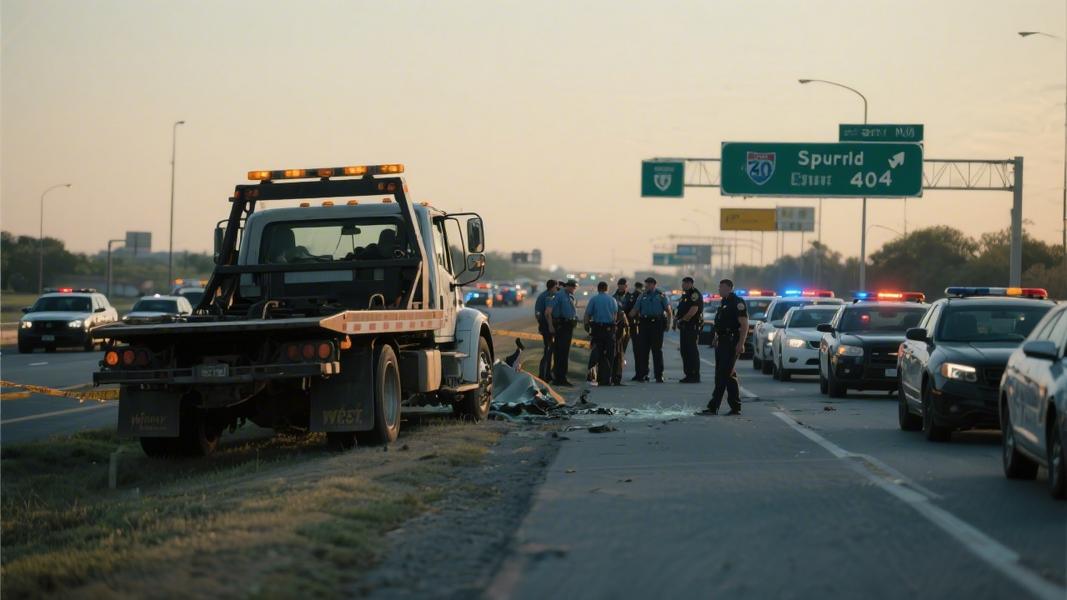
The roads in and around Dallas have been unforgiving lately — and the body count is starting to demand attention.
A string of deadly crashes along Interstate 20 and surrounding Dallas-area roads has left multiple people dead, several others injured, and at least one truck driver facing serious criminal charges. The incidents — spanning from Duncanville to Terrell and deep into the city itself — paint a troubling picture of highway safety in one of the nation’s busiest freight corridors.
Tow Operators Caught in the Crossfire
One of the more gut-wrenching scenes unfolded on eastbound I-20 near Cedar Ridge Drive in Duncanville, where a FedEx truck slammed into two wreckers that were stopped on the shoulder. One tow truck driver was killed. Another was injured. These are workers who show up to make the roads safer for everyone else — and they paid for it with their lives and their bodies, as reported by local news.
The crash happened on Wednesday, February 7, and the tow industry took notice fast. It’s a recurring nightmare for operators who spend their shifts parked inches from live traffic. As documented by industry publication Tow Times, incidents like this one aren’t anomalies — they’re an occupational hazard that the profession has been fighting to address for years.
A Predawn Ejection on the Same Stretch
Just miles away, on eastbound I-20 near Wheatland Road in Dallas, another life ended in the early morning darkness. At 2:34 a.m., a pickup truck rolled over and the driver was ejected — killed on impact. No passengers. No witnesses initially. Just a wreck and a body on the asphalt, as noted by DFW Scanner. These are the crashes that don’t always make the evening news, but they’re happening constantly.
Five Dead in Terrell — and a Driver Who Allegedly Fell Asleep
Then there’s Terrell. That’s where things got catastrophic.
A semi-truck driver identified as Alexis Osmani Gonzalez-Companioni allegedly dozed off behind the wheel and plowed into a Ford F-150 and several other vehicles on I-20 near Hiram Road. Five people died. One was hospitalized. Witnesses who saw it happen are still trying to process what they watched unfold in front of them.
“So I looked up and I saw the first truck, I saw his brake lights, saw the F-150, and here comes this tractor trailer,” witness Mulcahy recalled. “And I’ll tell you, man, I don’t know how many miles an hour he was going when he was driving, but he hit that car, and I knew he killed everybody in that truck.” That kind of certainty — the gut-level, instant recognition that you’ve just watched people die — is something no bystander should have to carry.
Gonzalez-Companioni was subsequently indicted on manslaughter and aggravated assault charges. A prosecutor summed up the grand jury’s deliberations with pointed brevity: “I don’t imagine the grand jury spent much time in reaching their decision,” as stated in coverage of the indictment proceedings. Hard to argue with that.
A Red Light, a Drunk Driver, and Singleton Boulevard
It’s not just the highways. On the night of February 1, 2026, around 8:30 p.m., an eastbound pickup truck blew through a red light in the 2000 block of Singleton Boulevard in Dallas and struck a sedan. One person died. Two others were injured. The pickup’s driver was arrested on charges of intoxication manslaughter and intoxication assault, as covered in subsequent reporting. A preventable death, by any measure — the kind that leaves families asking why someone got behind the wheel in that condition.
A Region That Needs to Reckon With Its Roads
Still, it’s worth stepping back. These aren’t random, unrelated tragedies scattered across a map. They’re clustered. They’re recurring. And they involve a mix of fatigued commercial drivers, impaired motorists, and workers whose jobs put them directly in harm’s way — all converging on the same overburdened infrastructure.
I-20 through North Texas is one of the most heavily trafficked freight routes in the country. That’s not going to change. What could change — in theory — are the regulations governing how long truckers drive without rest, the enforcement of move-over laws that are supposed to protect tow operators, and the consequences waiting for anyone who chooses to drink and drive. Whether those changes actually come is another question entirely.
For now, the families of the dead are left with something no policy fix can touch: the specific, irreversible weight of losing someone to a road that didn’t have to be this dangerous.
