
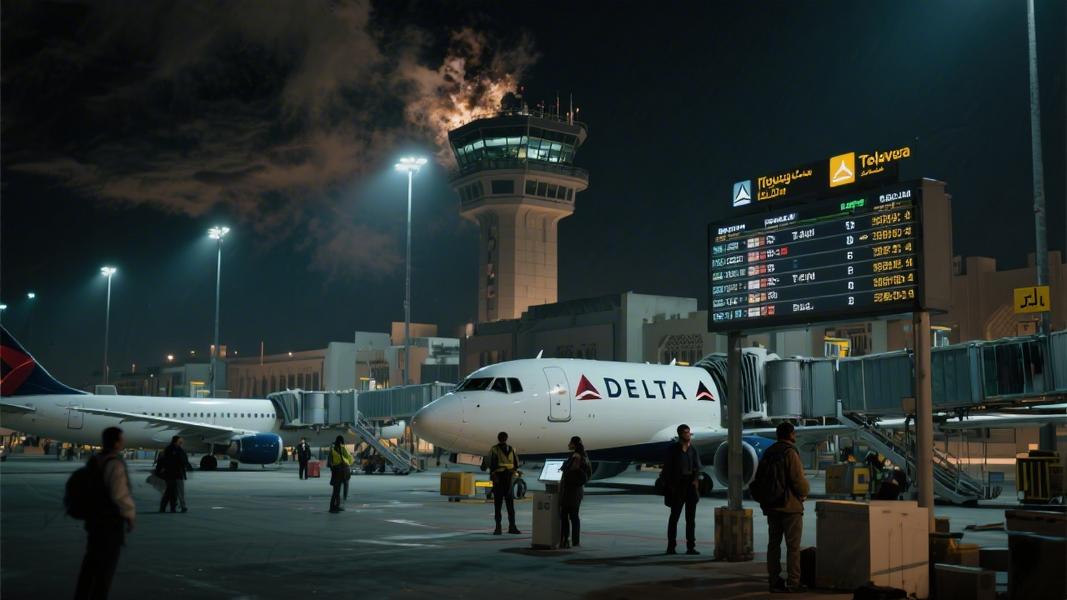
The skies over Tel Aviv went quiet fast. Within hours of the United States and Israel launching a joint military strike against Iran on Saturday, airlines were pulling flights, airspace was slamming shut, and travelers were left scrambling.
Delta Air Lines has suspended all service to Tel Aviv through at least Sunday, becoming one of several major carriers to ground operations in the region after the unprecedented military action sent shockwaves through global aviation. It’s not just an inconvenience — it’s a signal of just how rapidly the security calculus shifted on the ground.
A Sudden Shutdown
The strikes began on February 28, 2026, and the fallout was nearly immediate. Israeli airspace closed. Iranian airspace closed. Iraqi airspace followed. The result was a cascading series of cancellations and diversions that rippled outward across the region and into Europe. As one travel outlet noted, the closure of Israeli airspace came swiftly on the heels of the first strikes — “On 28 February 2026, the US and Israel commenced joint military action in Iran, Israeli airspace has now closed.”
Delta, for its part, isn’t saying much beyond the standard reassurance. “The safety of our customers and employees remains our top priority,” the airline said in a statement, adding that it is “continuously monitoring the evolving security environment and assessing our operations based on security guidance and intelligence reports.” Boilerplate, yes — but under the circumstances, probably the only thing a major carrier can responsibly say.
Delta Isn’t Alone
How wide is the disruption? Wider than Delta’s suspension alone suggests. A growing list of carriers — including United, Air France, KLM, Aegean Airlines, and FlyDubai — have all suspended or cancelled flights to Tel Aviv in the wake of the strikes, according to reports compiled from regional aviation sources. That’s not a handful of cautious operators hedging their bets. That’s a near-total commercial withdrawal from one of the region’s busiest aviation hubs.
Delta’s own travel advisory page has been updated to reflect the new reality. The airline confirmed that travel to, from, or through the Tel Aviv area “may be impacted” as of 10:58 AM ET on February 28 — a timestamp that captures, almost to the minute, how quickly the situation deteriorated.
What Comes Next
Still, the picture beyond Sunday remains murky. Delta has said updates will be communicated “as they are available” — which is airline-speak for: we don’t know yet either. The duration of any airspace closures, the scope of ongoing military activity, and the diplomatic fallout will all determine when — or whether — normal flight operations resume anytime soon.
That’s the catch. Unlike a weather delay or a mechanical issue, this isn’t a problem that gets resolved with a few phone calls and a maintenance crew. The region is in the middle of an active military conflict involving two of the world’s most powerful armed forces. Commercial aviation doesn’t come back until the guns go quiet — and right now, no one is sure when that is.
For passengers caught mid-itinerary or booked in the days ahead, the advice is simple and frustrating in equal measure: watch the advisories, stay flexible, and don’t assume anything. The skies over the Middle East have been redrawn overnight, and the timetable for redrawing them back is anyone’s guess.
