
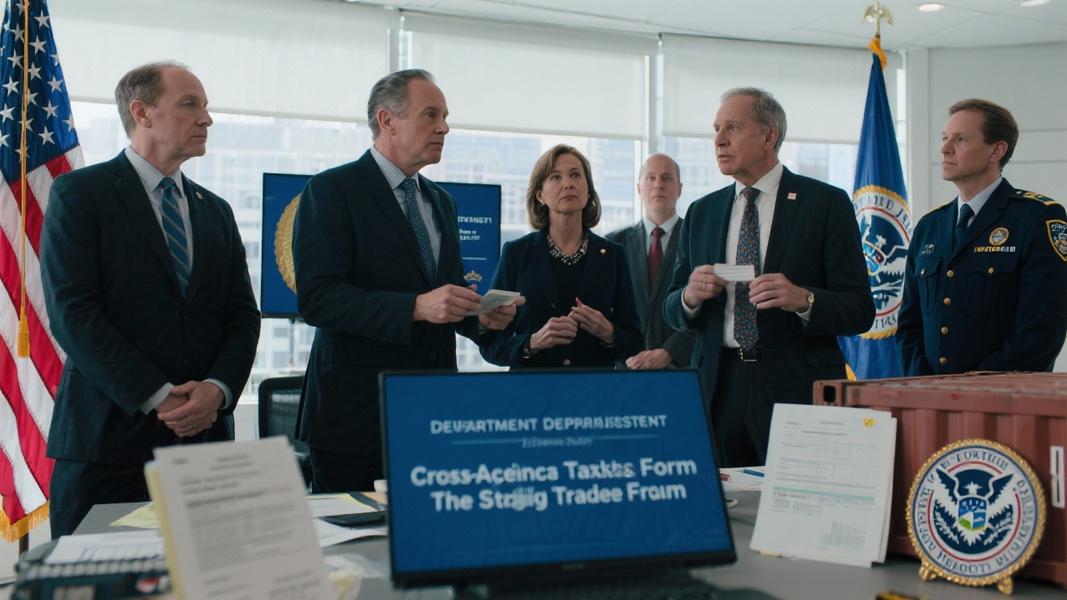
The Department of Justice is taking the gloves off in the fight against trade fraud, launching a new cross-agency task force aimed at companies that evade tariffs or smuggle prohibited goods into American markets — a move that signals a dramatic escalation in enforcement under the administration’s “America First” trade policy.
The Trade Fraud Task Force, announced yesterday, will combine resources from both the DOJ’s Civil and Criminal Divisions alongside Department of Homeland Security agencies to crack down on importers who circumvent trade laws, including antidumping regulations, countervailing duties, and Section 301 tariffs that have become central to U.S. trade strategy in recent years.
“The Task Force will augment the existing coordination mechanisms within the Department of Justice and leverage expertise from both the Civil and Criminal Divisions, as well as the Department of Homeland Security, to aggressively pursue enforcement actions against any parties who seek to evade tariffs and other duties, as well as smugglers who seek to import prohibited goods into the American economy,” the DOJ stated in its announcement.
Consolidating Resources
Behind the scenes, the DOJ has been reorganizing its enforcement muscle. The department has consolidated its Criminal Division’s Fraud Section units and Civil Division resources into a newly created Market, Government, and Consumer Fraud Unit (MGCF Unit) — a significant restructuring designed specifically to target trade fraud and tariff evasion.
What’s driving this renewed focus? The expanded tariff regime implemented during the Trump Administration has created new opportunities for evasion schemes, particularly involving imports from China and other countries targeted by trade actions.
The DOJ’s Major Frauds Unit, which had approximately 34 attorneys in 2024, has expanded and been renamed as the Market, Government and Consumer Fraud Unit. This beefed-up unit will focus on prosecuting various tariff evasion techniques, including misclassification of goods, undervaluation, transshipping, or relabeling a product’s country of origin to take advantage of lower tariff rates, according to legal experts familiar with the changes.
Assistant Attorney General Brett A. Shumate emphasized that the task force is aligned with broader economic goals. “The President’s America First Trade Policy supports American manufacturing by ending unfair trade practices. The Civil Division will coordinate with law enforcement partners to bring to justice any parties attempting to harm American workers through evasion of tariffs and other duties,” Shumate remarked.
National Security Implications
Is this just about money? Not according to DOJ officials, who are increasingly framing trade fraud as a matter of national security.
A May 12, 2025 memorandum from Matthew Galeotti, Head of DOJ’s Criminal Division, explicitly links trade fraud to national security by characterizing tariff evasion as a threat to American competitiveness and industrial policy. Companies importing strategic goods like steel, semiconductors, electric-vehicle batteries, or dual-use chemicals should expect heightened scrutiny and possible coordination with FBI counter-intelligence squads, legal analysts warn.
“For years, nefarious importers and their co-conspirators have put law-abiding businesses in the United States at a competitive disadvantage — and cheated the American public of funds — by brazenly committing trade fraud,” said Acting Assistant Attorney General Matthew R. Galeotti of the Criminal Division. “Trade fraud is not a victimless crime, and it won’t be tolerated. The Criminal Division, led by the Fraud Section, is committed to using every available tool to hold bad actors accountable and prevent the theft of money intended to reduce the deficit and fund government programs,” he added.
Enforcement Already Underway
The DOJ isn’t waiting to flex its enforcement muscles. Deputy Assistant Attorney General Brenna Jenny highlighted recent progress, noting, “Since March of this year, the Commercial Litigation Branch has reached civil settlements to resolve allegations of improperly evaded customs duties across a wide range of products, including multi-layered wood flooring, plastic resin, extruded aluminum products, and quartz surface products.” The department is also actively seeking whistleblower contributions to identify additional fraud schemes, Jenny noted.
Companies involved in import operations should be particularly concerned about the DOJ’s aggressive new asset-seizure strategy. The Criminal Division has directed attorneys to identify and forfeit assets traceable to customs schemes, potentially freezing receivables, escrow accounts, or inventory in U.S. warehouses to secure anticipated criminal penalties, according to legal publications.
The Task Force aligns with Executive Order 14243, which aims to improve the government’s ability to detect overpayments and fraud. It will collaborate closely with Department of Homeland Security partners, particularly U.S. Customs and Border Protection and Homeland Security Investigations (HSI), to identify and target trade fraud threatening economic and national security interests.
Whistleblower Focus
In a notable push for insider information, the Task Force is actively encouraging whistleblowers to submit referrals of trade fraud via the Criminal Division’s Corporate Whistleblower Program at [email protected]. Officials are also promoting the use of False Claims Act qui tam provisions, which allow private parties to file lawsuits on behalf of the government and potentially share in any financial recovery.
Assistant Director Ivan Arvelo of ICE Homeland Security Investigations expressed strong support for the initiative. “With unique customs authorities, expertise, generations of experience carried forward from the legacy U.S. Customs Service, and a steadfast commitment to interagency collaboration, ICE HSI’s Global Trade Division is fully committed to partnering with the Department of Justice and U.S. Customs and Border Protection to strengthen the investigations of trade-related crimes,” Arvelo commented.
For businesses caught in potential violations, the DOJ is offering an olive branch of sorts. The Task Force encourages importers and their agents to conduct thorough audits of their importing practices and voluntarily self-disclose any unlawful behavior, consistent with Justice Department guidelines that can potentially reduce penalties for cooperative entities.
But make no mistake — this isn’t just another bureaucratic reshuffling. With expanded resources, cross-agency coordination, and a mandate tied directly to the administration’s trade priorities, the new Task Force signals that companies playing fast and loose with trade laws may soon find themselves squarely in the government’s crosshairs.
