
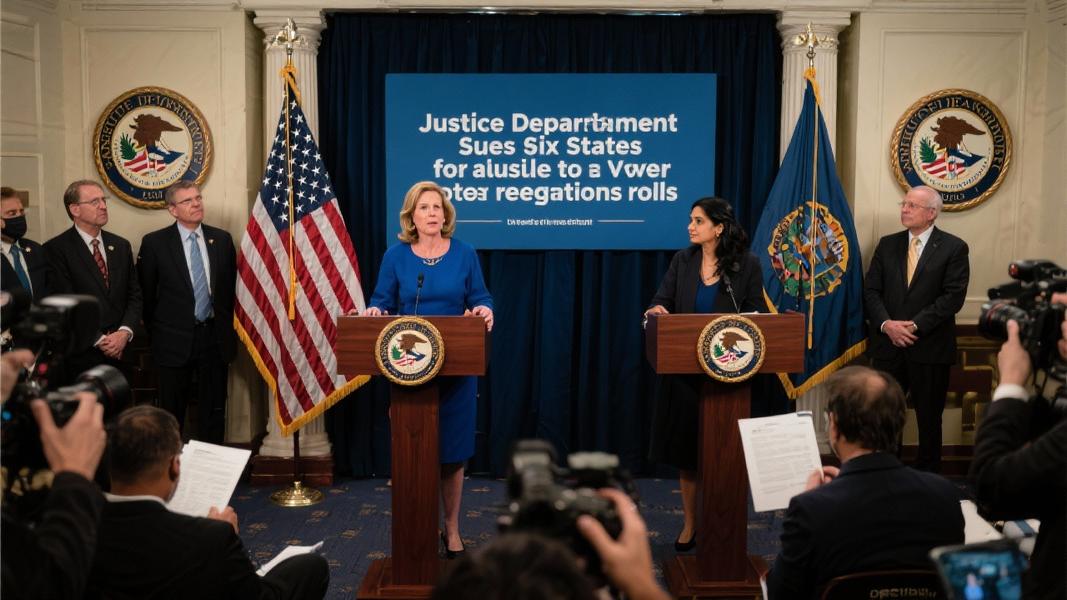
The Justice Department has launched a sweeping legal offensive against six states for refusing to turn over their voter registration data, escalating tensions between federal authorities and state election officials with just weeks to go before November’s presidential election.
In an extraordinary move, the DOJ’s Civil Rights Division filed federal lawsuits on Wednesday against California, Michigan, Minnesota, New York, New Hampshire, and Pennsylvania, accusing them of violating federal law by failing to provide their complete voter rolls upon request. The legal actions mark a significant expansion of the department’s earlier suits against Maine and Oregon for similar alleged violations.
A Nationwide Push for Voter Data
Attorney General Pamela Bondi didn’t mince words about the administration’s position. “Clean voter rolls are the foundation of free and fair elections,” Bondi stated. “Every state has a responsibility to ensure that voter registration records are accurate, accessible, and secure — states that don’t fulfill that obligation will see this Department of Justice in court.”
The lawsuits come after months of increasingly aggressive demands from the Justice Department for comprehensive voter data from states nationwide. In Nebraska, for example, officials received requests for sensitive information including names, addresses, birth dates, driver’s license numbers, and even partial Social Security numbers of all registered voters — with tight compliance deadlines that some state officials have characterized as unreasonable.
Why now? The timing has raised eyebrows among election officials and voting rights advocates, who question the urgency of such comprehensive data collection so close to a presidential election. The DOJ, however, insists these actions are simply enforcement of existing federal law.
Legal Basis for Federal Demands
The Justice Department claims authority under multiple federal statutes. According to court filings, the Attorney General is “uniquely charged by Congress” with enforcing the National Voter Registration Act, the Help America Vote Act, and provisions of the Civil Rights Act of 1960 that allow federal authorities to demand production and inspection of statewide voter lists.
Assistant Attorney General Harmeet K. Dhillon, who heads the Civil Rights Division, has been the driving force behind these efforts. “States are required to safeguard American elections by complying with our federal elections laws,” Dhillon explained. “Clean voter rolls protect American citizens from voting fraud and abuse, and restore their confidence that their states’ elections are conducted properly, with integrity, and in compliance with the law.”
But state officials have pushed back on multiple fronts. Some have complied partially while negotiating over the scope and security of data transfers. Others, like Minnesota and Maine, have taken a harder line, rejecting the requests outright — leading to the current wave of litigation.
Privacy Concerns vs. Federal Authority
The demands have sparked serious privacy and security concerns. State officials worry about the federal government collecting massive databases containing sensitive personal information of millions of voters, particularly as the requests include partial Social Security numbers and other identifiers typically protected under state law.
That said, the Justice Department insists these measures are necessary to ensure election integrity. The lawsuits against all six states were filed in their respective federal district courts, setting up what could be protracted legal battles even as the election approaches.
The standoff reflects deeper tensions between federal and state authority over election administration. While states traditionally manage their own elections, federal laws do provide oversight mechanisms — but the scope of that oversight is precisely what’s being contested now.
“This isn’t just about compliance with technical requirements,” one state election official said, speaking on condition of anonymity. “It’s about fundamental questions of federalism and data privacy in an era of increasing cybersecurity threats.”
As courts begin to consider these cases, the clock is ticking toward November. Whether these legal battles will be resolved before Election Day — and what impact they might have on election administration — remains to be seen. What’s clear is that voter rolls, once an obscure administrative matter, have become the latest battleground in America’s increasingly contentious fights over how elections are conducted.
