
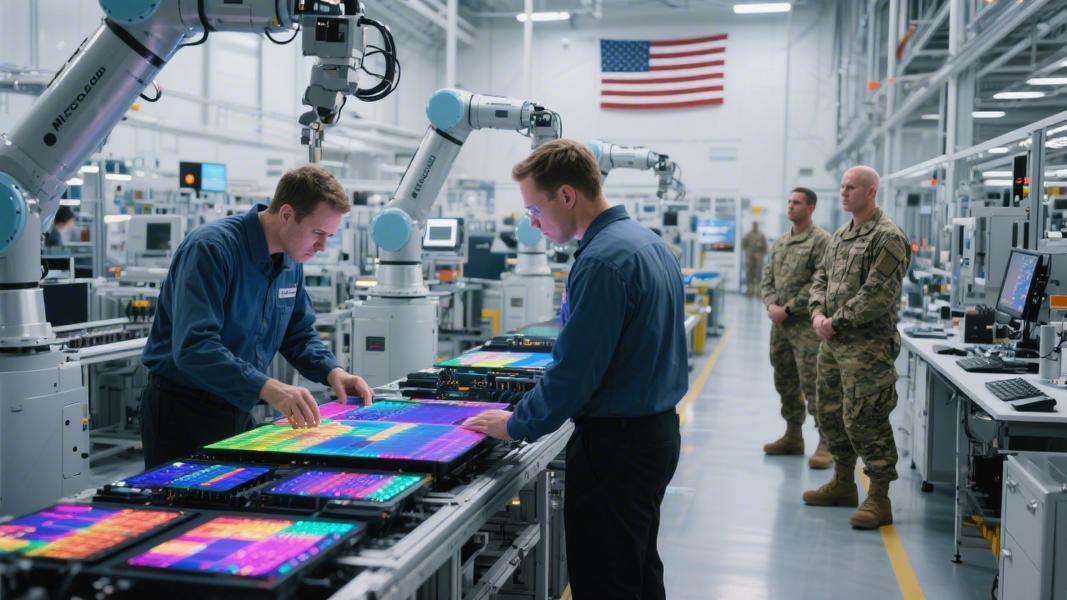
The Department of War is pouring $24.5 million into MicroLED display manufacturing, splitting the funds between Massachusetts-based Kopin Corporation and California’s Tectus Corporation in a bid to secure domestic supply chains for critical defense technologies.
The September 2025 investment, announced by DoW officials last week, targets the development of cost-effective manufacturing processes for displays that will be integrated into next-generation weapon systems, from heads-up displays for pilots to advanced night vision goggles.
“Microdisplays are crucial components in delivering information to the joint warfighter and are integrated into solutions across all domains,” said Assistant Secretary of War for Industrial Base Policy Michael Cadenazzi. “Securing a domestic supply of advanced MicroLED displays is vital for the Department’s next-generation defense applications, ensuring both performance and security.”
Manufacturing Renaissance
This latest funding represents just a fraction of the Department’s broader industrial base strategy. Since 2014, the Innovation Capability and Modernization Office has invested over $2.6 billion across 205 projects aimed at restoring domestic manufacturing capacity.
The push comes amid a significant realignment of defense priorities under Secretary of War Pete Hegseth, who recently approved the merger of the Defense Innovation Board and Defense Science Board into the new Science and Technology Innovation Board (STIB), according to Department records.
Additive manufacturing — commonly known as 3D printing — has emerged as a particular focus, with $3.3 billion allocated in the FY2026 budget. Why such a massive investment? The technology promises to dramatically reduce costs while increasing battlefield responsiveness.
“The parts could be 3D-printed at higher quality for about $3,000 and $60, respectively, but cost $14,000 and $47,000 for full assembly replacements from the manufacturer,” explained US Secretary of the Army, Dan Driscoll, highlighting the potential savings.
Strategic Investments
The Department isn’t limiting its industrial base investments to smaller players. In a move that raised eyebrows on Wall Street, DoW recently committed $1 billion in a direct-to-supplier convertible preferred equity investment in L3Harris’ Missile Solutions business, aimed at expanding U.S. solid rocket motor production capacity.
These investments align with the 2026 National Defense Strategy’s emphasis on revitalizing the Defense Industrial Base through manufacturing revival, workforce growth, and strategic partnerships — particularly for critical munitions and platforms.
The strategy is backed by serious money. The Fiscal Year 2026 National Defense Authorization Act secured a staggering $900.6 billion for national defense, supporting priorities like AI, hypersonic weapons, counter-UAS capabilities, and supply chain security, according to defense industry analysts.
Bureaucratic Streamlining
Organizational changes are accompanying these financial investments. The Department recently realigned the Defense Security Cooperation Agency and Defense Technology Security Administration under the Under Secretary of War for Acquisition and Sustainment, a move designed to unify acquisition, sustainment, and industrial base functions.
Perhaps most significantly for global defense markets, DoW has restructured its Foreign Military Sales program to prioritize speed and efficiency. The changes aim to leverage international demand to grow domestic industrial capacity while maintaining America’s technological edge.
“Coupled with this new executive order, we’re now positioned to leverage the total aggregated global demand for U.S. weapons to grow our nation’s industrial might, while maintaining the American warfighters’ technological edge,” a senior defense official stated.
As global tensions persist and supply chains remain vulnerable, the Department of War’s industrial strategy reflects a growing recognition that national security increasingly depends not just on technological superiority, but on the resilience and capacity of the manufacturing base that produces it.
