
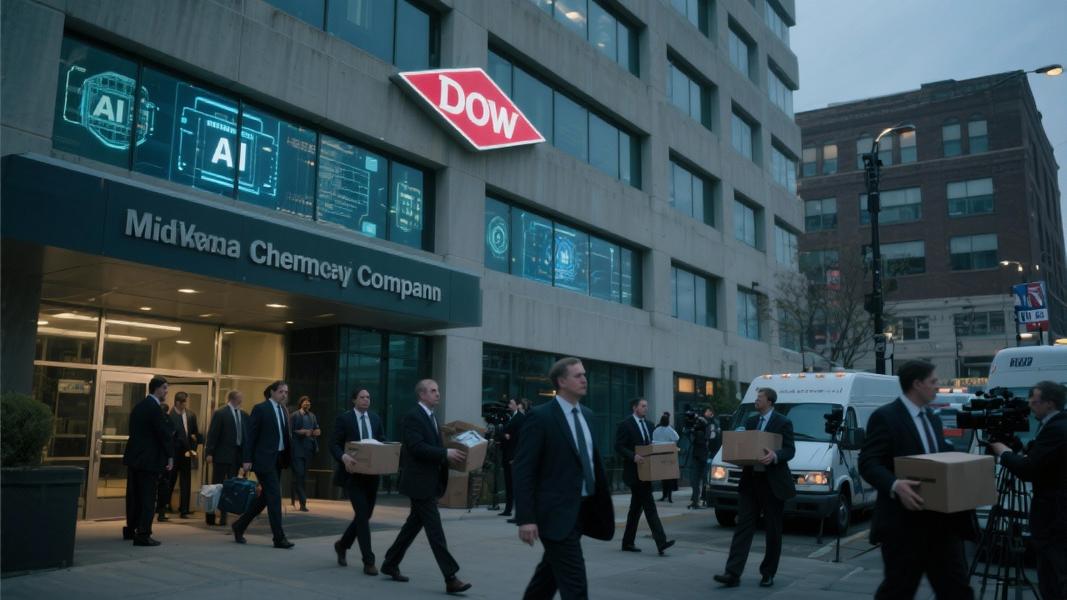
Dow, the industrial giant synonymous with American manufacturing, announced plans to slash approximately 4,500 jobs as it pivots toward artificial intelligence and automation technologies, marking one of the most significant workforce reductions in the company’s recent history.
The Michigan-based chemical manufacturer revealed the cuts will affect roughly 13 percent of its global workforce of 34,600 employees. Wall Street’s immediate reaction was tepid at best — Dow shares fell 2% in premarket trading following the announcement.
Just how expensive is this corporate transformation? The company estimates it will spend between $600 million and $800 million on severance packages alone, with an additional $500 million to $700 million in other one-time costs related to the restructuring.
A Pattern of Reductions
This isn’t Dow’s first round of cuts. The company has been steadily trimming its workforce over the past year as part of a broader cost-saving strategy. In January, executives announced plans to pursue $1 billion in cost savings, expecting to eliminate about 1,500 jobs globally. By July, the chemical manufacturer had closed three European plants, resulting in 800 job losses.
But the latest announcement represents a dramatic acceleration of that strategy. Headquartered in Midland, Michigan, Dow has long been a bellwether for American manufacturing employment. Now it’s becoming something else: a case study in how traditional industrial giants are navigating the AI revolution.
The company’s home state of Michigan has already weathered decades of manufacturing job losses. Will the shift toward automation create new opportunities or simply eliminate more middle-class jobs? That question remains unanswered as Dow proceeds with its technological transformation.
For the thousands of workers affected, the news comes at a particularly challenging time, with inflation still pressuring household budgets and economic uncertainty clouding the job market. The severance packages, while substantial in aggregate, will need to stretch across a workforce spanning multiple countries and continents.
As traditional manufacturers increasingly embrace automation and artificial intelligence, Dow’s announcement may signal a broader trend that could reshape industrial employment for decades to come — trading human labor for algorithms and robots in a bid to remain competitive in an increasingly digital global economy.
