
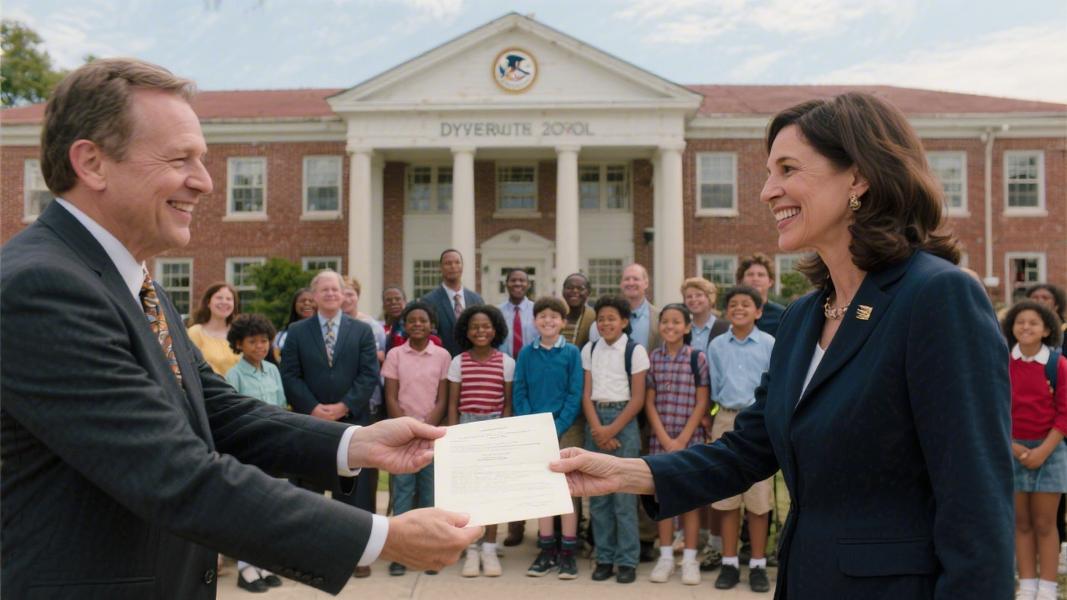
After six decades of federal oversight, Dyersburg City Schools in Tennessee has finally closed a chapter in its civil rights history. The Justice Department’s Civil Rights Division announced this week the dismissal of a desegregation case that had been monitoring the district since the height of the civil rights movement.
The landmark decision ends one of the nation’s longest-running school desegregation cases, initiated in 1966 when the federal government challenged the Dyersburg Board of Education over racially segregated public education that violated both the Constitution and the then-recently passed Civil Rights Act of 1964.
“Compliance means closure. When school districts comply in good faith with court orders to eliminate the vestiges of past discrimination, the federal government has no legitimate reason to continue monitoring,” said Assistant Attorney General Harmeet K. Dhillon of the Justice Department’s Civil Rights Division.
A Six-Decade Journey to Unitary Status
What exactly does it take to close a case that’s older than most of the teachers in the district? For Dyersburg, it required demonstrating what courts call “unitary status” — proof that the school system had eliminated all vestiges of its formerly segregated past.
The journey began when the United States filed its complaint against the Dyersburg school system in 1966. The following year, the court approved a formal desegregation plan while maintaining jurisdiction to ensure compliance. That oversight would continue for decades as the district worked to implement the required changes.
On February 11, 2026, the court finally declared that Dyersburg City Schools had achieved unitary status, formally recognizing that the district had eliminated the vestiges of prior de jure segregation. The case was dismissed with prejudice the following day, February 12, effectively ending federal oversight.
U.S. Attorney D. Michael Dunavant for the Western District of Tennessee praised the development, stating, “I am pleased to join in this long overdue dismissal, and I commend the Dyersburg City Schools for their diligent compliance and achievement of unitary status.”
Historical Context
The case, formally known as United States v. Dyersburg Board of Education (2:66-cv-00241), was most recently overseen by Judge Sheryl Halle Lipman. Court records show the final update to the case was made on February 13, 2026, marking the official end to a legal battle that spanned generations.
School desegregation cases have a complex history in America. Following the Supreme Court’s landmark Brown v. Board of Education ruling in 1954, which declared segregated schools unconstitutional, districts across the country — particularly in the South — faced legal challenges to integrate their schools. Many of these cases, like Dyersburg’s, continued long after the initial court orders.
The dismissal represents a significant milestone not just for Dyersburg but in the broader landscape of civil rights enforcement. It signals the Justice Department’s recognition that the district has fulfilled its obligations under both constitutional requirements and the specific court-ordered remedies.
Still, education experts note that the formal end of desegregation cases doesn’t necessarily mean the end of educational disparities or challenges in creating truly inclusive school environments.
For Dyersburg, though, the closing of this case marks the end of a long chapter that began during the Johnson administration and spanned twelve presidencies before reaching its conclusion.
