
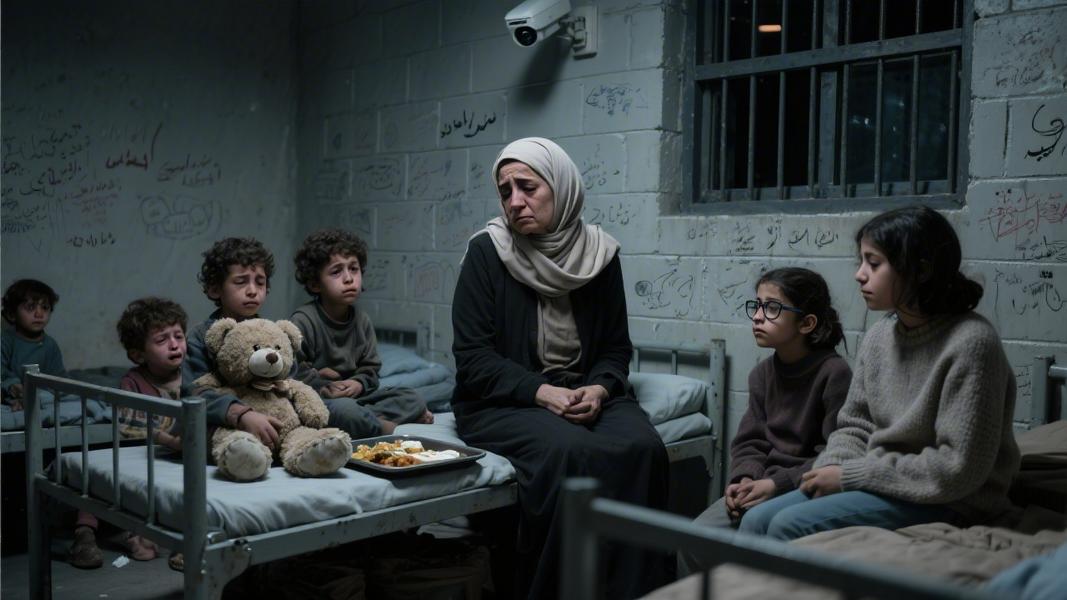
For nine months, six members of an Egyptian family have been locked inside a Texas immigration detention facility — and by their own account, they are barely holding on.
Hayam El Gamal and her five children, ranging in age from 5 to 18, have been held at the South Texas Family Residential Center in Dilley, Texas, since June 2025. That far exceeds the facility’s average two-week stay — and blows past the federal limit of 20 days for detained children. Their letters, smuggled out and shared with journalists and advocacy groups, describe a world of moldy food, untreated illness, religious humiliation, and psychological collapse. “This place has destroyed my children, both physically and mentally,” Hayam El Gamal wrote.
A Family on the Edge
The conditions they describe are not abstractions. Habiba El Gamal, one of the older children, wrote that she once found a fingernail in a bowl of fruit. The family alleges they’ve been served food with worms, food visibly covered in mold, and that younger children are often left with nothing better than instant noodles as an alternative. It’s the kind of detail that’s hard to dismiss as exaggeration — because it’s specific, it’s gross, and it’s the sort of thing a child would remember.
The 16-year-old son has lost more than 20 pounds since the family’s detention began. He reported severe stomach pain that was, at least initially, waved off by medical staff. “I can’t help you. Go and come back if you still have pain in 3 days,” a nurse told him, according to letters reviewed by investigators. The lights inside the facility reportedly never go off fully, and curtains can’t be closed. “I haven’t slept like a human being in 9 months,” the teenager said.
How bad does it have to get? The youngest child — five years old — reportedly has 13 untreated cavities that have only worsened during the family’s stay, with ibuprofen offered as the primary response. Another family member went two months without her prescription glasses. These aren’t edge cases. According to the family’s accounts, this is just Tuesday at Dilley.
Religious Dignity, or the Lack of It
For the Muslim women in the family, the indignities extend beyond food and medicine. Because curtains cannot be drawn and privacy is essentially nonexistent, female family members have been sleeping in their hijabs. A daughter was reportedly given heavy sweaters in the summer heat as a workaround for coverage — a solution that manages to be both inadequate and tone-deaf simultaneously. “I wondered how we could survive in a place that does not respect privacy or religious rights,” Hayam El Gamal said.
Still, it’s the accounts of physical force that are perhaps the most alarming. The family says they witnessed ICE agents assault a man who subsequently could no longer walk properly. Habiba wrote that guards made clear such treatment was reserved for those who refused orders — a statement that reads less like reassurance and more like a warning. “Fortunately, they told us that they would only use that kind of force with us if we refused to follow their orders,” she recounted, the word “fortunately” doing a lot of heavy lifting in that sentence.
The Toll on Children
The youngest children are wetting the bed. They’re having nightmares. They’ve told family members they hate their lives and miss their toys. The psychological damage, the family says, may be permanent. “This place broke something in us, something that I don’t know if we will ever be able to fix,” Habiba El Gamal wrote.
That’s not a rhetorical flourish. Research on childhood trauma consistently shows that prolonged institutional confinement — especially under conditions of neglect and fear — can rewire developing brains. Nine months is not a brief disruption. For a five-year-old, it’s nearly a fifth of their entire life.
The Facility, the Company, the Politics
The Dilley facility is the largest family immigration detention center in the United States, housing an average of more than 3,000 people and operated by the private prison company CoreCivic. It was shut down under the Biden administration and reopened under President Trump. U.S. Rep. Joaquin Castro, who has visited the facility and spoken with detainees, didn’t mince words. “They are literally being treated as prisoners,” he noted.
Recent data shows detainee numbers at Dilley dropped from roughly 1,300 to 700 in recent weeks — but 99 children remain in custody there. The El Gamal family is among them. That said, the government’s position on the family is complicated by the case of the father, who is not detained with them. DHS Secretary Kristi Noem has said authorities are investigating whether the family had prior knowledge of or provided support for an attack the father is allegedly connected to — a charge the family denies. “We are investigating to what extent his family knew about this heinous attack,” Noem said. “Justice will be served.”
The family, for its part, is asking for something far simpler than justice. They’re asking to leave.
Whether the U.S. government ultimately finds any culpability in the mother or children remains an open legal question. What isn’t open to much debate — given the letters, the medical records, the weight loss, and the cavities — is what nine months inside Dilley has already cost them. As Habiba put it, something has been broken. The question now is whether anyone in a position of power is listening.
